
Commercial Roofing Contractors in Orlando, FL
A commercial roof leak is a business problem: tenants, inventory, liability, and schedules. Orlando Roofing Crew connects Orlando property owners and managers with licensed, insured commercial roofing crews for leak repair, flat roof service, coatings, maintenance, and re-roofing, with written scopes that hold up for budgets, lenders, and insurers.
How Commercial Roofing Decisions Actually Get Made in Orlando
A commercial roof is a capital asset with a maintenance schedule, a warranty, and a replacement date. The best outcomes come from planning, not emergencies.
Most commercial roof problems are discovered the same way: a tenant calls about a stain, a manager finds ponding after a storm, or an insurance renewal or lender asks about the roof. By then the options are narrower and more expensive than they had to be. The pattern that works for owners and managers is simple: know the roof's system and age, inspect it on a schedule and after major storms, repair small problems quickly, and plan the next big step (coating, recover, or replacement) years ahead, not weeks.
Orlando Roofing Crew connects owners and managers with commercial crews for each stage. The six services below each have their own page with process and cost drivers. This page explains how to choose among them, what Florida and Orlando require, and how to buy commercial roofing work without getting burned.
Commercial Roofing Services
Each service has its own page with detail on process and what drives cost.
Commercial Roof Leak Repair
Leak detection and repair to stop damage to tenants, inventory, and interiors.
Membranes & SeamsCommercial Flat Roof Repair
Seam, puncture, flashing, and ponding repairs on TPO, modified bitumen, and built-up roofs.
PreventionCommercial Roof Maintenance
Scheduled inspections and upkeep that extend roof life and protect warranties.
RestorationCommercial Roof Coating
A way to extend a sound roof's life without a full tear-off.
New RoofsCommercial Roof Installation
Re-roofing and recover options, with permits and inspections.
AssessmentCommercial Roof Inspection
Condition reports for owners, buyers, lenders, and capital planning.
Commercial Roof Systems Common in Central Florida
The system on your roof determines how it is repaired, coated, and replaced. Identify it first.
| System | How it is built | Typical Florida considerations |
|---|---|---|
| TPO (thermoplastic polyolefin) | Single-ply white membrane, mechanically attached or adhered, with heat-welded seams | Reflective and widely used on commercial roofs. Seam and flashing condition drives performance. Repairs are welded or patched |
| PVC | Single-ply thermoplastic membrane with heat-welded seams | Often chosen where chemical or grease exposure is a concern, such as restaurants. Check manufacturer guidance |
| Modified bitumen | Asphalt-based sheets, torch-applied, cold-applied, or self-adhered, often with a granulated or coated surface | A long track record on low-slope roofs. Installation method affects fire-safety requirements and cost |
| Built-up roofing (BUR) | Multiple plies of felt and bitumen with a surfacing layer | Common on older buildings. Redundant layers, but heavy and labor-intensive to remove |
| Metal (standing seam, R-panel) | Steel or aluminum panels attached to purlins or deck | Long service life on warehouses, churches, and retail. Details at curbs, penetrations, and seams matter |
| Spray polyurethane foam (SPF) with coating | Sprayed foam that cures into a seamless layer, protected by a coating | Used on low-slope roofs in Florida. The 2026 Florida Building Code allows a new protective coating over existing SPF without tear-off |
System names and details vary by manufacturer. Your roof's specific manufacturer and warranty documents govern how it can be repaired.
If you do not know which system you have, an inspection will identify it, and the system and its manufacturer's warranty terms should be written into the report. EPDM rubber membranes exist in Florida but are less common on new commercial work than TPO because the black surface absorbs heat. For how the three membranes compare in Florida, see TPO vs EPDM vs modified bitumen.
What Property Managers Actually Need
Documentation
Dated photos, written scopes, and reports that satisfy owners, lenders, insurers, and tenants.
Minimal Disruption
Work is scheduled and sequenced around tenants, business hours, and safety.
Licensed & Insured
Every assigned contractor is independently licensed in Florida and insured. Ask for certificates before work begins.
Budgeting Clarity
Inspection findings are prioritized so you can plan repairs, coatings, and replacement over time.
Fast Leak Response
Priority dispatch for active leaks, with temporary protection to limit damage to tenants and contents.
Warranty Awareness
Roof work should respect your manufacturer warranty, which can require certified installers or specific procedures.
Repair, Coat, Recover, or Replace? A Decision Framework
This is the most expensive decision on any commercial roof. It should be made on evidence, not on who is selling what.
| Condition | Likely best path | Why | What to confirm |
|---|---|---|---|
| Isolated seam, flashing, or penetration failures on a sound membrane | Repair | Fixes the defect; cheapest per year of life if the rest of the roof is healthy | That there is no wet insulation around the repair |
| Sound membrane and dry insulation with surface wear or UV chalking | Restoration coating | Extends life and adds reflectivity without a tear-off | Moisture survey; manufacturer compatibility; warranty rules |
| Dry insulation, adequate substrate, membrane near end of life | Recover (new membrane over existing) | Avoids tear-off cost and disruption where code and the manufacturer allow | Code limits on layers; weight; wet insulation; adhesion |
| Wet insulation, widespread blistering or splits, ponding for years | Replace (tear-off) | Wet insulation does not dry reliably and ruins a coating or recover | Moisture mapping; structural condition of the deck |
| Chronic recurring leaks despite repairs | Investigate, then repair or replace | Recurring leaks often point to wet insulation or a design problem | Whether drainage, flashing design, or equipment curbs cause repeat failures |
Each path has a different cost, lifespan, warranty implication, and disruption. We deliberately do not quote lifespans or prices here, because they depend on your system, condition, and manufacturer. A good assessment gives you each option's scope, an estimate, and the assumptions behind it, so you can compare.
Ask for the moisture evidence
Before agreeing to a coating or recover, ask how the crew established that the insulation is dry: infrared scans, nuclear or capacitance meters, core cuts, or a combination. Coating over wet insulation is a common and expensive mistake. See coating vs recover vs replace for commercial buildings for how the options compare.
The Problems We See Most Often
Ponding Water
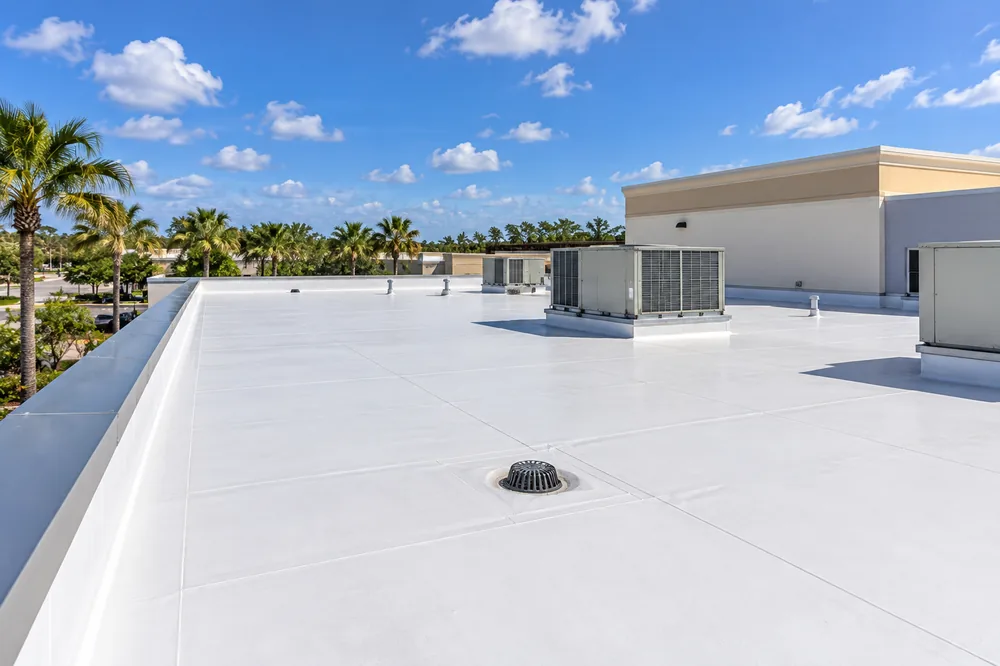
Low-slope roofs are meant to drain. Water that stays for more than a day or two after rain accelerates membrane wear, can overload the structure, and signals drainage or deflection problems. See ponding water on flat roofs.
- Clogged drains and scuppers are the easy fix
- Structural deflection or insufficient slope is the harder fix
- Coatings vary in how well they tolerate standing water
Penetrations, Curbs and Rooftop Equipment
Rooftop HVAC units, exhaust fans, plumbing vents, and conduit all penetrate the roof. Each curb and flashing is a potential leak, and service technicians walking the roof can damage membranes.
- Sealants and flashings at curbs need regular checks
- Walk pads protect membranes where technicians travel
- Abandoned penetrations from removed equipment should be properly closed
Seams, Blistering and UV Degradation
Heat-welded and adhered seams can open as the membrane ages and moves. Blisters form where moisture or air is trapped. UV and heat break down surfaces over years.
- Seam failures are often repairable early
- Blisters that have split indicate moisture entry
- Surface wear is what restoration coatings address
Commercial Roof Coatings: What They Are and When They Work
A coating can add years to a sound roof. Applied to the wrong roof, it is money wasted.
A restoration coating is a liquid-applied layer that cures into a seamless, waterproof, often reflective surface over an existing roof. It cannot fix wet insulation, structural problems, or a membrane that has failed across the whole roof. It works best on a roof that is basically sound: dry insulation, adequate adhesion, and surface wear rather than systemic failure.
| Coating type | Common use | Notes |
|---|---|---|
| Acrylic (water-based) | Reflective restoration over many membranes and metal | Needs good drainage, since prolonged ponding can degrade it. Often more economical |
| Silicone | Restoration where some ponding occurs | Generally tolerates standing water better than acrylic. Dirt pickup and recoat compatibility need planning |
| Polyurethane / polyurea | Heavy-duty, traffic-bearing, or specialty surfaces | Typically more demanding to apply; requires careful prep |
| Coatings over spray polyurethane foam | Protecting SPF roofs from UV and weather | The 2026 Florida Building Code allows a new protective coating over existing SPF without tear-off, following manufacturer instructions |
Always confirm compatibility with your existing membrane and the coating manufacturer's warranty requirements.
- Assess first. Moisture survey, adhesion tests, and a condition review decide whether a coating is viable.
- Prepare the surface. Cleaning, repairs, and primer where required. Poor prep is the most common cause of coating failure.
- Apply to spec. Thickness and coverage rates matter, and manufacturers specify them.
- Document. Keep warranty paperwork and the application record.
See commercial roof coating in Orlando for the process and cost drivers.
What a Real Commercial Roof Maintenance Program Includes
A maintenance program is the least expensive way to get more years from a roof, and often a warranty requirement.
| Task | Frequency (typical) | Why |
|---|---|---|
| Full roof inspection with photos | At least once a year, plus after major storms | Catches damage and wear early and documents condition |
| Drain, scupper, and gutter cleaning | Seasonally and before hurricane season | Prevents ponding and overload |
| Seam, flashing, and sealant checks | With each inspection | These are the usual leak points |
| Rooftop equipment curb and penetration checks | With each inspection | HVAC and exhaust curbs are a major leak source |
| Debris removal | As needed and after storms | Debris holds moisture and blocks drains |
| Small repairs | As found | Fixing small problems promptly avoids large ones |
| Written report and record-keeping | After each visit | Supports budgets, insurers, lenders, and warranties |
Frequencies vary by roof system, building, and manufacturer requirements.
Ask whether the program is itemized in writing, what is included in the base fee versus billed separately, how fast they respond to leak calls, and whether it satisfies your manufacturer's warranty conditions. See commercial roof maintenance and whether maintenance contracts are worth it.
A Leak Response Protocol for Property Managers
When a tenant calls about a leak, the first hour sets the outcome. Have a protocol.
- Protect people and property. Move tenants and inventory away from the leak, cover equipment, and cut power to wet areas if safe.
- Document. Photograph and video the damage, note the date and time, and keep a log of communications.
- Call dispatch. State that it is a commercial property, whether the building is occupied, the roof type if known, and who the decision-maker is.
- Temporary protection. Crew tarps or temporarily seals to stop the leak and limit interruption. See emergency roof repair.
- Notify stakeholders. Tenants, owners, and your insurer, as your lease and policy require.
- Get a written scope. For the permanent repair, with cause, scope, schedule, and price.
- Close the loop. Confirm the repair, update tenants, and add the event to the roof file.
Responsibility for a leak and for resulting tenant losses depends on the lease and the facts. See commercial roof leak liability.
Hurricane-Season Preparation for Commercial Roofs
Hurricane season runs June 1 through November 30. A building that is ready loses less.
Before June 1
- Schedule an annual inspection and make repairs
- Clean drains, scuppers, and gutters
- Check that rooftop equipment is secured, panels are fastened, and covers are intact
- Remove loose items from the roof that could become projectiles
- Confirm your insurance policy, deductibles, and your carrier's claim contacts
- Document roof condition with photos
When a storm is forecast
- Secure equipment and loose items, and make sure drains are clear
- Plan staff and tenant communications
- Know who to call for emergency dispatch
After the storm
- Wait for safe conditions, then inspect from the ground
- Photograph and log damage
- Call dispatch for temporary protection of any open or leaking areas
- Report the loss promptly. Claim deadlines in Florida were shortened by SB 2-A (2022)
- Get a written scope for permanent repairs
Building a Roof Capital Plan
Owners with a roof plan make better decisions and spend less over time.
A roof plan is simple: an inventory of each roof section (system, age, area), a condition rating from a documented inspection, an expected remaining-life estimate, and a schedule of repairs, coatings, and replacements over the next five to ten years with estimated costs. It helps you set reserves, answer lenders and insurers, and avoid emergency replacements. Insurers and lenders increasingly ask for roof condition and age on commercial properties.
- Inventory. Roof sections, systems, areas, ages, and warranty status
- Assess. Annual inspection with photos and moisture data where relevant
- Prioritize. Urgent repairs, near-term maintenance, and long-term replacement
- Budget. Spread large projects over years where possible, and compare coating and recover to replacement
- Review yearly. Update after storms, repairs, and new inspections
Commercial Roof Warranties: What to Look For
A commercial warranty is a contract with conditions. Reading it before a problem is cheaper than reading it after.
| Warranty type | Provided by | What it usually covers | Watch for |
|---|---|---|---|
| Manufacturer material warranty | The membrane manufacturer | Defects in the material | Prorating, exclusions for ponding or damage |
| Manufacturer system or 'NDL' warranty | Manufacturer via certified installer | Materials and, often, labor for leaks from material or installation defects, sometimes without a dollar cap | Certified-installer requirement; maintenance conditions; inspection requirements |
| Contractor workmanship warranty | The roofing contractor | Installation workmanship | Term length; contractor's staying power |
| Coating warranty | Coating manufacturer | Coating performance for stated years | Substrate and application requirements; ponding exclusions |
Terms vary widely. Get the actual warranty documents before work begins.
Warranties often require maintenance records, prompt notice of leaks, and use of the manufacturer's approved repair methods. Unapproved repairs or an uncertified installer can void coverage.
Roofing Needs by Property Type
The same roof system behaves differently depending on what is under it.
| Property type | Typical concerns | Planning notes |
|---|---|---|
| Retail centers and strip malls | Many tenants, many penetrations, ponding, tenant disruption | Coordinate with anchor tenants; keep a roof file per building |
| Restaurants and food service | Grease from exhaust fans, kitchen penetrations, heat | Membrane compatibility with grease; protect drains; regular cleaning |
| Offices and medical | Interior sensitivity, rooftop equipment, access control | Schedule work outside sensitive hours; control noise and odor |
| Hospitality and multifamily | Large roof areas, mixed pitched and flat, occupancy | Phase work; plan for resident communication |
| Warehouses and industrial | Large low-slope or metal roofs, skylights, equipment | Metal roof fasteners and seams; coating options on aging membranes |
| Churches and schools | Long-lived buildings, budgets, complex rooflines | Capital plans; phased replacement; safety and schedule coordination |
Storm Damage, Wind, and Commercial Insurance
Commercial policies differ widely. Know yours before the storm.
Commercial property policies vary even more than homeowners policies in deductibles, covered perils, valuation (replacement cost versus actual cash value), and conditions such as roof age or maintenance requirements. Many carry wind or named-storm deductibles that are a percentage of the building's insured value. After a storm, document the damage thoroughly, take reasonable steps to prevent further loss, and contact your carrier promptly. Under SB 2-A (2022), a new or reopened property insurance claim must be reported within one year of the date of loss, and a supplemental claim within 18 months; confirm how that applies to your policy.
- Photograph and log damage, temporary repairs, and tenant impact
- Keep invoices for emergency work and materials
- Request a written scope from the contractor to support the claim
- Under section 489.147 of the Florida Statutes, a contractor cannot pay, waive, or rebate your deductible with intent to defraud
- A contractor can document the loss but generally cannot negotiate your claim; that requires a licensed public adjuster or an attorney
- See commercial roof leak liability
Sources & Verification
Facts on this page were checked against the sources below in October 2026. Laws, codes, and program rules change, so confirm current details with the agency before you rely on them.
Permits, Inspections, and Code on a Commercial Re-Roof
Commercial roof work is permitted work with inspections. These are the points that matter to owners.
Commercial re-roofs are subject to the Florida Building Code and local permitting. The City of Orlando states that its in-progress (dry-in) inspection, reinstated January 1, 2020, applies to all residential and commercial re-roof projects, and that a completed inspection affidavit verifying roof deck nailing and the secondary water barrier is required at the final inspection. Other jurisdictions, including Orange County for unincorporated addresses and the Seminole and Osceola County cities, have their own procedures. Your contractor pulls the permit and schedules inspections, and you should confirm they have.
- Reroofing provisions are changing. The 9th Edition (2026) Florida Building Code takes effect December 31, 2026 and revises the reroofing section, including when tear-off is required and exceptions for reusing an adequate substrate or coating an existing spray foam roof.
- The 2022 change to the 25% rule (section 553.844(5)) applies to roofs built or replaced under the 2007 Florida Building Code or later, so a repair of more than 25% of a roof section does not automatically trigger whole-section upgrades. Older roofs can still be subject to the earlier rule.
- Product approval. Roofing products need Florida product approval and must be installed as approved.
- Energy code. Insulation and reflectivity requirements can apply to replacement roofs. Ask the contractor how the energy code applies to your building, because requirements depend on the roof system and scope.
- Warranty and manufacturer requirements can be stricter than code. Many commercial manufacturer warranties require certified installers and specific details.
Sources & Verification
Facts on this page were checked against the sources below in October 2026. Laws, codes, and program rules change, so confirm current details with the agency before you rely on them.
Commercial Bids, Contracts, and Change Orders
Understanding how a bid is built protects you from surprise costs.
| Term | What it means | What to watch |
|---|---|---|
| Lump-sum bid | One price for a defined scope | The scope must be specific. Vague scopes hide extras |
| Unit pricing | Prices per square foot or per item (such as per repaired seam or per square foot of decking) | Quantities are estimates; ask how they will be measured and verified |
| Allowances | A budgeted amount for uncertain work, such as wet insulation replacement or deck repair | Ask for the unit price and how overruns are handled |
| Alternates | Optional scope priced separately, such as extra insulation or a longer warranty | Compare alternates across bids the same way |
| Change orders | Written changes to scope and price | Require written approval before extra work begins |
| Progress payments and retainage | Payments tied to completion, with a portion held back until the end | Tie payments to inspected milestones, and get lien releases |
A bid package that works for owners includes the roof plan or description, any known conditions (leaks, past repairs, moisture data), the manufacturer and warranty requirements, access and schedule constraints, insurance and licensing requirements for bidders, and how bids will be compared. Three comparable bids are more useful than three different scopes.
- Safety and access. Ask how workers will be protected from falls, how materials get to the roof, and how pedestrians and tenants are kept safe.
- Hot work. If torch-applied membranes are used, ask about fire safety measures and fire watch procedures.
- Weather protocol. Who protects the building from rain if work is interrupted, and how quickly.
- Tenant communication. Notices before work, contacts during work, and an escalation path for complaints.
How to Hire a Commercial Roofing Contractor and Avoid Common Mistakes
Commercial roofing is a specialty, and the price of a mistake is large.
- Verify the license. Florida roofing contractors are licensed through the DBPR. A Certified Roofing Contractor (CCC) is licensed statewide; a Registered Roofing Contractor (RC) only in a local jurisdiction. Check MyFloridaLicense.com.
- Get insurance proof. General liability, workers' compensation or a valid exemption, and, for commercial work, ask about coverage limits that match the risk.
- Check manufacturer certification. If a manufacturer warranty matters, confirm the installer is certified for that system.
- Demand a written scope with moisture evidence. How was the insulation checked? What is assumed about the deck?
- Compare like for like. System, thickness, insulation, attachment, flashing and edge details, warranty terms, and cleanup.
- Plan for tenants and safety. Staging, hours, noise, fall protection, and building access should be in writing.
- Understand payment and lien terms. Progress payments, lien releases, and who handles the Notice of Commencement.
- Keep records. Warranty paperwork, product data, inspection results, and photos go in a roof file for the life of the building.
Red flags
A bid far below the others with no explanation; no moisture survey before recommending a coating or recover; pressure to sign before the permit is applied for; unwillingness to show a license number or proof of insurance; or any offer to cover your insurance deductible.
Which Commercial Service Fits Your Situation?
Related Services
Commercial Roofing Across Orlando & Central Florida
Commercial work is dispatched across Orlando, with active corridors in Lake Mary, Winter Park, Lake Nona, and Dr. Phillips.
Commercial Roofing FAQs
TPO and other single-ply membranes, modified bitumen, built-up roofs, spray foam with coatings, and metal roofs, on retail, office, industrial, restaurant, and multifamily properties.
Yes. Scheduling and sequencing are planned with you to minimize disruption and keep the work safe.
Sometimes, if the membrane and insulation are sound and dry. An inspection and moisture survey decide. See commercial roof coating.
At least once a year and after major storms. See commercial roof inspection frequency.
Yes. See commercial roof maintenance.
Roof replacements and many significant repairs are permitted work through the local building department. The City of Orlando applies its in-progress dry-in inspection to commercial re-roofs too.
That depends on the lease. See commercial roof leak liability.
It can, if repairs are done by an uncertified installer or against the manufacturer's requirements. Check your warranty before work begins and ask the contractor to confirm.
A moisture survey, such as infrared scanning or meter readings, with confirmation by core samples where needed. Do not coat or recover without it.
It depends on the system, installation quality, maintenance, and the Florida climate. An inspection documents condition and expected remaining life for planning.
Yes. Call the dispatch line and say it is a commercial property. See emergency roof repair.
A documented inspection of the membrane, seams, flashings, drains, penetrations, and equipment, moisture evidence where needed, and a prioritized scope and estimate.
Get a Commercial Roof Assessment
Request an inspection and receive a documented condition report and a prioritized scope of work.
Orlando Roofing Crew connects property owners with vetted, independently licensed and insured Florida roofing contractors. Inspections, repairs, and workmanship warranties are provided directly by the independent licensed contractor assigned to your property.
Request a Free Inspection
A local specialist inspects your roof and gives you a written scope. No obligation.