
Asphalt Shingle Roofing in Orlando, FL
Shingle roofing is the most common roof in Central Florida subdivisions and the most affordable to replace. Orlando Roofing Crew connects Orlando owners with licensed local crews who install algae-resistant, wind-rated shingle systems, and who explain the ratings and installation details on the product they are quoting.
Is an Asphalt Shingle Roof Right for Your Orlando Home?
For most homeowners watching a budget, yes, if it is specified and installed for Florida. Here is what that means.
Asphalt shingles cover most of the roofs in Orlando's suburbs, and for good reasons: they cost less than tile or metal, they come in many colors, any competent roofer can install them, and repairs are straightforward. What they do not do is last as long here as the label suggests. Local roofers commonly report that asphalt shingle roofs in Florida last roughly 15 to 20 years, sometimes up to 25, shorter than the 25- to 30-year figures on packaging, because heat, UV, and humidity age shingles faster than in cooler climates.
That makes the choices you make at installation matter: the wind class of the shingle, whether it is algae-resistant, how it is nailed, what goes underneath, and how the roof is ventilated. A well-chosen, well-installed shingle roof can serve for many years and perform well in storms. A cheap one installed carelessly can fail early and leave you with an insurance headache.
| Choose shingle when | Consider something else when |
|---|---|
| Budget is the main constraint | You plan to stay for decades and want the longest-lasting roof (metal, tile) |
| Your HOA specifies a conventional shingle look | Your HOA requires tile |
| You may sell in the next several years | You want maximum wind performance and are willing to pay for it |
| Your roof structure was designed for light roofing | You want a roof that reflects much more heat (consider light-colored metal or tile) |
| You want easy repairs and a competitive market of installers | Tile or metal specialists are available and affordable in your area |
Architectural vs. 3-Tab vs. Designer Shingles
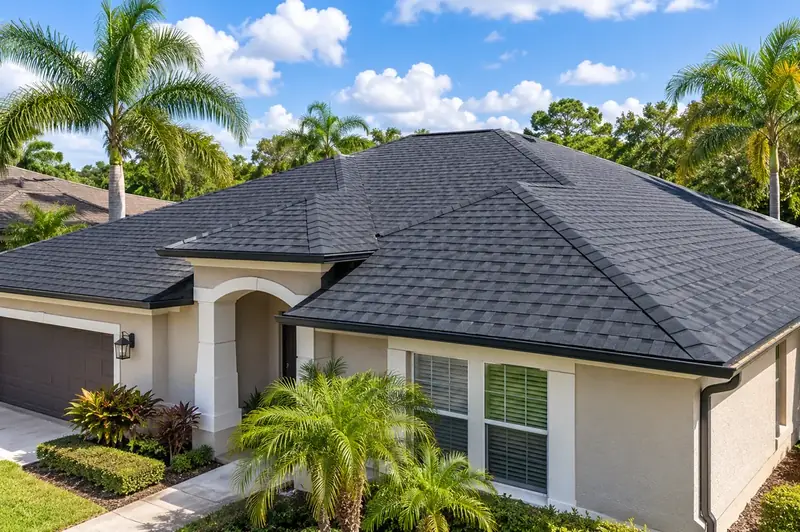
Architectural (Dimensional) Shingles
Thicker, laminated shingles with a layered look and generally better wind ratings and lifespan than 3-tab. Most replacements are architectural, and most manufacturers' premium lines are in this category.
- Better wind and wear performance
- More color and style choices
- Moderate cost over 3-tab
3-Tab Shingles
Flat, single-layer shingles that cost less and are less common on new installs. They typically have a shorter lifespan and lower wind ratings, and many manufacturers have reduced or dropped their 3-tab lines.
- Lowest upfront cost
- Shorter service life
- Less common in HOA communities
Designer and Luxury Shingles
Heavier, thicker shingles that imitate slate or shake, with dramatic profiles and longer warranties. They cost more, and their installation requirements can be more demanding.
- Dramatic appearance
- Longer limited warranties
- Higher cost; often specified by HOAs in upscale communities
Shingle Wind Ratings: What the Numbers Mean
Packaging brags about mph. Here is what those numbers are, and are not.
Shingles are tested to standard wind classes. The Florida Building Code ties which class is acceptable to the design wind speed at the building site. The class is a test result, not a promise that a roof will survive a storm of that speed, and a roof only performs to its class if it is installed exactly as the manufacturer's approval requires.
| Standard | Class | Wind speed in the test |
|---|---|---|
| ASTM D3161 (fan-induced) | Class A | 60 mph |
| ASTM D3161 (fan-induced) | Class D | 90 mph |
| ASTM D3161 (fan-induced) | Class F | 110 mph |
| ASTM D7158 (uplift) | Class D | 90 mph basic wind speed |
| ASTM D7158 (uplift) | Class G | 120 mph basic wind speed |
| ASTM D7158 (uplift) | Class H | 150 mph basic wind speed |
Under the Florida Building Code's shingle table, ASTM D3161 Class F or ASTM D7158 Class H shingles are acceptable in all wind zones. Sources: Florida Building Commission staff analysis; Florida Division of Emergency Management.
Ask your contractor which class the specific product carries, what installation method achieves it (some require extra nails, a special starter strip, or specific sealing), and whether that is what the quote includes. See shingle wind ratings explained.
Sources & Verification
Facts on this page were checked against the sources below in October 2026. Laws, codes, and program rules change, so confirm current details with the agency before you rely on them.
What to Ask For in a Florida Shingle Roof
Seven decisions separate a good Florida shingle roof from an average one.
- Wind class. Choose a product with a wind class appropriate for your site and ask how it is installed to achieve it.
- Algae resistance. Black streaks are common on Florida roofs. Algae-resistant shingles with copper-bearing granules are widely available and worth specifying.
- Nailing pattern. Correct nail count, placement, and length matter for wind resistance. Many manufacturers' high-wind instructions call for more nails than their standard pattern. Ask which will be used.
- Starter strip and edge details. Edges and rakes are where wind starts peeling a roof. Ask about starter strips and drip edge.
- Underlayment and secondary water barrier. What goes beneath the shingles affects how the roof performs if wind-driven rain gets past them. The City of Orlando checks the secondary water barrier at final inspection.
- Valley treatment. Open, closed-cut, or woven valleys each have strengths. Ask which will be used and why.
- Ventilation. Ridge and soffit ventilation affect attic heat and roof life.
Impact-Resistant (Class 4) Shingles: Worth It in Florida?
Class 4 shingles are sold on hail resistance. Florida's hail risk is modest, but the question deserves a real answer.
Impact-resistant shingles are tested to resist damage from a steel ball dropped from a height, and the highest rating is called Class 4. They are heavily marketed in hail-prone states. Central Florida sees hail occasionally, usually small, so hail resistance is a secondary reason to buy them here. Some also offer extra resistance to debris impact, and some insurers in some states offer premium discounts for them. In Florida, premium discounts for roof features are tied to wind mitigation inspections, and any discount for impact-rated shingles is carrier-specific and not guaranteed.
- Worth considering if you want extra durability against debris and hail, and the price difference is modest.
- Not a substitute for wind rating. Check the wind class separately.
- Ask your agent whether your carrier offers any credit before you pay for the upgrade.
- Read the warranty. Impact resistance is not the same as a promise against all damage.
What Shortens a Shingle Roof's Life in Central Florida
The label says 25 or 30 years. Florida has opinions.
| Factor | What it does to shingles | What helps |
|---|---|---|
| Heat | Attic and surface temperatures dry out the asphalt, making shingles brittle and shortening sealant life | Attic ventilation; lighter colors; quality product |
| Ultraviolet exposure | Breaks down asphalt and strips granules, exposing the mat | Higher-quality shingles with robust granule adhesion |
| Humidity and shade | Algae growth; holds moisture against the surface | Algae-resistant shingles; tree trimming; gentle cleaning |
| Daily heavy rain | Reveals leaks at flashing and boots; speeds wear at edges and valleys | Proper flashing; clear valleys |
| Hurricane-season wind | Lifts and creases shingles; breaks sealant strips | Correct wind class and nailing; secure edges |
| Poor installation | Blow-offs, leaks, and early failure | Licensed, experienced crew; inspections |
| Poor ventilation | Heat and moisture accumulate in the attic | Balanced intake and exhaust |
Local roofers commonly report roughly 15 to 20 years for shingle roofs here, sometimes up to 25. Individual roofs vary.
None of this means shingles are a poor choice. It means plan for the replacement cycle, choose a product and installation for Florida, and keep the roof inspected so small problems do not cut its life further. See how long a roof lasts in Florida.
Shingle Color, Heat, and Cooling Costs
Florida research has measured it. The effect is smaller than metal and tile, but real.
The Florida Solar Energy Center's test of seven side-by-side homes in Fort Myers measured the sunlight reflected by different roofs. A dark gray fiberglass shingle reflected about 8 percent, a white fiberglass shingle about 24 percent, and white metal and white tile reflected roughly 66 to 77 percent. White shingles reduced cooling energy by roughly 3 to 5 percent compared with dark shingles in that test, while white metal and tile reduced it by roughly 18 to 26 percent.
| Roof | Solar reflectance | Cooling energy vs. dark shingle |
|---|---|---|
| Dark gray shingle | 8.2% | baseline |
| White shingle | 24.0% | 3 to 5% lower |
| White metal | 66.2% | within 18 to 26% lower (white reflective roofs) |
The test homes were small and unoccupied, and modern 'cool roof' shingle granules may reflect more than the white shingle tested in 2000.
The takeaway for a shingle buyer: lighter colors and cool-roof granule technology help a little. Attic ventilation and insulation do more. Color also affects what your HOA will approve. See shingle color and attic temperature.
Sources & Verification
Facts on this page were checked against the sources below in October 2026. Laws, codes, and program rules change, so confirm current details with the agency before you rely on them.
Attic Ventilation and Your Shingle Roof
Shingles bake from above and from below. Ventilation controls the below.
A shingle roof sits on top of an attic that can reach extreme temperatures in a Florida summer. Poor ventilation raises the temperature of the decking and the underside of the shingles, accelerates aging, increases cooling costs, and lets moisture build up. Good ventilation moves air in at the eaves and out at the ridge or roof vents, continuously.
- Intake: soffit vents must be open and unblocked by insulation or paint
- Exhaust: ridge vents, roof vents, or turbines, in balance with intake
- Baffles keep insulation from blocking soffit airflow
- Do not mix exhaust types carelessly; mixing ridge vents with power vents can short-circuit airflow
- Exhaust fans from bathrooms and kitchens should vent outdoors, not into the attic
- Check at re-roof time. A new roof is the cheapest time to correct ventilation
Shingle Roof: Repair, or Time to Replace?
| Sign on your shingle roof | Usually means | Typical action |
|---|---|---|
| A few missing or creased shingles after a storm | Localized wind damage | Repair, and document if claiming |
| Cracked pipe boots or failed flashing | Local component failure | Repair |
| Granules filling gutters and bare patches | Surface wearing out across the roof | Evaluate replacement. See granule loss |
| Curling edges and cupping across slopes | Age and heat aging | Evaluate replacement |
| Brittle shingles that crack when lifted | End of life | Replacement; repairs may damage more shingles |
| Multiple leaks in different areas | Wider failure | Replacement conversation |
| Soft or spongy spots in the roof | Deck moisture damage | Deck repair; likely replacement. See sagging decking |
A good crew will tell you when a repair will not hold. Our repair vs. replace guide explains the Florida rules, including the 2022 change to the 25% rule.
Shingle Roofs, Storms, and Insurance
Shingles are the most common roof in the area, and the most common storm claim.
After a storm, shingle roofs show damage as missing, creased, or lifted shingles, broken sealant strips, torn tabs, exposed underlayment, and impact marks. A dated inspection documents what happened. Under SB 2-A (2022), a new or reopened claim must be reported within one year of the date of loss. Many policies pay on an actual-cash-value basis or through a roof surface reimbursement schedule for roofs 10 or more years old, and roof age is part of underwriting: an insurer may not refuse to issue or renew solely because of the age of a roof under 15 years old, and for older roofs an inspection showing five or more years of useful life remaining protects against refusal on age alone.
- Photograph the roof before repairs
- Keep records of the roof's age and any past repairs
- A contractor cannot waive your deductible, and generally cannot negotiate your claim
- When replacements will not match, Florida's matching statute (section 626.9744) requires homeowners insurers to make reasonable repairs or replacement of items in adjoining areas, considering cost, uniformity, and remaining life
- See the Florida roofing insurance guide
Sources & Verification
Facts on this page were checked against the sources below in October 2026. Laws, codes, and program rules change, so confirm current details with the agency before you rely on them.
Red Flags When Buying a Shingle Roof
- A bare price with no product named. 'Architectural shingles' is not a product. Insist on the line, wind class, and warranty in writing.
- No mention of deck repair, underlayment, or flashing. These are where cheap quotes cut.
- No permit or inspection plan. The City of Orlando requires an in-progress dry-in inspection and a final inspection with an affidavit on re-roofs.
- A very large deposit. Florida's down payment rule (section 489.126) applies when a contractor takes more than 10 percent up front, but a big deposit is a risk regardless.
- Pressure after a storm. Storm chasers, offers to cover your deductible (illegal), and documents that assign claim rights are all red flags.
- No local address or license number. Verify the license at MyFloridaLicense.com and ask for proof of insurance.
Major Shingle Manufacturers and Product Lines
Brand matters less than the specific product, its wind class, and how it is installed.
Several large manufacturers dominate residential shingles, including GAF, Owens Corning, CertainTeed, IKO, and Atlas, and each sells good, better, and best lines. Names change over time, so compare current product data sheets rather than relying on the brand alone. What to compare:
| What to compare | Why it matters |
|---|---|
| Wind class and installation requirements | Determines whether the roof meets code and performs in storms |
| Algae-resistance technology | Affects appearance and moisture retention |
| Shingle thickness and construction | Affects durability and wind performance |
| Warranty terms | Limited warranties vary in length, proration, transferability, and requirements |
| Certified installer programs | Enhanced warranties often require a certified installer |
| Florida product approval | Required for use in Florida |
Ask the contractor to name the exact product line, show the data sheet, and write it into the contract. 'Architectural shingles' is not a product.
What a Proper Shingle Installation Involves
- Tear-off and deck inspection. Existing roofing is removed and the deck inspected for rot and loose fastening. Damaged sheathing is replaced, and the deck is re-fastened to the attachment the permit calls for.
- Secondary water barrier and underlayment. Self-adhering membrane over deck seams where specified, plus underlayment over the deck.
- Drip edge and flashing. Edge metal, wall and valley flashing, and boots are set before shingles go on.
- Starter and field shingles. A starter course at the eaves and rakes seals the bottom edge. Field shingles are nailed to the manufacturer's pattern.
- Ridge, hip, and ventilation. Cap shingles and ridge vents are installed to the product's instructions.
- Inspection and cleanup. Required inspections are completed, and the site is cleaned with magnets.
Common installation mistakes
- Too few nails, or nails placed too high, which voids wind ratings and invites blow-offs
- Overdriven or underdriven nails
- Shingles installed over a damaged or inadequately fastened deck
- Reused or missing flashing
- Skipped starter strips or drip edge
- Poor ventilation, shortening roof life
- Skipped inspections, which can mean a roof must be removed
Shingle Warranties: What Is Actually Covered
| Warranty | Provided by | Typically covers | Limits |
|---|---|---|---|
| Limited manufacturer warranty | The shingle manufacturer | Manufacturing defects in the shingle | Often prorated; excludes installation errors, storm damage, and algae unless a specific algae warranty applies |
| Enhanced or system warranty | Manufacturer via a certified installer | A broader package including components and sometimes labor | Requires certified installer and approved components; check transferability |
| Wind warranty | Manufacturer | Wind damage up to a stated speed if installed to specific instructions | Conditional on installation method and sometimes registration |
| Workmanship warranty | The roofing contractor | Installation errors | Length varies; depends on the contractor remaining in business |
Read each warranty for what voids it, whether it transfers to a buyer, how to file a claim, and who to call. A modest warranty from a contractor who will be around is worth more than a bigger one from a crew that disappears.
What Drives the Cost of a Shingle Roof in Orlando
| Cost factor | How it changes the price |
|---|---|
| Roof size and complexity | Square footage, pitch, valleys, and dormers affect labor and material. |
| Shingle line | Premium and designer lines cost more than standard architectural. |
| Deck condition | Rotten or poorly fastened decking is only fully visible after tear-off. |
| Underlayment and water barrier | Better underlayment and secondary water barrier cost more. |
| Permits, HOA, and access | Fees, submittals, and tight access add to the total. |
| Ventilation and extras | Ridge vents, new flashing, and gutters add cost. |
One published Orlando-area guide (RoofingCalc, updated March 2025) puts asphalt shingle replacement at roughly $4.50 to $7.50 per square foot installed, or about $9,000 to $15,000 for a 2,000-square-foot roof, and a local contractor's published guidance cites most homeowners spending between $8,000 and $15,000. These are indications only. Your written estimate after a free inspection is the number that counts.
Sources & Verification
Facts on this page were checked against the sources below in October 2026. Laws, codes, and program rules change, so confirm current details with the agency before you rely on them.
- RoofingCalc: How Much Does a New Roof Cost in Orlando? — published estimate, updated March 26, 2025
Published estimates vary between sources and over time.
Where to Go Next
Related Services
Shingle Roofing Across Orlando & Central Florida
Shingle roofing is installed across the Orlando area.
Shingle Roofing FAQs
Local roofers commonly report roughly 15 to 20 years, sometimes up to 25, shorter than the label suggests. See roof lifespan in Florida.
Crews install major manufacturers such as GAF, Owens Corning, CertainTeed, IKO, and Atlas. Product choice depends on your roof, HOA, and budget.
In Florida's humidity, usually yes. Black streaks are common and unsightly.
Code allows overlays in limited circumstances, but a tear-off lets the deck be inspected and is generally recommended.
Ask what your local code requires. Class F (ASTM D3161) or Class H (ASTM D7158) is acceptable in all Florida wind zones, and installation method matters as much as the label.
Hail is occasional and usually small. They may add durability, but check the wind class separately and ask your insurer about credits.
It depends on the manufacturer's instructions for your wind zone. Many high-wind instructions call for more nails than the standard pattern.
Most communities approve specific products and colors. Submit samples first. See HOA roofing rules.
Yes. A re-roof is permitted work with inspections, including, in Orlando, an in-progress dry-in inspection and a final inspection with an affidavit.
A self-adhering membrane over deck seams, or an approved strip application, that stops water if the surface leaks. It is checked at the City of Orlando's final inspection.
Get a Written Shingle Roof Estimate
Start with a free inspection and an itemized estimate.
Orlando Roofing Crew connects property owners with vetted, independently licensed and insured Florida roofing contractors. Inspections, repairs, and workmanship warranties are provided directly by the independent licensed contractor assigned to your property.
Request a Free Inspection
A local specialist inspects your roof and gives you a written scope. No obligation.