
Emergency Roof Repair in Orlando, FL
When a limb comes through the roof, shingles or tiles blow off, or water is pouring through a ceiling, the first job is stopping it. Orlando Roofing Crew connects Orlando and Central Florida property owners with licensed, insured local crews who dispatch for emergency tarping and temporary repairs first, then plan and permit the permanent fix once conditions are safe.
If Your Roof Is Failing Right Now: The First Ten Minutes
Roofing can wait a few minutes. People and electrical safety cannot.
- Get everyone clear of danger. If a tree or large limb has hit the roof, or a ceiling is bulging or sagging with water, move people out of that area. A saturated ceiling can collapse without warning.
- Call 911 for fire or injury. If there is any fire, smoke, or injury, call 911 first. Lightning strikes can start fires in attics that are not visible right away.
- Stay away from downed power lines. Treat every line as live. Call your electric utility (for example OUC or Duke Energy, depending on your address) and keep everyone back.
- Cut power to wet areas. If water is dripping near light fixtures, ceiling fans, outlets, or the attic air handler, turn off power to that circuit at the breaker, if you can reach the panel safely and it is dry.
- Contain the water. Move furniture and valuables, lay towels, and set buckets. Do not poke into a bulging ceiling unless a professional tells you to.
- Photograph and video everything. Do it before you clean up: the roof from the ground, the interior damage, and any debris. This record matters for insurance.
- Call the dispatch line. (689) 359-5257. Say water is entering the home. Emergency requests are dispatched ahead of routine repairs.
Do not go on the roof
Do not climb onto a wet, storm-damaged, or fire-damaged roof to try to fix it yourself. Falls from roofs are a leading cause of storm-recovery injuries, and a damaged roof can fail underfoot.
What Counts as a Roofing Emergency
Not every roof problem needs a midnight call. These do.
Water Actively Entering the Home
Dripping, pooling, or a bulging ceiling during or after rain means the roof envelope is open right now.
Storm Damage to the Roof Surface
Missing shingles, slipped or broken tile, lifted metal panels, or exposed underlayment after high wind.
Tree or Large Debris Impact
A fallen limb or tree that punctured, crushed, or opened part of the roof. Keep everyone out of the affected rooms until it is assessed.
Lightning or Fire Damage
Central Florida has frequent lightning. Any suspected fire is a 911 call first. Roof damage from a strike is a roofing call second.
Exposed Roof Deck or Open Sections
If roofing has blown off and bare decking or underlayment is exposed ahead of more rain, the deck can be saturated quickly.
A Leak During a Forecast of More Rain
A small leak with heavy rain coming is a different risk than a small leak with a week of dry weather.
Emergency, Urgent, or Routine? A Plain Triage Table
Calling the right way gets you the right response, and keeps dispatch free for people with active water.
| Situation | How to treat it | What to do |
|---|---|---|
| Water pouring in, ceiling bulging, open hole in the roof | Emergency | Call (689) 359-5257 now, say water is entering. Contain water, protect people, cut power to wet circuits |
| Storm blew off roofing; deck or underlayment exposed; more rain forecast | Emergency | Call now. Temporary protection is the first priority |
| Active drip, but it is dry and no rain is forecast | Urgent | Call the same day. A temporary seal or scheduled repair may be appropriate |
| Slow stain, no active water, roof otherwise sound | Routine | Schedule a free inspection. See roof leak repair |
| Storm happened, no signs of leaks | Routine | Schedule an inspection to document any damage. See storm damage and claims |
If you are not sure which row you are in, call and describe what you see. If it can safely wait for a scheduled visit, you will be told so, and you will not be pressured.
What Happens After You Call
Emergency response is mitigation first. The permanent repair is planned once the roof is safe to work on.
Call & Triage
Dispatch asks what you are seeing, whether anyone is at risk, where water is entering, and the roof type, then routes the request to the nearest available partner crew. Have your address, gate code if any, and a callback number ready.
Safety Check & Documentation
The crew assesses access and conditions (wind, lightning, wet surfaces) and photographs the damage before anything is covered. If conditions are unsafe, they will tell you so and explain what they can do from the ground or the attic in the meantime.
Temporary Protection
A tarp, sealant, or board-up stops further intrusion. This is temporary mitigation and is not the permanent repair. You should receive photos of what was done and a record of the work.
Permanent Repair Plan
You receive a written scope for the lasting fix. Work is scheduled when weather and safety allow, and permitted where required. For a storm-related loss, the scope is also something you can share with your insurer.
What to Have Ready When You Call
A good first call saves time and gets the right crew and materials to your address.
- Address and access. The full address, any gate code or guard contact for a gated community, and where to park a truck.
- Roof type. Shingle, tile, metal, or flat. Tile and metal need different crews and materials.
- Where the water is entering. Which room, and whether it is a drip, a stream, or a ceiling that is bulging.
- What caused it. A storm, a tree, or unknown. Mention a fallen tree or limb, since heavy debris changes the plan.
- Any safety concerns. Downed lines, fire, flooding, or someone elderly or disabled in the home.
- Your insurer. Not needed on the first call, but helpful for planning the documentation afterward.
- Photos. If you can safely take and send a few, they help the crew arrive prepared.
Emergency Tarping, Sealing & Board-Up: What Each Does
Which temporary measure is used depends on the roof type, the damage, and the weather.
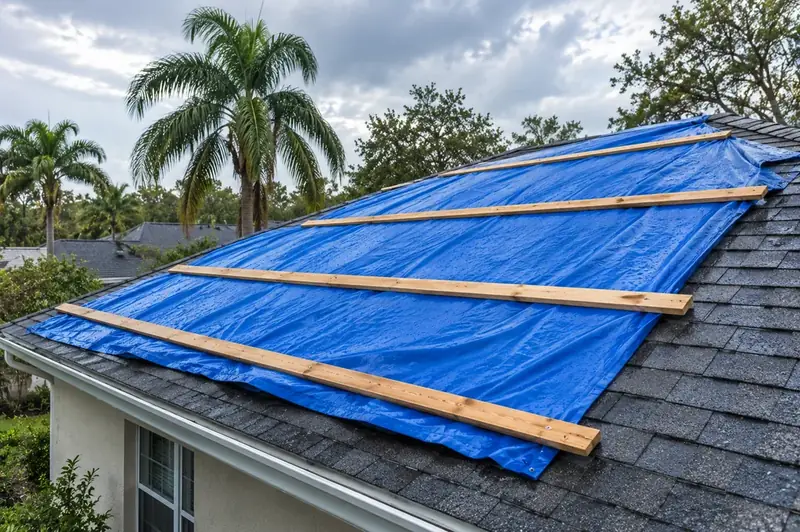
Roof Tarping
A properly secured, heavy-duty tarp keeps water out of an open or damaged section until the permanent repair. To work, it must be fastened so wind cannot lift it, overlapped so it sheds water rather than channeling it into the opening, and extended past the damaged area. Methods vary by crew and roof type. On shingle roofs a tarp is commonly secured with lumber battens; on tile, crews use methods intended to limit cracking and avoid fastening through tile where possible.
- Stops active intrusion into the attic and living space
- Installed so it can be removed cleanly when permanent repair begins
- Photographed in place, with receipts, for any claim
Temporary Sealing & Patching
For a small, well-defined opening, such as a lost pipe boot or a few missing shingles, a temporary seal or patch can be faster and more durable than a tarp. This is common after a vent cap blows off or a limb strikes a small area.
- Appropriate for isolated, accessible damage
- Used when conditions allow a quick, secure seal
- Followed by the permanent repair at the next dry window
Board-Up & Structural Cover
When a tree has opened a large section or taken out decking, a tarp alone may not be enough. Plywood or other structural cover over the opening, topped with a tarp, can protect the interior until permanent repair. Large openings may also call for a structural assessment before anyone works near them.
- Used when decking is missing or unsafe
- Often paired with a tarp for water shedding
- May require engineering or building department involvement for structural damage
From Temporary Protection to a Lasting Repair, by Roof Type
The emergency fix buys time. What the permanent repair involves depends on what your roof is made of and how it was damaged.
| Roof type | Typical emergency damage | What the permanent repair usually involves |
|---|---|---|
| Asphalt shingle | Wind-torn or missing shingles; limb impact; exposed underlayment | Remove damaged shingles, repair or replace underlayment and decking as needed, install matching shingles and seal them. A roof with widespread damage may be a replacement |
| Concrete or clay tile | Cracked, slipped, or missing tile; punctures from debris; displaced ridge tile | Replace and re-secure tile with matching profile where available, check underlayment beneath the damage, re-set ridge and hip tile. See tile roofing |
| Metal panel | Lifted or creased panels; torn trim; missing fasteners | Replace or re-secure damaged panels and trim, check clips and fasteners along the affected area, re-seal penetrations |
| Flat or low-slope | Punctures, torn seams, lifted membrane edges, drain blockage | Patch or re-weld membrane, re-seal flashings, clear and repair drainage. Extensive damage may call for a section re-roof |
| Deck and structure | Soft, saturated, or broken decking; damaged rafters | Replace decking sections; structural damage may need engineering review before roofing goes back on |
A good crew explains this before the permanent work starts: what was damaged, what will be replaced, what will be repaired, and what the building department needs to see. If the roof is old and the storm exposed widespread wear, the honest answer may be that a repair will not hold. See repair vs. replace and the Florida rules on roof repairs, which changed in 2022.
Before, During, and After a Storm: A Roof-Focused Timeline
Most roof damage is limited by what you do before the storm and in the first day after.
Before the storm (well before June 1 is best)
- Have the roof inspected and any known issues repaired before hurricane season. See our hurricane season prep checklist
- Trim limbs that overhang the roof
- Photograph the roof and exterior as they are now, for a before-and-after record
- Save your policy, declarations page, and agent contact information somewhere you can reach without power
- Know your hurricane deductible and what it applies to
During the storm
- Stay inside, away from windows and from areas under the roof if it begins to fail
- Do not go onto the roof, in the attic, or outside to check damage while winds are high
- If water enters, contain it where you safely can, and note the time
First 24 hours after
- Wait for safe conditions, then walk the property and look for downed lines, damaged trees, and obvious roof damage from the ground
- Photograph and video everything before moving it
- Call the dispatch line for temporary protection if there is an opening or active leak
- Contact your insurer to report the loss, and note the date, time, and name of the person you spoke with
- Start drying wet interiors as soon as it is safe
First two weeks
- Get a written scope for the permanent repair and compare it with any insurer estimate
- Verify any contractor's license and insurance before agreeing to work
- Do not sign anything that assigns claim rights or lets a contractor negotiate for you
- Keep a file: photos, estimates, invoices, correspondence, and dates
The Emergency Documentation Checklist
Strong records make everything easier: the repair, the claim, and any warranty question later.
| What to capture | Why it matters |
|---|---|
| Wide photos of the whole roof and each side of the house | Shows overall condition and which slopes are affected |
| Close-ups of each damaged area with something for scale | Establishes the extent and type of damage |
| Interior photos and video of every wet area, including ceilings, walls, and floors | Links the roof opening to resulting interior damage |
| The date and time of the storm or event, and weather reports if available | Ties the damage to a specific loss |
| Temporary repair invoices and photos of what was installed | Often part of a covered claim, and proof you took reasonable steps |
| Roof age, past repairs, and any prior inspection reports | Insurers sometimes ask, and it helps the roofer plan |
| A running log of calls: who you spoke to, when, and what was said | Helps resolve disputes about timing and instructions |
Water Inside the House Is a Different Trade
A roofer stops water entering. Drying and restoring what got wet is a separate job.
Emergency roofing protects the roof envelope. It does not dry out wet insulation, drywall, flooring, or contents, and it does not remediate mold. In Florida's humidity, wet materials need attention quickly; a commonly cited window before mold growth becomes a concern is roughly 24 to 48 hours, so do not wait on the permanent roof repair to start drying. A water-mitigation or restoration company handles extraction, drying, and any remediation, and your insurer may have specific requirements about that work.
- Photograph wet materials before removing them
- Ask your carrier about water-mitigation coverage and required documentation
- Keep wet or damaged materials until the loss is documented, unless they present a health hazard
- Run dehumidification and air movement as soon as it is safe, and consider professional drying for larger losses
Emergency Repairs and Your Insurance Policy
Decisions made in the first hours can affect your claim. Here is what Florida law and most policies say.
Homeowners policies commonly expect you to take reasonable steps to prevent further damage after a loss, and reasonable temporary repairs are often reimbursable as part of a covered claim. Coverage depends on the cause of the damage and the terms of your specific policy. Do not assume; ask your agent or carrier, and keep every record.
- Document first. Photograph and video damage before temporary repairs cover it, and keep invoices and a written description of what was done and why.
- Report promptly. Under SB 2-A (2022), a new or reopened claim must be reported within one year of the date of loss, and a supplemental claim within 18 months. Insurers must acknowledge claim communications within 7 calendar days under section 627.70131.
- Know your deductible. Many Florida policies carry a separate hurricane deductible, a percentage of the dwelling limit, for named-storm losses. Section 627.701 requires insurers to offer $500, 2%, 5%, and 10% options. Check your declarations page.
- A contractor cannot waive your deductible. Under section 489.147, it is insurance fraud for a contractor to pay, waive, or rebate your deductible with intent to defraud, and contractors cannot offer anything of value in exchange for inspecting your roof or making a claim.
- Contractors generally cannot negotiate your claim. That requires a licensed public adjuster or attorney. A contractor can document and give you a written scope.
- Assignments of benefits are banned on newer policies. SB 2-A eliminated assignments of benefits for residential policies issued on or after January 1, 2023. Read anything before you sign.
Read next
Our Florida roofing insurance guide explains claims in more detail, including actual cash value vs. replacement cost and roof age rules.
Sources & Verification
Facts on this page were checked against the sources below in October 2026. Laws, codes, and program rules change, so confirm current details with the agency before you rely on them.
- Florida Senate: SB 2-A 2022 bill summary
- Florida Statutes s. 627.70131 — claim acknowledgment timelines
- Florida Statutes s. 627.701 — hurricane deductibles
- Florida Statutes s. 489.147 — prohibited practices; deductibles
After a Major Storm: What to Expect, and How to Avoid Storm Chasers
Hurricane season runs June 1 through November 30. After a significant storm, demand for roofers rises sharply, and so do scams.
After a significant storm, thousands of roofs need attention at once. Local crews prioritize active leaks and open roofs first. If you are not actively leaking, you may get temporary protection long before the permanent repair, and the permanent repair can be weeks or months away. That is a normal part of storm recovery, not a sign you were ignored.
Demand also brings out contractors who follow storms and knock on doors. Some are legitimate, many are not, and almost all will be gone when a warranty claim comes up. Protect yourself:
- Verify the license yourself. Look up the contractor on MyFloridaLicense.com and confirm the status is current and active, and that the license type fits roofing. A Certified Roofing Contractor license (CCC) is valid statewide; a Registered Roofing Contractor license (RC) is valid only in the local jurisdiction where it was registered.
- Ask for proof of insurance. General liability and workers' compensation, or a valid exemption, ideally sent directly from the insurer or agent.
- Be cautious of large deposits. Pay by a traceable method and keep receipts. Be wary of requests for payment in full up front.
- Refuse any deductible deal. An offer to cover or waive your deductible is illegal in Florida and a sign you should walk away.
- Do not sign claim paperwork you have not read. That includes anything that lets a contractor handle or negotiate your claim.
- Get the scope, price, and license number in writing before any permanent work begins.
- You can always call someone yourself. You are never obligated to hire a contractor who showed up uninvited.
Permits still apply. Permanent roof repairs and replacements are generally permitted work, even after a storm, and your contractor handles the paperwork with the local building department. In the City of Orlando, for example, re-roof projects have an in-progress (dry-in) inspection and a final inspection that requires a completed affidavit confirming roof deck nailing and a secondary water barrier. Skipping inspections can lead to the roof being disapproved and having to be removed.
Sources & Verification
Facts on this page were checked against the sources below in October 2026. Laws, codes, and program rules change, so confirm current details with the agency before you rely on them.
- MyFloridaLicense.com (DBPR) — license lookup
- City of Orlando: Apply for a Residential Roof Permit — dry-in inspection and affidavit
- Florida Statutes s. 489.147
What Drives the Cost of Emergency Roof Repair in Orlando
Emergency work is priced by scope and urgency. These are the factors that matter, and what a fair quote should show.
| Cost factor | How it changes the price |
|---|---|
| Size of the opening | A small opening needs less material and time than a large storm-damaged section. |
| Roof type and access | Steep roofs, height, and tile or metal add time, specialty materials, and safety measures. |
| Conditions and timing | After-hours calls and the days right after a major storm may carry different pricing and wait times. |
| Temporary vs. permanent work | Emergency protection is quoted separately from the permanent repair so you can see each. |
| Materials used | Tarps, lumber, sealants, and board-up materials are itemized. |
| Documentation | Photos and receipts for temporary work help if the loss is covered. Ask for them. |
Ask on the call how emergency work is priced and whether there is a minimum or trip charge, so there are no surprises. Be skeptical of anyone who refuses to discuss pricing until the work is done, and of anyone who insists you sign a long-term contract for the permanent repair on the spot while you are under stress.
Commercial Roof Emergencies
Business roofs have their own needs: tenants, inventory, liability, and schedules.
What We Coordinate
- Leak response on flat and low-slope roofs
- Temporary protection that limits interruption
- Photo documentation for owners, lenders, and insurers
- A prioritized scope for permanent repair
What to Tell Dispatch
- Whether the building is occupied and what is below the leak
- The roof system if known (TPO, modified bitumen, metal)
- Any rooftop equipment near the leak
- Who is the decision-maker and how to reach them
Emergency or Not? Where to Go Next
Related Services
Emergency Roof Repair Across Orlando & Central Florida
Emergency dispatch covers Orlando and the surrounding communities. Response depends on crew availability and conditions, and demand rises after major storms.
Emergency Roof Repair FAQs
Call (689) 359-5257 and ask about after-hours availability. Be ready to say what you see, where water is entering, and whether anyone is at risk.
It depends on crew availability, weather, and call volume, especially right after a storm. Active leaks are dispatched ahead of routine work. A crew will tell you honestly if lightning or high wind delays roof access.
When conditions are safe, temporary protection is the first priority. High winds or lightning can delay roof access.
Reasonable temporary repairs are often reimbursable as part of a covered claim, but it depends on the cause of loss and your policy. Keep photos and receipts.
Temporary protection generally does not. Permanent repairs may, depending on scope and the local building department, which your contractor confirms.
Temporary mitigation can be done in wet weather when it is safe. Permanent repairs wait for dry conditions. See what emergency crews actually do.
Be cautious. Verify the license on the state's public lookup, confirm insurance, avoid large deposits, and never sign over claim rights without reading the document. You are always free to call someone yourself.
No. Under section 489.147 of the Florida Statutes, doing so with intent to defraud is insurance fraud, and a contractor offering it is a red flag.
Get everyone out of the affected area, call 911 if anyone is hurt or there is fire, stay away from downed lines, photograph the damage, and call dispatch. A large opening may need a board-up and a structural assessment, not just a tarp.
Yes. See commercial roof leak repair for flat and low-slope roofs.
It is possible. A clogged condensate line or overflowing drain pan in the attic can drip through a ceiling. The crew rules this out as part of the diagnosis.
That is a water-mitigation or restoration trade, not roofing. Start drying quickly, and check what your policy requires.
Get Emergency Roof Help in Orlando
Call the dispatch line for the fastest response, or send a request and we will call you back. Either way, the first goal is stopping the water.
Orlando Roofing Crew connects property owners with vetted, independently licensed and insured Florida roofing contractors. Inspections, repairs, and workmanship warranties are provided directly by the independent licensed contractor assigned to your property.
Request Emergency Dispatch
Tell us where you are and what you see, and a local crew will call you back right away.