
Metal Roofing in Orlando, FL
Metal is one of the strongest answers to Central Florida's sun, heat, and wind, and one of the most misunderstood. Orlando Roofing Crew connects Orlando property owners with licensed, insured local crews who install standing seam, 5V crimp, corrugated, and metal shingle roofs, and who will tell you honestly when metal is, and is not, the right fit for your house, your HOA, and your budget.
Is a Metal Roof Worth It in Orlando?
For many owners who plan to stay put, yes. For others, no. Here is how to tell which one you are.
A metal roof usually costs more than an asphalt shingle roof and can cost less than, or about the same as, a high-end tile roof. What you get for the higher price is a roof built to shed Florida's rain and heat, designed and tested for high wind uplift when installed to the product's approved method, and expected to last well beyond a shingle roof. Whether that is worth it depends mostly on how long you will own the home, your HOA, your roof's shape, and your insurance situation.
Metal tends to make sense when
- You plan to stay in the home for a decade or more, so the longer service life pays back
- Your current shingle roof needs replacing and you are tired of doing it every 15 to 20 years
- You want strong wind performance and are willing to pay for correct installation
- Your attic runs hot and you would like a reflective roof surface
- Your HOA allows a metal profile and color you like
- Your deck and structure are sound, or you are willing to repair them
Think twice, or choose something else, when
- You plan to sell within a few years and the neighborhood does not expect or reward metal
- Your HOA restricts metal or requires a specific tile or shingle look
- The lowest upfront cost is the overriding concern
- Your roof has a simple leak, not a failing surface. See roof leak repair
- You want to install over a poor roof or poor decking to save money. Metal does not hide those problems
| Asphalt shingle | Concrete / clay tile | Metal | |
|---|---|---|---|
| Typical upfront cost in Orlando | Lowest of the three | Highest of the three | Between, or close to, tile depending on system |
| Weight on the structure | Light | Heavy; structure verified before tile | Light |
| Wind performance | Wide range; depends on product class and installation | Depends on attachment method and installation | Designed and tested to high uplift when installed to the approved method |
| Heat reflectance | Dark shingles absorb heat; lighter ones reflect more | Varies by color; light tile reflects well | Reflective finishes can reflect much of the sun's heat |
| Typical life in Florida | Often shorter than the label because of heat and UV | Tile can last decades; underlayment is usually the limiting part | Commonly decades longer than shingle when properly installed |
| Appearance | Many styles | Traditional Florida look | Modern, farmhouse, or tile-look metal available |
| Repair behavior | Easy to repair; matching fades | Needs tile-experienced crews | Panels and trim are repaired or replaced; depends on profile |
A general comparison, not a promise about any one roof. For a deeper comparison see our guide to metal vs. tile vs. shingle in Central Florida.
Read next
A fuller side-by-side is in Metal vs. Tile vs. Shingle in Central Florida, and what each costs is in Metal Roof Cost in Florida.
Why Orlando Homeowners Choose Metal Roofing
Metal costs more upfront than a shingle roof. These are the reasons people pay it.
Wind Performance
Properly installed metal systems are designed and tested for high wind uplift. The result depends on the product's tested attachment and on how it is installed, which is why Florida requires product approval.
Heat and Sun
Reflective finishes can reflect much of the sun's heat, and metal does not wear down from UV the way asphalt granules do.
Long Service Life
A well-installed metal roof commonly outlasts asphalt shingles by decades, which changes the math on the next replacement.
Fewer Failure Points
Standing seam panels run the full roof slope with concealed fasteners, so there are fewer seams and exposed screws to leak.
Sheds Water Fast
Smooth panels shed Florida's heavy downpours quickly and do not hold moisture the way porous materials can, which also helps against algae streaking.
Insurance Conversations
A new roof built to current code, with documented wind features, can support wind mitigation credits. Any premium effect is carrier-specific.
Standing Seam, 5V Crimp, Corrugated, and Metal Shingles
Not all metal roofs are the same product. The panel profile and how it is fastened change cost, appearance, and performance.
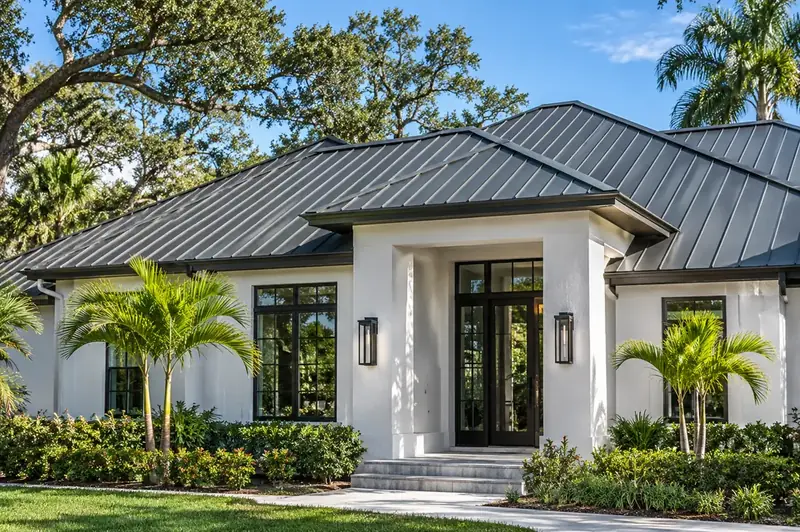
Standing Seam
Panels have raised seams that lock or snap together, held down by concealed clips so there are no exposed screws on the water-shedding surface. The clips let the panel move as it heats and cools, which reduces stress and fastener loosening. It is the cleanest-looking residential metal roof and generally the most expensive of the panel types.
- Concealed fasteners reduce long-term leak points
- Accommodates thermal movement without loosening
- Needs precise installation: panel layout, clip spacing, and trim details decide how it performs
5V Crimp
A traditional profile with five-ribbed 'V' ridges. It is common on Florida cracker-style homes, cottages, and accents, and typically uses exposed fasteners. Exposed screws have rubber washers that age in the sun, so a 5V roof needs periodic checking and eventual fastener replacement.
- Familiar Florida appearance
- Exposed fasteners need periodic checking and eventual replacement
- Usually lower cost than standing seam
Corrugated and R-Panel (Screw-Down)
The most economical metal options. Corrugated and R-panel are screwed through the face of the panel, which makes them quick to install but dependent on well-maintained fasteners and washers over time.
- Common on barns, sheds, carports, and agricultural buildings
- Fastener washers wear and need attention over time
- Less common on primary residences in HOA communities
Metal Shingles and Stone-Coated Steel
Stamped metal panels that look like shingles, tile, or shakes. Some are aluminum interlocking shingles; others are steel panels coated with stone granules. These are popular where an HOA wants a conventional look but the owner wants metal's performance.
- Often accepted in communities that restrict ribbed metal
- Many systems are lighter than concrete tile
- Installation methods and warranties vary widely by manufacturer
Steel, Galvalume, Aluminum and Copper: Materials and Finishes
Material choice matters most near saltwater and for long-term corrosion resistance. Finish matters for color retention.
| Material | What it is | Florida notes |
|---|---|---|
| Galvalume steel | Steel coated with an aluminum-zinc alloy (commonly specified to ASTM A792, such as AZ-50) | A very common choice for inland Orlando. Coating quality and cut-edge protection matter for long life |
| Galvanized steel | Steel coated with zinc | Common and cost-effective, and often painted. Ask how the zinc coating and paint are warranted |
| Aluminum | Naturally corrosion-resistant metal, commonly specified around .032 inch thick for residential panels | A preferred choice near the coast and for maximum corrosion resistance. Typically costs more than steel and dents more easily |
| Copper and zinc | Premium metals that develop a natural patina | Mostly used for accents, such as bay windows and entries, on custom homes. Dissimilar metals must be isolated to avoid corrosion |
Gauge and thickness vary by manufacturer and system. Always compare the actual product data sheet, not the label on the quote.
Gauge, in plain terms
For steel, a lower gauge number means thicker metal. Residential standing seam is commonly specified in 24 or 26 gauge steel, while lighter 29-gauge steel is typical of economy corrugated panels. Thicker panels dent less and are generally stiffer, but cost more. Ask for the gauge and the manufacturer's data sheet in writing.
Finishes and color
Painted metal roofs come with factory finishes. A PVDF (often sold under the Kynar 500 name) finish is a premium coating known for color retention, while silicone-modified polyester (SMP) finishes are less costly. Color affects heat: lighter, reflective finishes absorb less of the sun's energy. Some finishes carry long paint and fade warranties; read them closely, because coverage often excludes certain exposures. Coatings on other roof types are covered in cool roof coatings and Florida summer heat.
Salt, corrosion, and Orlando
Orlando is inland, roughly an hour from either coast, so salt spray is less of an issue than it is on a barrier island. Corrosion still matters, especially at cut edges, fasteners, and where different metals touch. If your home is near the coast, or you simply want maximum corrosion resistance, ask about aluminum. Whatever the metal, fasteners and trim should be compatible with it.
Wind, Product Approval, and the Florida Building Code
In Florida a roof is a tested system, not just a material. This is what that means for a metal roof.
Orlando is not in the High-Velocity Hurricane Zone, which applies to Miami-Dade and Broward counties, but the Florida Building Code's wind provisions apply here, and roofing products must have Florida product approval. For metal roofs, that approval is typically based on testing the complete assembly: the panel, the clips and fasteners, the underlayment, and the deck. Standing seam systems are commonly tested to the TAS 125 standard (uniform static air pressure) and to UL uplift standards. The approval documents the maximum design pressure the system is rated for and the exact way it must be installed.
The practical meaning: a metal roof performs as tested only if it is installed exactly as the approval requires, with the right clips, fastener type and spacing, deck, and underlayment. A good installer can show you the approval for the product they are quoting and explain how your roof's wind zone and building height fit within its rating.
What to ask to see
- The Florida product approval number for the specific panel and installation method
- The design pressure rating and how it compares with what your building's location and roof geometry require
- The deck type and attachment the approval assumes, and what will be done to your existing deck to meet it
- The underlayment named in the approval, and whether a secondary water barrier is included
Metal over existing shingles: when it is allowed
In some jurisdictions the code allows a metal roof to be installed over a single layer of existing roofing that is in good condition, usually with a re-roofing inspection affidavit and the product approval installation details on site for the inspector. Lake County, Florida, publishes guidance along these lines. Rules differ by jurisdiction and by code edition, and the 9th Edition (2026) Florida Building Code, effective December 31, 2026, revises the reroofing section. Even where a recover is allowed, many roofers recommend tear-off so the deck can be inspected and re-fastened, because a recover hides decking problems and adds weight. Always confirm with the building department that serves your address. See metal roofs over existing shingles.
What the City of Orlando checks on a re-roof
In the City of Orlando, residential and commercial re-roofs have an in-progress (dry-in) inspection, and the final inspection requires a completed affidavit verifying the roof deck nailing and the secondary water barrier. Projects without the dry-in inspection can be disapproved and required to remove the roof. Other jurisdictions, including Orange County for unincorporated addresses and the Seminole and Osceola County cities, have their own versions of these steps. Your contractor schedules the inspections, but you should know to ask.
Sources & Verification
Facts on this page were checked against the sources below in October 2026. Laws, codes, and program rules change, so confirm current details with the agency before you rely on them.
- Florida Building Commission: product approval — searchable product approvals
- City of Orlando: Apply for a Residential Roof Permit — dry-in inspection and affidavit
- Lake County, FL: Roofing information guidelines (example of recover rules)
- Florida Roofing & Sheet Metal Contractors Association: 2026 FBC updates — reroofing changes effective December 31, 2026
Do Metal Roofs Really Keep a Florida House Cooler?
Many roofers claim big energy savings with no source. Here is what Florida research actually found.
The best-known Florida test is a study by the Florida Solar Energy Center (FSEC) at the University of Central Florida. In summer 2000 researchers compared seven identical, unoccupied side-by-side homes in Fort Myers with different roofs. They measured how much sunlight each roof reflected and how much each reduced cooling energy compared with a dark gray shingle roof.
| Roof | Solar reflectance | Cooling energy reduction vs. dark shingle |
|---|---|---|
| Dark gray fiberglass shingle (control) | 8.2% | baseline |
| White fiberglass shingle | 24.0% | 3 to 5% |
| Terra cotta barrel tile | 34.6% | 3 to 9% |
| White metal | 66.2% | within the 18 to 26% range reported for the white reflective roofs |
| White barrel tile | 74.2% | within the 18 to 26% range reported for the white reflective roofs |
| White flat tile | 77.3% | within the 18 to 26% range reported for the white reflective roofs |
Source: Florida Solar Energy Center, 'Comparative Evaluation of the Impact of Roofing Systems on Residential Cooling Energy Demand in Florida.' The study reported cooling energy reductions of 18 to 26 percent and peak demand reductions of 28 to 35 percent for the white reflective roofs as a group.
What this does and does not tell you. It shows that a highly reflective roof surface, whether white metal, white tile, or similar, can cut cooling use substantially in a Florida home compared with a dark shingle roof. It does not show that 'metal' saves a fixed percentage. The effect depends on the finish color and reflectance, on attic insulation and ventilation, and on the house. The test homes were small (about 60 percent of a typical new home), unoccupied, and tested once in Fort Myers in 2000, and modern 'cool roof' finishes may perform differently. A dark-colored metal roof, for example, would not reflect like the white test roof.
Be skeptical of exact claims
If a salesperson promises a specific percentage savings on your cooling bill, ask for the source and for the roof color and attic details it assumed. The research supports 'reflective roofs help,' not a guaranteed number.
Sources & Verification
Facts on this page were checked against the sources below in October 2026. Laws, codes, and program rules change, so confirm current details with the agency before you rely on them.
- Florida Solar Energy Center: FSEC-CR-1220-00 — roofing and cooling energy study
Metal Roofs, Wind Mitigation Credits, and Insurance
Some of the best reasons to put on a new roof involve insurance. Here is how it actually works, without the sales hype.
Florida insurers are required to offer discounts for verified wind-resistance features, and the standard way to verify them is the Uniform Mitigation Verification Inspection Form, known as OIR-B1-1802. A licensed inspector documents features such as the roof covering, the roof deck attachment, the roof shape, whether there is a secondary water resistance layer, the roof-to-wall connection, and the protection of windows and doors. Each documented feature can contribute to a premium credit, but the amounts are set by each insurer and vary by policy and by how many features qualify.
A revised form, OIR-B1-1802 (Rev. 04/26), took effect April 1, 2026. It tightens documentation (the inspector completes every field and attaches photographs), updates how roof deck attachment, roof covering, roof-to-wall connections, and secondary water resistance are classified, and adds recognition of the FORTIFIED Home program. Citizens Property Insurance has stated the revisions do not change the credits available. Previously completed inspections on the older form remain acceptable if they were done within five years before April 1, 2026 and the home has not been structurally modified.
What a new metal roof can change
- Roof covering. A new roof installed to current Florida code, with its product approval documented, can qualify under the roof covering category.
- Roof deck attachment. A re-roof is the natural time to re-fasten the deck to meet the strongest attachment classes. Metal installers commonly do this as part of a tear-off.
- Secondary water resistance. A peel-and-stick membrane over deck seams can qualify, and is commonly installed under metal.
- Roof shape. A hip roof can earn credit regardless of material.
Do not count on a specific discount
Credit amounts are carrier-specific, and not every insurer rates metal differently from other code-compliant roofs. Ask your agent for a quote with the new roof's wind mitigation form before you commit to metal for insurance reasons.
Roof age and the 15-year rule
Under section 627.7011 of the Florida Statutes, an insurer may not refuse to issue or renew a homeowner's policy solely because of the age of a roof under 15 years old, and for roofs 15 years old or older, a homeowner can have an authorized inspector assess the roof; if the inspector finds five or more years of useful life remaining, the insurer may not refuse solely on age. A long-lived roof reduces the chance that roof age becomes an underwriting problem. Legislation proposed in 2026 would extend these protections, so confirm the current statute with your agent.
Help paying for hardening: My Safe Florida Home
My Safe Florida Home is a state program that has offered a free wind mitigation inspection and grants of up to $10,000 toward eligible home-hardening work, including roof deck attachment and roof upgrades, for eligible owner-occupied, homesteaded, site-built homes. Funding is limited and awarded first come, first served, and eligibility rules and funding change from year to year. Check the program's website for current availability before you plan around it.
Sources & Verification
Facts on this page were checked against the sources below in October 2026. Laws, codes, and program rules change, so confirm current details with the agency before you rely on them.
What a Proper Metal Roof Installation Involves
A metal roof is only as good as its installation. This is the sequence, and the details worth checking.
- Tear-off and deck inspection. Existing roofing is removed and the deck is inspected for rot, delamination, and loose fastening. Metal does not hide deck problems, so the deck has to be right. Damaged sheathing is replaced and the deck is re-fastened to the attachment the permit calls for.
- Secondary water barrier and underlayment. A peel-and-stick membrane over deck seams and a high-temperature underlayment rated for metal go down. Standard felt can fail under the heat that builds beneath a metal roof, so underlayment choice matters.
- Edge metal, flashing, and penetrations. Drip edge, wall and valley flashing, and boots around vents are set so every transition is sealed before panels go on.
- Panel layout, clips, and attachment. Panels are laid out square to the roof, clips or fasteners are placed at the spacing the approval requires, and panels are locked or screwed as designed.
- Trim and details. Ridge, hip, rake, eave, valley, and penetration trim is formed and fastened to match the approved system. This is where most leaks start on a poorly done metal roof.
- Inspection and cleanup. The building department inspects (including the in-progress and final inspections where required), the crew cleans up with magnets for stray fasteners, and you receive product, workmanship, and finish warranty documentation.
Common installation mistakes
- Wrong or insufficient underlayment for a high-heat metal roof
- Fasteners over-driven, under-driven, or the wrong type, which causes leaks and loosening
- Not allowing for thermal movement, which leads to buckling, 'oil canning,' and noise
- Dissimilar metals touching, such as copper accents against aluminum or steel, which corrodes one of them
- Cut edges left unprotected on steel panels
- Sloppy penetration and valley details that look fine on day one
- Skipping the in-progress inspection, which can mean a roof that must be removed and redone
Common Metal Roof Questions, Answered Plainly
Metal roofing is surrounded by sales claims. Here are the most common questions, with honest answers.
Is a metal roof loud in the rain?
Residential metal roofs are normally installed over solid decking with underlayment, which muffles rain noise considerably. Complaints about noise usually come from thin-panel utility roofs with no solid deck beneath them, such as barns and sheds.
Does metal attract lightning?
No. A metal roof does not make a lightning strike more likely. If a strike does occur, a metal roof can spread the energy across the surface rather than ignite, and metal roofs generally carry a Class A fire rating when assembled as tested. Fire and lightning are separate questions from wind.
Will it dent?
Thin or low-gauge panels can dent, especially from large hail, a fallen branch, or foot traffic. Central Florida sees hail occasionally but rarely at damaging sizes. Thicker gauges and some profiles resist denting better, and aluminum dents more easily than steel of similar thickness.
Will it rust?
Properly coated steel and aluminum are designed not to. Rust problems usually start at cut edges, scratches, fasteners, or where dissimilar metals touch. Keep debris off the roof, touch up scratches with the manufacturer's recommended product, and use compatible fasteners and trim.
Is it hotter or cooler in summer?
A reflective finish can reduce heat gain compared with dark shingles, as the Florida Solar Energy Center's test showed. A dark metal roof reflects less. Attic ventilation and insulation matter as much as the roof surface.
Can I walk on it?
Carefully, in the right places, and with the right shoes. Some profiles are easy to dent or scratch, and wet metal is slippery. Leave roof work to professionals.
Can it be repaired if damaged?
Yes. Panels and trim can be replaced or re-sealed, though matching a discontinued color or profile can take sourcing. Ask the installer how replacement panels will be sourced and what the manufacturer's color availability is.
Will My HOA Allow a Metal Roof?
This is the single most common reason a metal roof project stalls. Check first.
Many Central Florida communities, including Windermere, Lake Nona, Dr. Phillips, and Celebration, have architectural review. Some allow metal in particular profiles and colors, some allow only metal that mimics tile or shingle, and some do not allow it at all. Florida law gives owners some protections on specific items, but roofing material is generally governed by your community's recorded covenants and architectural guidelines. The only reliable source is your own community's governing documents and its architectural review committee.
- Read your covenants and architectural guidelines for roofing material, profile, and color rules
- Ask the review committee what submittal they need: color samples, panel profile drawings, manufacturer data sheets, and a contractor's license and insurance
- Submit before you order materials, and get approval in writing
- If metal is not allowed, ask about aluminum shingles or stone-coated steel that mimic an allowed look
- Allow time. Review can take weeks, and your schedule should reflect that
Many communities approve standing seam in muted, traditional colors and decline bright or industrial finishes. If you are in a historic district, such as a locally designated area in Orlando or Winter Park, exterior changes may also require historic review. See central Florida HOAs and roofing materials.
What Drives the Cost of a Metal Roof in Orlando
Metal costs more upfront than shingle. These are the factors behind the number, and what published estimates say.
| Cost factor | How it changes the price |
|---|---|
| Profile and panel gauge | Standing seam costs more than 5V crimp or corrugated, and heavier gauge costs more than lighter. |
| Material type | Aluminum typically costs more than coated steel. |
| Roof complexity | Valleys, dormers, hips, and penetrations add trim and labor. |
| Existing roof and deck | Tear-off, deck repair, and underlayment choice all affect the total. |
| Permits, HOA, and access | Permit fees, submittals, gated-community logistics, and tight access can all affect the total and the schedule. |
| Warranty and finish | Premium finishes and longer manufacturer warranties cost more. |
To give you a sense of scale, one published Orlando-area cost guide (RoofingCalc, updated March 2025) puts metal roofing at roughly $10.50 to $18.50 per square foot installed, or about $21,000 to $37,000 for a 2,000-square-foot roof, compared with about $4.50 to $7.50 per square foot for asphalt shingle and $14.00 to $19.50 for tile. Other sources give different numbers, standing seam typically costs more than the low end, and costs have moved with material prices, so treat these as one published indication rather than a quote. Your written estimate, after a free inspection, is the number that matters.
Compare quotes on the same basis: the same profile, gauge, finish, underlayment, deck work, and warranty. A low quote that quietly uses a thinner panel, a lesser finish, or a standard felt underlayment is not the same product.
Financing
Financing may be available for qualified projects. See financing options.
Sources & Verification
Facts on this page were checked against the sources below in October 2026. Laws, codes, and program rules change, so confirm current details with the agency before you rely on them.
- RoofingCalc: How Much Does a New Roof Cost in Orlando? — published estimate, updated March 26, 2025
Published estimates vary widely between sources and over time. We cite one source as an indication, not a quote.
Metal Roof Maintenance in Florida
Metal is low-maintenance, not no-maintenance.
- Rinse and clear debris. Leaves, pine needles, and palm fronds trap moisture in valleys and at edges. Clear them gently.
- Check exposed fasteners yearly. On 5V crimp and corrugated roofs, look for backed-out screws and cracked washers, and replace them.
- Inspect sealants and trim. Sealants at penetrations and trim age and should be checked as part of an annual inspection.
- Touch up scratches with the manufacturer's recommended product to prevent corrosion.
- Watch for dissimilar metals. Do not mount copper or other metals against steel or aluminum without isolation.
- Keep records. Warranty paperwork, product data, and inspection reports should live in one folder.
A yearly check, ideally before June 1 and hurricane season, catches most problems. See our roof maintenance program.
How to Choose a Metal Roofing Contractor
Metal installation is a specialty. Many roofers install it rarely, and it shows.
- Verify the license. Florida roofing contractors are licensed through the DBPR's Construction Industry Licensing Board. A Certified Roofing Contractor (CCC) license is valid statewide; a Registered Roofing Contractor (RC) license is valid only in the local jurisdiction where it was registered. Check status at MyFloridaLicense.com.
- Ask how many metal roofs they have installed and ask to see recent local examples or references, especially of the profile you want.
- Ask for the product approval and the manufacturer's installation requirements for the exact system.
- Get insurance proof. General liability, and workers' compensation or a valid exemption.
- Compare line by line. Same profile, gauge, finish, underlayment, deck work, flashing and trim, permit handling, and warranty.
- Read the warranty. Workmanship (by the contractor) and manufacturer (panel and finish) warranties are separate, and each has exclusions and conditions.
Red flags
A quote that is far below the others with no explanation, no product approval number, pressure to sign immediately, a request for a large deposit before work starts, door-to-door solicitation after a storm, or any offer to cover your insurance deductible.
Is Metal the Right Move?
Related Services
Metal Roofing Across Orlando & Central Florida
Metal roofing is installed across the Orlando area. Some communities limit profiles and colors, so check HOA rules in places like Windermere, Lake Nona, and Celebration.
Metal Roofing FAQs
For many owners who plan to stay long term, yes, because of wind and heat performance and service life. The upfront cost is higher, so it depends on how long you will own the home and your HOA.
A properly installed metal roof commonly outlasts asphalt shingles by decades. Actual life depends on the material, coating, installation, and maintenance, and warranties vary by manufacturer.
It varies with profile, gauge, material, and roof complexity, so we do not publish a flat figure. One published Orlando guide estimates roughly $10.50 to $18.50 per square foot installed, and a free inspection produces a written, itemized estimate.
Many do, within limits on profile and color. Check your rules and submit the details before ordering materials. See HOA roofing rules.
Possibly, through wind mitigation credits, but any effect is carrier-specific and not guaranteed. See metal roofs and insurance premiums.
Less than most roofs, but not none. Exposed fasteners and sealants need periodic checks, and debris should be cleared from valleys and edges.
Sometimes, within code and manufacturer limits and local rules. A tear-off lets the deck be inspected and re-fastened. See metal over shingles.
Not when installed over solid decking with proper underlayment.
No. It does not make a strike more likely.
A reflective finish can. Florida Solar Energy Center testing found white reflective roofs reduced cooling energy by 18 to 26 percent compared with a dark shingle roof, but results depend on color, attic, and house. Be skeptical of exact promises.
Yes. A re-roof is permitted work, with inspections. In the City of Orlando that includes an in-progress (dry-in) inspection and a final inspection with an affidavit covering deck nailing and the secondary water barrier.
Yes, see commercial roofing.
Get a Written Metal Roof Estimate
Start with a free inspection. You will get an itemized estimate for the profile and material that fits your house, with no obligation.
Orlando Roofing Crew connects property owners with vetted, independently licensed and insured Florida roofing contractors. Inspections, repairs, and workmanship warranties are provided directly by the independent licensed contractor assigned to your property.
Request a Free Inspection
A local specialist inspects your roof and gives you a written scope. No obligation.