
Roof Leak Repair in Orlando, FL
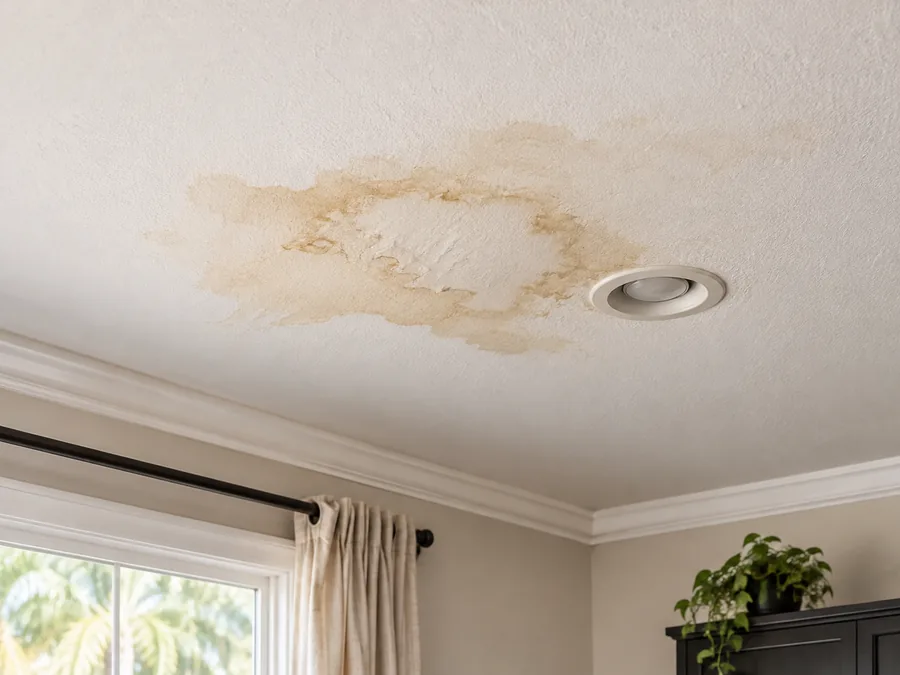
A ceiling stain after an afternoon downpour is almost never directly under the spot where water got in. Orlando Roofing Crew connects Orlando and Central Florida property owners with licensed, insured local roofing crews who trace the real entry point from the attic out, fix that, and put the cause and the repair in writing, whether your roof is shingle, tile, metal, or flat.
What to Do About a Roof Leak in Orlando
If you are reading this with water coming through a ceiling, start with the first three steps below, then call.
- Contain it. Move furniture and valuables, put a bucket under the drip, and keep clear of any ceiling that is bulging or sagging. If water is near light fixtures or outlets, turn off power to that room at the breaker.
- Document it. Photograph and video the stain, the drip, and the area around it before you clean anything. Date-stamped photos help with any insurance claim and help the roofer.
- Call a licensed roofer, not just any roofer. In Florida, anyone can say they are a roofer; only a contractor holding a state license (or a local registration) can legally take on most roofing work. You can check any license in about a minute on the state's public lookup. We explain how below.
A leak is a symptom. The repair is only as good as the diagnosis behind it, and in Central Florida a good diagnosis often means looking at more than the roof: attic air handlers, drain lines, and even condensation can look like a roof leak. The rest of this page explains how leaks actually happen on Orlando roofs, how a proper diagnosis works, what a repair does and does not fix, what the law says about repair versus replacement after 2022, how insurance treats leaks, and how to hire someone who will do it right.
In a hurry?
Active water intrusion is an emergency. Call (689) 359-5257 and say water is coming in, or read our emergency roof repair page for what happens after you call.
Signs Your Roof Is Leaking (Some Are Easy to Miss)
Obvious drips are the last stage. These earlier signals are worth acting on.
Brown or Yellow Rings That Grow
A stain that darkens or spreads after rain points to water arriving from above. A stain that never changes may be old and dry. Mark its edge with a pencil and watch.
Dark Streaks or Damp Spots in the Attic
Staining on decking and rafters, damp insulation, or a musty smell in the attic is evidence of repeated intrusion, often long before the ceiling shows anything. If the same area keeps leaking, see how many repairs are too many before you replace.
Missing, Slipped, Lifted, or Cracked Roofing
From the ground, look for shingles that are missing or curled, tiles that have slipped out of line or cracked, and metal panels with lifted edges.
Leaks Only When the Rain Blows Sideways
If it only drips in wind-driven rain, the entry point is usually flashing, a vent, a wall intersection, or the edge of the roof, not the open field. For a closer look at one common failure point, see flashing failure around chimneys.
Peeling Paint, Bubbling Drywall, or Mold Spots
Moisture that gets into drywall shows up as bubbling paint, soft spots, or small dark spots on the ceiling or at the top of walls.
Higher Cooling Bills and Hot Attic Spots
Wet insulation loses much of its value as insulation. A rise in cooling costs with no other explanation can be a clue.
Why Roofs in Central Florida Leak the Way They Do
Leaks are not random. The climate here puts specific stress on specific parts of a roof.
Orlando gets roughly 50 inches of rain a year, and most of it falls between June and September in short, intense afternoon thunderstorms rather than steady drizzle. Those storms often arrive with gusty wind, which pushes rain sideways and upward under edges, flashing, and the gaps around vents. A roof that sheds a gentle rain perfectly well can leak in a wind-driven downpour. (Rainfall figures are long-term averages; we confirm exact normals against National Weather Service data before publishing.)
The sun is the other half of the story. Constant ultraviolet exposure and heat cycle roofing materials hard: rubber pipe collars crack, sealants dry out and shrink, asphalt shingles lose their protective granules, and the underlayment beneath tile and metal bakes in a hot attic. None of that causes a leak on its own. It slowly removes the margin, so the first heavy storm after a material gives out is the one that shows it.
Construction details that matter here
- Hip roofs are common. Hip roofs perform well in wind but have many ridges, hips, and valleys, each a seam that has to stay sealed.
- Stucco walls meet the roof. Many Central Florida homes are concrete block with stucco. Where a roof edge meets a stucco wall, the flashing and the stucco-to-roof detail are a frequent leak location.
- Air handlers often live in the attic. That means condensation, drain pans, and drain lines sit right above ceilings. They can cause stains that look exactly like roof leaks.
- Lanais, screen enclosures, and additions. Low-slope roofs over patios and additions, and the points where enclosure frames attach to the main roof, are common trouble spots.
- Trees and palms. Oak leaves, pine needles, and palm fronds pack valleys and roof edges, hold moisture against roofing, and let water back up under it.
The Eight Most Common Leak Sources, and How Each One Fails
Most leak calls come from a short list of repeat locations. Each fails differently and is repaired differently.
1. Flashing at Walls, Chimneys, and Dormers
Flashing is the metal or membrane that seals where a roof meets something else: a wall, a chimney, a dormer, or another roof plane. Sealant is often used as a backup. Under Florida sun, sealant dries, shrinks, and pulls away within years, while metal flashing can corrode, separate, or have been installed without the right overlap in the first place. On stucco homes, the junction between stucco and flashing is a classic problem: movement and moisture open a gap, and wind-driven rain follows it.
- Step flashing at sidewalls and counter-flashing at chimneys inspected for separation and corrosion
- Failed sealant replaced with correct flashing, not just another layer of sealant on top
- Kick-out flashing checked where a roof edge terminates against a wall, a small part that prevents a lot of damage
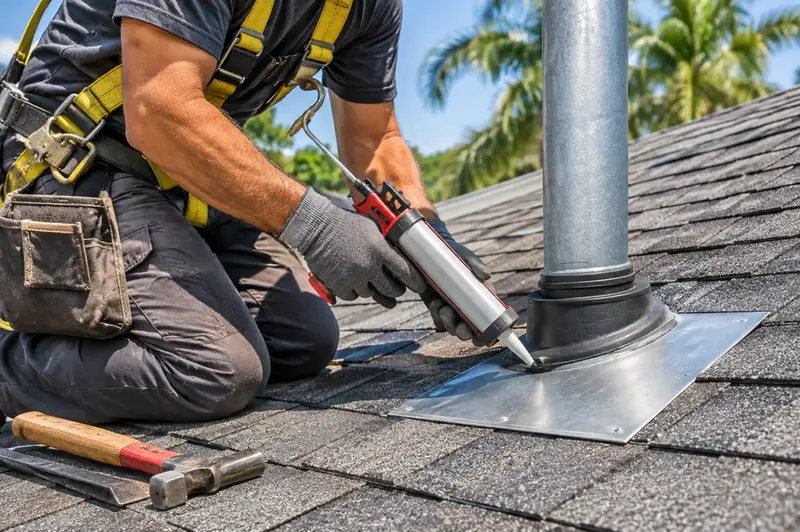
2. Pipe Boots, Vents, and Roof Penetrations
Every plumbing vent, exhaust fan, and attic vent is a hole in the roof sealed by a boot, collar, or flashing. The rubber or neoprene collar around a plumbing stack hardens and cracks in UV, creating a small gap that leaks every time it rains. Box vents and turbine vents can rust or loosen, and exhaust caps can come off in wind.
- Cracked collars replaced, and the roofing around them checked for hidden water staining
- Neighboring boots and vents inspected, since they usually age together
- One of the fastest and most affordable repairs on this list when caught early

3. Tile Underlayment, and Cracked or Slipped Tile
On a tile roof, the tile sheds most water, but the underlayment beneath it is the actual waterproofing layer. A leak under tile usually means the underlayment has aged out, that fasteners through it have become leak paths, or that a cracked tile is letting water reach a weak spot. Industry sources commonly put tile life at 40 to 50 years or more and underlayment life at roughly 20 to 25 years, which is why a tile roof can leak while looking perfect from the street.
- Cracked and slipped tiles replaced, with matching profile and color where available
- Underlayment condition checked wherever tile is lifted for the repair
- Widespread underlayment failure becomes a re-roof conversation. See tile roofing

4. Valleys
A valley is where two roof planes meet, and it carries more water than any other part of the roof. Wear shows up there first. Debris dams water, metal valley liners corrode, and on shingle roofs the shingles at the valley edge can wear through. Where a valley has leaked for a while, the decking underneath is often soft.
- Valley metal or woven shingles repaired or replaced
- Soft or delaminated decking sections replaced locally before roofing goes back on
- Additional damage found once the area is opened is flagged and priced before extra work happens
5. Skylights and Solar Tubes
Skylights leak at the flashing around the frame far more often than through the glass or the unit itself. Seals age, curb flashing separates, and older skylights may have been installed without a proper curb or flashing kit. Solar tubes have a smaller footprint but the same weak point: the flashing at the roof.
- Flashing re-done around the unit, which is usually the real fix
- Unit replacement recommended only when the frame or glass itself has failed
- See repair the flashing or replace the skylight
6. Flat and Low-Slope Sections
Lanai roofs, porch roofs, additions, and some modern homes have flat or low-slope sections. They shed water slowly, so ponding, seam failures, and failed flashing against walls are the main issues. Many of these roofs use modified bitumen, TPO, or built-up systems, and repairs depend on knowing which one you have.
- Seams, punctures, and wall flashing inspected and repaired
- Drainage and ponding evaluated, since standing water accelerates wear
- See flat roofing for larger-scale options
7. Exposed Fasteners and Seams on Metal
On 5V crimp and corrugated metal, exposed screws sit on top of the roof with rubber washers that dry out and crack in the sun. Fasteners back out as panels expand and contract. On standing seam, leaks tend to be at trim, penetrations, and panel ends rather than the field.
- Fasteners re-tightened or replaced with correct-size screws and washers
- Seams and trim re-sealed or re-lapped where needed
- See metal roofing
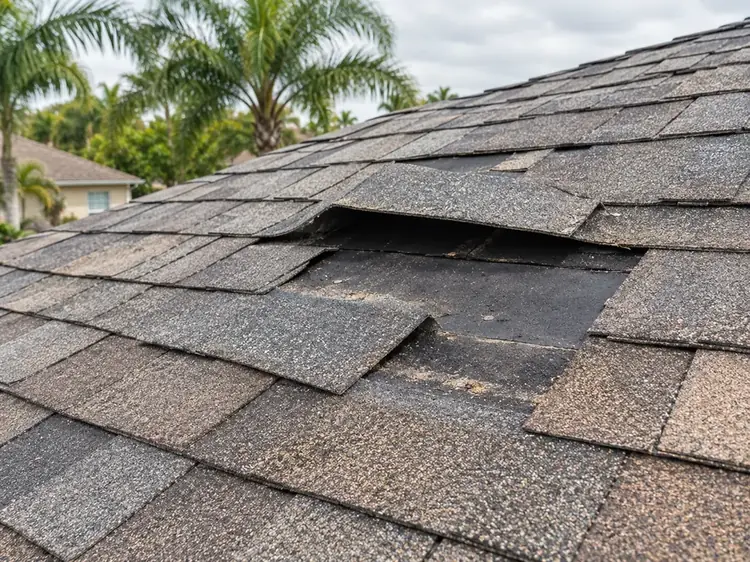
8. Worn, Lifted, or Missing Shingles
Shingles lose granules and seal strips with age and heat, and wind lifts and creases them. A few missing shingles are a fair repair on an otherwise healthy roof. Widespread curling, cracking, and granule loss means the roof is wearing out as a system.
- Damaged shingles replaced and sealed down
- Surrounding roofing checked for hidden creasing
- See missing or blown-off shingles and granule loss
Leak Source at a Glance
How each common leak source tends to show up and what the typical fix involves.
| Leak source | Typical clue | Usual fix | What it can signal |
|---|---|---|---|
| Pipe boot or vent | Drip near a plumbing stack or exhaust; leaks in any rain | Replace the boot or collar; check neighbors | Other original boots are likely the same age |
| Wall or chimney flashing | Stain along an exterior wall line; worse in wind-driven rain | Re-flash with correct overlap and counter-flashing | Stucco or masonry movement or sealant failure |
| Valley | Stain below a valley; debris packed in valley | Repair or replace valley metal, clear debris, check decking | Soft decking if the leak has been long-running |
| Tile underlayment | Leak with intact-looking tile; staining in attic | Local repair or lift-and-relay re-roof | Underlayment aged across the roof |
| Cracked or slipped tile | Visible broken or shifted tile | Replace and re-seat tile; check underlayment under it | Past foot traffic or storm impact |
| Skylight flashing | Ring-shaped stain around the skylight | Re-flash the curb; replace unit only if failed | Original installation shortcuts |
| Low-slope seam | Stain under a lanai or addition; ponding on the roof | Repair seams or flashing; improve drainage | End of life for the membrane |
| Metal fastener or seam | Drips along a screw line; rust streaks | Re-fasten or replace fasteners; re-seal seams | Fastener washers failing across the roof |
This table is a general guide. Only an inspection can confirm the actual source on your roof.
How a Roof Leak Is Actually Diagnosed
A good diagnosis is a method, not a guess. This is what a qualified crew should do.
Water travels. It follows decking, rafters, and the top of insulation before it drips onto a ceiling, and it can move several feet horizontally along the way. That is why a roofer who only looks at the roof directly above the stain will often repair the wrong spot. The diagnosis below is the sequence good crews follow.
Step 1: Interview and interior inspection
The crew starts by asking when the leak appears (every rain, only wind-driven rain, only after long rains, or even in dry weather), when it started, and what has been done before. Then they look at the stain itself, its shape and location, and any other signs in the room.
Step 2: Attic inspection
In the attic, the crew traces water staining on decking and rafters uphill from the interior stain, looks for wet or compressed insulation, checks nail points and penetrations from below, and looks for daylight where there should be none. A moisture meter helps separate old, dry staining from active moisture. On many leak calls, the attic reveals the real path faster than anything done on the roof.
Step 3: Rule out non-roof sources
In Central Florida, several non-roof sources can mimic a roof leak. Ruling them out first prevents a repair that does not fix the problem.
| Source | How it usually behaves | How it can be told apart |
|---|---|---|
| Roof leak | Appears during or after rain; may only appear in wind-driven rain; stains darken after storms | Attic staining that tracks to a roof defect; correlates with weather |
| Air-handler condensate drain or pan overflow | Appears in warm, humid weather whether or not it rains; often below an attic air handler | Water present at or under the unit; clogged drain line; wet pan; correlates with cooling runtime |
| Sweating ducts or cold surfaces | Appears on humid days; may drip along duct runs or supply registers | Condensation on duct surfaces; correlates with humidity, not rain |
| Plumbing leak | Constant or intermittent regardless of weather; may follow pipe runs | Water meter movement; staining along a pipe; correlates with water use |
Step 4: Exterior roof survey
On the roof, the crew works from the highest probable entry point downward. Penetrations come first, because pipe boots, vents, chimneys, and skylights fail far more often than open roofing. Then wall intersections, valleys, edges, and ridge and hip lines. On tile, the crew walks on planned paths to avoid creating new cracks. For skylights specifically, see skylight leaks: repair the flashing or replace the skylight.
Step 5: Confirm the source before opening anything
Where the source is not obvious, a controlled water test can isolate it: a person in the attic watches while someone on the roof applies water to one small area at a time, working from the low side of the suspect zone upward and pausing between sections. The goal is to reproduce the leak, which confirms the entry point before any roofing is removed. Intermittent leaks that only occur in wind-driven rain are the hardest, and may need more than one visit.
Infrared thermal imaging can help find moisture in flat roofs and sometimes in attic assemblies, but it is a tool for narrowing the search, not proof by itself. A crew that offers it should still confirm the source.
What you should receive
Dated photos of the entry point and of the damage, a plain-language explanation of what failed and why, and a written scope that names exactly what will be repaired. If additional damage is found once the area is opened, it should be flagged and priced before additional work happens, not added to the bill afterward.
Temporary Fixes Are Not Repairs
Stopping water now and fixing the roof properly later are two different jobs.
When water is actively entering the home, the right first move is temporary protection: a secured tarp, a sealant patch over a small defect, or a board-up over an open section. These measures are meant to last days or a few weeks at most. They do not repair the roof, and tarps left on for long stretches degrade in sun and wind and can fail.
Permanent repair is done once the roof is dry and the weather and safety allow, and it should be based on the diagnosis above, not on whatever the temporary fix happened to cover. If a temporary measure is applied, keep photos of the damage before it went on, a description of what was done, and every receipt. Policies commonly expect you to take reasonable steps to prevent further damage and often reimburse reasonable temporary repairs as part of a covered claim, but that depends on your policy and the cause of the loss.
- Temporary protection is for stopping active water, usually within hours of a call
- A permanent repair is scheduled once the cause is confirmed and conditions are safe
- A written scope should separate the temporary work from the permanent repair so you can see each cost
- See emergency roof tarping in Orlando for what a tarp does and does not do
Repair or Replace? The Florida Rules, Explained Correctly
Many websites still repeat the old '25% rule.' It changed in 2022, and the change matters for leak repairs.
For years, Florida's building code said that if more than 25% of a roof section was repaired, replaced, or recovered within a 12-month period, the entire roof section had to be brought up to the current code. That 'rule of thumb' pushed many partial repairs toward full replacements, and it is still repeated on plenty of contractor websites.
Senate Bill 4-D, effective May 26, 2022 and now in section 553.844(5) of the Florida Statutes, changed that for many roofs. If an existing roof or roof section was built, repaired, or replaced in compliance with the 2007 Florida Building Code or any later edition, and 25 percent or more of it is being repaired, replaced, or recovered, only the portion being worked on must meet the current code. The 25% trigger for the whole section does not apply to those roofs.
The important exception
Roofs that were not built or replaced to the 2007 Florida Building Code or later, which generally means homes built before March 1, 2009 that have not been re-roofed since, can still fall under the older rule. Your roof's age and history matter, and the local building department makes the determination for your address.
What that means for a leak repair
- On a newer roof, a repair is usually just a repair, however much of the roof it touches
- On an older original roof, a larger repair may prompt the building department to require more work, so ask your contractor to confirm with the permit office before a large repair begins
- Whether a repair needs a permit at all depends on scope and jurisdiction. Orange County, for example, publishes that repairs of a certain small size do not need a permit, while larger ones do; confirm the current rule with the permit office that serves your address
Repair versus replacement: a decision table
| Situation | Repair is usually enough | Replacement deserves a serious look |
|---|---|---|
| Source of the leak | One identified source (boot, flashing, valley, a few tiles) | Several unrelated leak points across different slopes |
| Roof age and material | Roof is well within its expected life | Roof is at or past its expected life; tile underlayment is aged across the roof |
| Surface condition | Surrounding roofing is sound | Widespread granule loss, curling, cracking, or brittleness |
| Past repairs | Few or none | Repeated repairs that keep adding up |
| Deck condition | Dry and solid except in one small area | Soft or delaminated decking in more than one area |
| Insurance and resale | Roof age is not a problem for your insurer | Your carrier is asking about roof age or condition. See below |
Roof age and your insurance
Under section 627.7011 of the Florida Statutes, an insurer may not refuse to issue or renew a homeowner's policy solely because of the age of a roof that is under 15 years old. For a roof that is 15 years old or older, the homeowner can have an authorized inspector inspect it at their own expense, and the insurer may not refuse solely on age if the inspection shows five or more years of useful life remaining. Legislation proposed in 2026 would expand those protections, so check the current statute and ask your agent before you decide. Many policies also pay on an actual-cash-value basis for older roofs, which can change the math on repair versus replacement. Our repair vs. replace guide walks through it.
Sources & Verification
Facts on this page were checked against the sources below in October 2026. Laws, codes, and program rules change, so confirm current details with the agency before you rely on them.
- Florida Statutes s. 553.844 (roofing code provisions, SB 4-D) — text of subsection (5)
- Dinsmore: New Florida Statute Changes Building Code Requirements for Roof Repairs — legal summary of SB 4-D
- Florida Statutes s. 627.7011 (roof age and homeowner's policies)
- Orange County Roof Permit information — permit requirements for unincorporated Orange County
Will Insurance Cover a Roof Leak in Florida?
It depends on why the roof leaked. This is how most policies and Florida law treat it.
Homeowners policies generally respond to sudden, accidental damage, such as wind tearing shingles off or a tree limb puncturing the roof, and generally exclude damage caused by long-term wear, age, deterioration, or neglected maintenance. A leak from a cracked pipe boot on a 20-year-old roof and a leak from a storm that blew shingles off are often treated very differently, and the details are specific to your carrier and policy. Read your declarations page and policy, and ask your agent.
What Florida law now says that affects roof leaks
- Filing deadlines are shorter. Under SB 2-A (2022), a new or reopened claim must be reported within one year of the date of loss, and a supplemental claim within 18 months. Both were longer before.
- Insurers must respond faster. Under section 627.70131, an insurer must acknowledge a claim communication within 7 calendar days and begin investigating within 7 days of receiving proof of loss.
- Hurricane deductibles are separate. Under section 627.701, insurers must offer hurricane deductibles of $500, 2%, 5%, or 10% of the dwelling limit (rules vary at higher limits), and a hurricane deductible generally cannot be applied more than once per calendar year. If your leak follows a named storm, check which deductible applies.
- Assignment of benefits is gone for newer policies. SB 2-A eliminated assignments of benefits for residential policies issued on or after January 1, 2023, so a contractor generally cannot take over your claim rights. Read any document before you sign it.
- A contractor cannot waive your deductible. Under section 489.147, it is insurance fraud for a contractor to pay, waive, or rebate all or part of your deductible with intent to defraud, and contractors cannot offer anything of value in exchange for inspecting your roof or making a claim. Any contractor who offers to 'cover your deductible' is breaking the law and putting you at risk.
A practical checklist
- Photograph and video the damage and the interior before cleanup
- Take reasonable steps to prevent further damage, and keep every receipt
- Read your policy's insuring agreement, exclusions, and deductible
- Report the loss to your carrier promptly and note the date and who you spoke with
- Ask the contractor for a written scope with cause of failure, not a sales pitch
- Never sign a document you have not read, especially one that mentions assignment, authorization to negotiate, or direction to pay
Contractors cannot negotiate your claim
In Florida, handling or negotiating an insurance claim on your behalf generally requires a licensed public adjuster or an attorney, not a roofing contractor. A contractor can document damage and give you a written scope. See our Florida roofing insurance guide.
Sources & Verification
Facts on this page were checked against the sources below in October 2026. Laws, codes, and program rules change, so confirm current details with the agency before you rely on them.
The Roof Leak Repair Process, Step by Step
Most single-source repairs are finished in one visit once the entry point is confirmed.
Free Inspection & Leak Tracing
A specialist interviews you about the leak, inspects the attic and roof, rules out non-roof sources, and traces the actual entry point before recommending any repair.
Written Scope & Estimate
You receive an itemized description of what will be repaired and why, plus a photo record, not a vague 'roof repair' line item.
Repair Performed
Most flashing, boot, and single-area repairs are completed in one visit. If more is found, it is explained and priced before it is done.
Walkthrough & Warranty
The repair is reviewed with you, and the performing contractor provides workmanship warranty documentation. Terms vary by contractor and repair, so read them.
What Drives the Cost of a Roof Leak Repair in Orlando
Orlando Roofing Crew does not publish a flat price because a leak repair is not a flat job. These factors move the quote, and a good estimate should show each one.
| Cost factor | How it changes the price |
|---|---|
| Size and location of the failure | A single cracked pipe boot is a small job. A leaking valley with soft decking is a larger one. The inspection decides which one you have. |
| Roof type and access | Shingle, tile, metal, and flat roofs need different materials and skills. Steep pitch, height, and tight access add setup and safety time. |
| Material matching | Sun-faded shingles and older tile profiles may not match exactly. Matching availability affects cost and appearance. |
| Hidden damage once opened | Water that has been entering for a while may have damaged decking or insulation. Extra work is flagged and priced before it is done. |
| Temporary vs. permanent work | Emergency tarping is quoted separately from the lasting repair, so you can see both. |
| Permits | Small repairs may not need a permit. Larger repairs can, and permit fees and inspections add to the total. |
Published cost guides give wide ranges for Orlando repairs, from a few hundred dollars for small flashing and boot repairs to several thousand dollars for larger structural repairs, but we do not quote those numbers as ours because they combine very different jobs. What we commit to is that you receive a written scope and price after a free inspection, with extras priced before they are done. If one roofer's number is far below the others, ask what is left out: a patch over the stain, rather than a repair at the source, is the usual reason.
How to Hire a Roofer for a Leak (and Spot a Bad One)
A leak repair is a small job, which is exactly why it attracts unlicensed operators. These checks take minutes.
1. Verify the license
Florida roofing contractors are licensed through the Department of Business and Professional Regulation's Construction Industry Licensing Board. A Certified Roofing Contractor holds a license beginning with CCC that is valid statewide. A Registered Roofing Contractor holds a license beginning with RC that is valid only in the local jurisdiction where it was registered. Look the contractor up by name or license number at MyFloridaLicense.com and confirm the status is current and active. Be wary of anyone who cannot give you a license number.
2. Ask for proof of insurance
Ask for a certificate of general liability insurance, and for proof of workers' compensation coverage or a valid exemption. If a worker is injured on your roof and the contractor is not covered, you can be exposed. A certificate sent directly from the insurer or agent is better than a photocopy.
3. Get the scope and the cause in writing
A legitimate leak estimate says what failed, where, and what will be done about it, with materials named and any exclusions listed. 'Roof repair, one price' is a red flag.
4. Watch the payment terms
Be cautious about large deposits for a small repair, and about any request for payment in full before work begins. Pay by a traceable method and keep your receipts.
Red flags
- Door-to-door solicitation after a storm, especially from out-of-area crews
- An offer to cover, waive, or 'absorb' your insurance deductible
- Pressure to sign right now, or a document that assigns your claim rights or lets them 'handle' your claim
- A quote that is far lower than others and cannot be explained
- No physical address, no license number, or an unwillingness to show proof of insurance
- A repair that is a sealant patch over a stain, with no diagnosis
How to Prevent the Next Leak
Most leaks are preventable with small, regular attention.
- Inspect after every major storm. Walk the property and look at the roof from the ground for missing or shifted roofing. Binoculars help. Do not climb onto a wet or storm-damaged roof.
- Schedule an annual checkup, ideally before June 1. Hurricane season runs June 1 through November 30, and a pre-season look catches sealant failures and loose roofing before storms test them. See our roof maintenance program.
- Keep valleys, edges, and gutters clear. Debris holds water against the roof. Trim overhanging limbs, which also reduces storm damage. See tree trimming and roof health.
- Clear the air-handler condensate drain line. It is not a roof problem, but a clogged line causes stains that are mistaken for one.
- Control algae the right way. Black streaks are usually algae, not dirt. See algae on Florida roofs. Pressure washing damages shingles, so use a soft-wash method. See soft wash vs. pressure washing.
- Keep records. Photos, repair invoices, and inspection reports help with warranties and insurance.
Which Service Do You Actually Need?
A rough starting point. A free inspection confirms it either way.
Related Services
Roof Leak Repair Across Orlando & Central Florida
Leak repair is dispatched through our partner network across Orlando and the surrounding communities. Roof types and typical leak sources differ a lot by neighborhood, from tile roofs in Windermere and Dr. Phillips to 1990s shingle subdivisions in Oviedo and Lake Mary and older homes in Winter Park. See your area's page for local detail.
Roof Leak Repair FAQs
It depends on how localized the damage is, the roof's age and material, and what the building department requires for your address. A free inspection gives a straight answer, and our repair vs. replace guide covers the general decision factors.
Small gaps often only open under heavy or wind-driven rain. That points to flashing, a vent, or a wall intersection more than a missing shingle.
Yes. Stains are rarely below the entry point because water travels along decking and framing. Tracing from the attic is how the source is confirmed.
Possibly. A clogged condensate line or overflowing drain pan in the attic can drip through a ceiling. It is checked as part of the diagnosis so you do not pay for a roof repair you do not need.
On tile roofs the underlayment beneath the tile is the real waterproofing layer. It can age out or fail at flashings while the tile still looks intact. See why tile roofs leak when the tiles look fine.
Temporary mitigation can be done in wet weather. Permanent repairs are timed for safe, dry conditions, and a crew will tell you which is which.
It depends on the cause and your policy. Sudden storm damage is treated differently from wear and age. Photograph everything first and read our Florida insurance guide.
Minor repairs may not, but scope and jurisdiction decide. Orange County publishes a size threshold for repairs, and other cities and counties have their own rules. Your contractor or the local building department can confirm for your address.
For many roofs it is not. Under a 2022 change to section 553.844 of the Florida Statutes, roofs built or replaced to the 2007 Florida Building Code or later only need the repaired portion to meet current code. Older original roofs can still be subject to the earlier rule. See the explanation above.
Most single-source repairs are finished in one visit once the source is confirmed. Valley and decking work can take longer.
The performing contractor provides a workmanship warranty on the repair itself. Terms vary by contractor and repair type, so review the documentation you are given.
Ask the performing contractor first, since workmanship warranties exist for this. Provide photos and the date. If the repair was a patch rather than a diagnosed fix, a proper inspection is the next step.
Get the Actual Source of the Leak Fixed
A leak does not get better with time, and Florida humidity makes the damage inside worse faster. Every inspection is free and you get a specific written scope before any work begins.
Orlando Roofing Crew connects property owners with vetted, independently licensed and insured Florida roofing contractors. Inspections, repairs, and workmanship warranties are provided directly by the independent licensed contractor assigned to your property.
Request a Free Inspection
A local specialist inspects your roof and gives you a written scope. No obligation.