Third leak this year? See when repeated roof repairs signal replacement and how Florida's 25% rule affects the call. Call (689) 359-5257 for a second look.
As an established engineering guideline, if an asphalt shingle or tile roof has required more than two or three separate leak repairs within a 12-to-24-month period, or if cumulative repair estimates begin approaching a substantial share of total replacement value, continuous patching is a financially counterproductive gamble. In Florida's high-UV and storm-prone environment, recurring leaks across multiple slopes indicate that the underlying waterproofing membrane has reached systemic end-of-life rather than suffering isolated physical damage.
The Repair-or-Replace Dilemma in Florida's Subtropical Climate
Every homeowner faces a calculated decision when water appears on a ceiling: pay several hundred or a few thousand dollars for a targeted repair, or commit to a major capital outlay for complete roof reconstruction. While repairing an isolated leak on an 8-year-old roof makes total economic sense, continuing to patch a 16-year-old roof that leaks in a new spot every three months is akin to pouring money into a bottomless pit.
Roofs in Central Florida do not age gracefully compared to structures in moderate northern climates. The combination of year-round ultraviolet radiation, torrential convective summer rainstorms, high attic humidity, and cyclonic wind shear causes roofing materials to degrade at an accelerated pace. Asphalt binders dry out, fiberglass mats become brittle, concrete tiles experience underlayment rot, and metal fastener washers crack from thermal cycling. Understanding where your roof sits on the durability lifecycle is essential to protecting your home's equity.
The Three-Strike Rule: Signs of Systemic vs. Isolated Roof Failure
Experienced roofers differentiate sharply between an isolated penetration failure and systemic material exhaustion. A single repair is appropriate when a localized, identifiable event has damaged an otherwise healthy roof system. Examples include:
- A tree branch puncturing a single section of decking during an isolated thunderstorm.
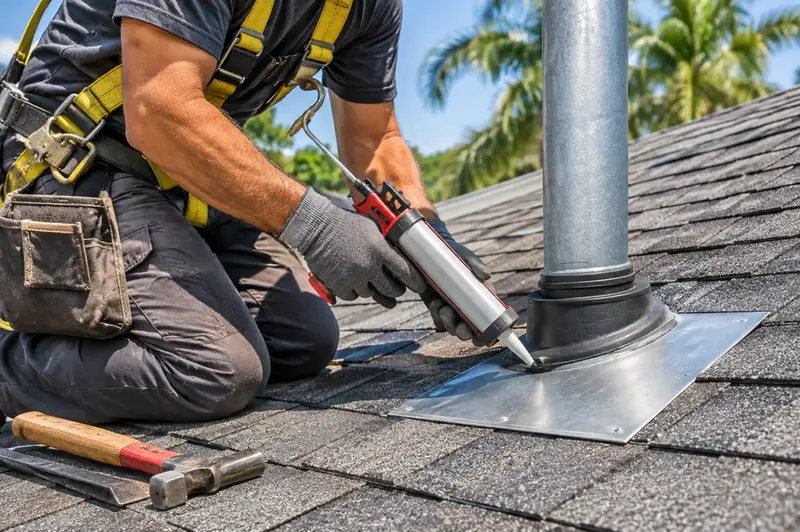
- A failed rubber collar on an otherwise intact plumbing vent pipe boot.
- A dislodged piece of step flashing around a skylight caused by faulty initial installation.
In contrast, systemic failure indicates that the entire protective envelope has lost its physical integrity. If you observe any of the following "three-strike" indicators, additional patching will only delay an inevitable complete failure while compounding hidden water damage:
- Multi-Slope Leaks: Leaks manifesting simultaneously or consecutively on completely different roof slopes (e.g., east-facing garage and west-facing master bedroom) indicate sitewide underlayment failure rather than a single flashing defect.
- Widespread Granule Loss and Bald Shingles: Mineral granules protect asphalt shingles from solar UV degradation. When you find gutters packed with granules, or observe dark, shiny asphalt patches exposed across multiple courses, the shingle's weatherproofing layer has eroded down to the fiberglass substrate.
- Failed Shingle Brittleness (The 45-Degree Bend Test): When a roofer lifts a shingle tab to replace an adjacent damaged piece and the tab snaps or cracks along the top fold instead of bending smoothly, the shingles have lost their essential elastomeric plasticizers. Once shingles reach this brittle state, repairing one shingle inevitably damages three adjoining shingles, triggering a cascading chain reaction of leaks.
- Widespread Deck Sponginess: If walking across the roof reveals soft, flexing, or spongy plywood beneath your feet, chronic unaddressed moisture intrusion has delaminated the wood sheathing over wide areas, destroying nail-holding holding power.
The 50 Percent Rule of Cumulative Repair Cost
A commonly discussed homeowner budgeting heuristic (not a formal code or industry rule): if the projected cost of your upcoming repair, combined with all repair expenses incurred over the preceding 24 months, exceeds 30 to 50 percent of the total cost of a new roof, replacing the roof immediately yields a higher net return on investment by halting ongoing interior damage and capturing wind mitigation insurance credits.
Florida's 25% Rule: Statutory Changes Under Senate Bill 4-D
Historically, Florida homeowners and contractors were governed by a strict "25 percent rule" embedded in the Florida Building Code: if more than 25 percent of a roof surface was repaired or replaced within any 12-month period, the entire roof was legally mandated to be torn off and replaced to current building code standards.
In May 2022, the Florida Legislature enacted landmark reforms through Senate Bill 4-D, codified in Florida Statute Section 553.844(5). This critical statute modified the building code requirements for existing residential roofs:
Florida Statute s. 553.844(5) Roof Repair Exception
Under current Florida law, if an existing roof or roof section was permitted, built, or replaced in compliance with the 2007 Florida Building Code or any subsequent code edition, repairing or replacing 25 percent or more of that roof does not automatically trigger a mandatory total roof replacement. Instead, only the repaired or replaced portion is required to meet the current Florida Building Code standards.
However, there is a vital caveat: if your home was built prior to March 1, 2009 (the effective date of the 2007 FBC) and has never had a fully permitted roof replacement since that date, your roof may not qualify for this statutory exemption. In those cases, any repair exceeding 25 percent of the roof surface area still legally mandates a complete tear-off and replacement. Consulting an experienced licensed contractor ensures you navigate local municipal permitting rules accurately without violating state building statutes.
| Evaluation Factor | Strong Candidate for Targeted Repair | Mandatory Threshold for Full Replacement |
|---|---|---|
| Roof Age (Architectural Shingles) | Under 10 to 12 Years old | Over 15 to 18 Years old (Approaching maximum Florida lifespan) |
| Leak Frequency | 1 isolated leak event in 3+ years | 3 or more separate leaks within a 24-month rolling period |
| Repair Scope vs. Total Surface | Less than 10% of a single roof slope | Exceeds 25% of surface area, or multiple slopes involved |
| Shingle Flexibility | Supple; bends to 45 degrees without fracture | Brittle; cracks or tears when lifted to slide new step flashing |
| Structural Deck Condition | Firm, sound OSB or plywood throughout | Spongy, sagging decking; widespread dry rot on truss chords |
| Homeowners Insurance Status | Active policy renewal confirmed without underwriting caveats | Threat of non-renewal; 4-point inspection flags <3 years useful life |
| Wind Mitigation Credits | Current mitigation discounts locked in | Qualifies for thousands in insurance premium savings with new roof |
The Insurance Pressure: Florida Statute s. 627.7011 and 4-Point Audits
In Florida's property casualty insurance market, you might want to nurse your roof through another two years of patching, but your insurance carrier may have a completely different opinion. Under Florida Statute s. 627.7011, insurance carriers are generally prohibited from refusing to issue or renew a homeowners insurance policy solely because of roof age if the roof is under 15 years old.
However, once a roof reaches 15 years of age, insurers are legally permitted to mandate an authorized roof inspection (such as a Citizens-standard 4-Point Inspection) before binding coverage or renewing your policy. If the licensed inspector documents visible deterioration—such as cupping, curling, heavy granule erosion, exposed fiberglass matting, or previous unpermitted patch jobs—the carrier will issue a formal Notice of Non-Renewal. Under s. 627.7011, the only way to retain coverage on a 15+ year-old roof is if the inspection report certifies that the roof has at least 5 years of useful life remaining.
If your roof is already leaking repeatedly, no certified inspector can truthfully sign off on 5 years of remaining useful life. Investing several thousand dollars into localized patching when your carrier is about to demand a complete replacement within 60 days is a costly strategic error. Executing a comprehensive roof replacement not only eliminates leaks permanently but secures the required roofing documentation that protects your policy from sudden cancellation.
Neighborhood Roofing Realities in Lake Mary and Heathrow
Throughout master-planned residential communities in Lake Mary, FL, such as Heathrow, Timacuan, and Magnolia Plantation, thousands of executive homes constructed between 1995 and 2008 are currently reaching the outer boundary of their initial or secondary roof lifespans. These subdivisions are characterized by mature oak canopies, shaded roof valleys that retain morning moisture, and strict Homeowners Association (HOA) architectural guidelines regarding color, material uniformity, and curb appeal.
When an aging roof in an HOA community is patched repeatedly, mismatched shingle dye lots and patchy tar repairs create an unsightly, patchwork aesthetic that frequently triggers neighborhood architectural code violations. For Lake Mary property owners evaluating whether to proceed with another patch or invest in a full roof replacement in Lake Mary, FL, replacing the entire roof with modern Class 4 impact-resistant architectural shingles or standing-seam Galvalume metal permanently resolves HOA aesthetic compliance while substantially lowering annual homeowner insurance premiums.
The Hidden Costs of Delaying a Necessary Replacement
Homeowners who delay a necessary roof replacement to save short-term capital almost always pay significantly more in the long run. The direct cost of the new roofing material is only one part of the financial equation. Chronic unaddressed leaks create insidious secondary damages:
- Structural Truss and Rafter Decay: Water trickling down rafter tails rots the structural fascia and truss gusset plates, requiring expensive carpentry sistering during the eventual replacement.
- Blown-in Insulation Saturation: Wet fiberglass or cellulose attic insulation loses its thermal resistance (R-value), driving up monthly Duke Energy or FPL electric bills while serving as an incubation sponge for mold.
- Ceiling and Wall Drywall Demolition: Chronic leaks destroy textured drywall ceilings, crown molding, and hardwood flooring, transforming a simple exterior roofing job into a disruptive interior remodeling project.
- Loss of Deck Nail-Holding Capacity: Rotted plywood decking will not hold roofing fasteners securely, meaning Florida Building Code compliance will require tearing off dozens of full plywood sheets at significant per-sheet replacement rates.
Frequently Asked Questions About Roof Repair vs. Replacement
More than two or three leak repairs within a 24-month span strongly indicates that your roof has reached the end of its serviceable life. When leaks emerge in distinct locations across different slopes, patching becomes an expensive cycle that fails to address widespread membrane deterioration.
Under Florida Statute s. 553.844(5) (enacted via SB 4-D in 2022), if an existing roof was built or replaced under the 2007 Florida Building Code or newer, repairing 25% or more of that roof does not force a total replacement; only the repaired section must meet current code. However, older roofs built prior to 2009 without subsequent reroofs still risk mandatory total replacement.
Yes, significantly in many cases. Replacing an aging roof allows your contractor to re-nail the deck with 8d ring-shank nails, install a code-compliant secondary water barrier (sealed roof deck), and verify Class F/H wind-rated coverings on a certified Wind Mitigation Inspection Form (OIR-B1-1802), earning substantial annual wind mitigation discounts.
A professional roofer conducts a gentle manual bend test. If lifting a shingle tab to a 45-degree angle to slip in a new fastener causes the asphalt mat to crack, snap, or crease across the top edge, the shingles are too brittle for repair. Attempting to patch brittle shingles causes more leaks than it solves.
Under Florida Statute s. 627.7011, carriers cannot deny coverage solely for age if the roof is under 15 years old. For roofs 15 years or older, you have the right to provide an inspection showing 5 or more years of useful life remaining; however, if the roof shows visible signs of failure or leaks, the carrier can legally issue a non-renewal notice.
Related Central Florida Roofing Guides: Continue reading Chimney Flashing Leaks: Why Flashing Fails in Florida and Roof Repair in the Rain: What Emergency Crews Do.