
Flat Roofing in Orlando, FL
Flat and low-slope roofs do not shed water the way a pitched roof does, so drainage, seams, and membrane quality decide everything. Orlando Roofing Crew connects Orlando property owners with licensed local crews for flat roof repair, re-roofing, and maintenance, on homes, additions, lanais, and commercial buildings.
How Flat Roofs Work, and Why They Fail Differently
A 'flat' roof is not flat. It is a low-slope roof designed to move water slowly to drains, scuppers, or edges.
On a pitched roof, gravity moves water off quickly and the roofing overlaps like fish scales. A low-slope roof relies on a continuous waterproof membrane instead, with seams that have to be sealed, and a slight slope and drainage to carry water away. Because water moves slowly and sits longer, the membrane, seams, flashing, and drains do far more work than their pitched-roof equivalents, and small failures show up as leaks quickly.
In Central Florida, flat and low-slope roofs are common on commercial buildings, on lanais and porches, over additions and garages, and on some modern-style homes. They face the same sun, heat, and heavy downpours as every other roof, but with less margin for error. Intense UV and heat degrade membranes and sealants, and a drain clogged with oak leaves or palm debris before an afternoon storm can mean standing water within minutes.
| Roof feature | Pitched roof | Flat or low-slope roof |
|---|---|---|
| Water movement | Sheds quickly by gravity | Moves slowly; relies on slope, drains, scuppers |
| Waterproofing | Overlapping shingles, tile, or metal over underlayment | Continuous membrane with sealed seams |
| Most common leak points | Flashing, penetrations, valleys | Seams, flashing at walls and curbs, drains, ponding areas |
| Impact of clogged drains | Minor | Serious: ponding, overload, leaks |
| Maintenance sensitivity | Moderate | High: debris, drains, and seams need regular attention |
Common Flat Roof Problems in Central Florida
Ponding Water
Water that remains on the roof for a day or two after rain stresses the membrane and seams. A commonly used industry definition of ponding is water that remains for 48 hours after rain. See ponding water on flat roofs.
UV and Heat Wear
Constant sun and heat break down membranes, sealants, and coatings over time, causing chalking, cracking, and shrinkage.
Seam and Flashing Failures
Seams, wall flashings, curbs, and penetrations are the most common leak points on a low-slope roof.
Wind and Debris Damage
Storms can lift membrane edges, tear flashing, and puncture the surface with debris.
Blisters and Splits
Trapped moisture or air forms blisters. Blisters that split admit water.
Clogged Drains and Scuppers
Leaves, palm fronds, and debris block drains. Standing water follows.
TPO, PVC, Modified Bitumen, Built-Up and More
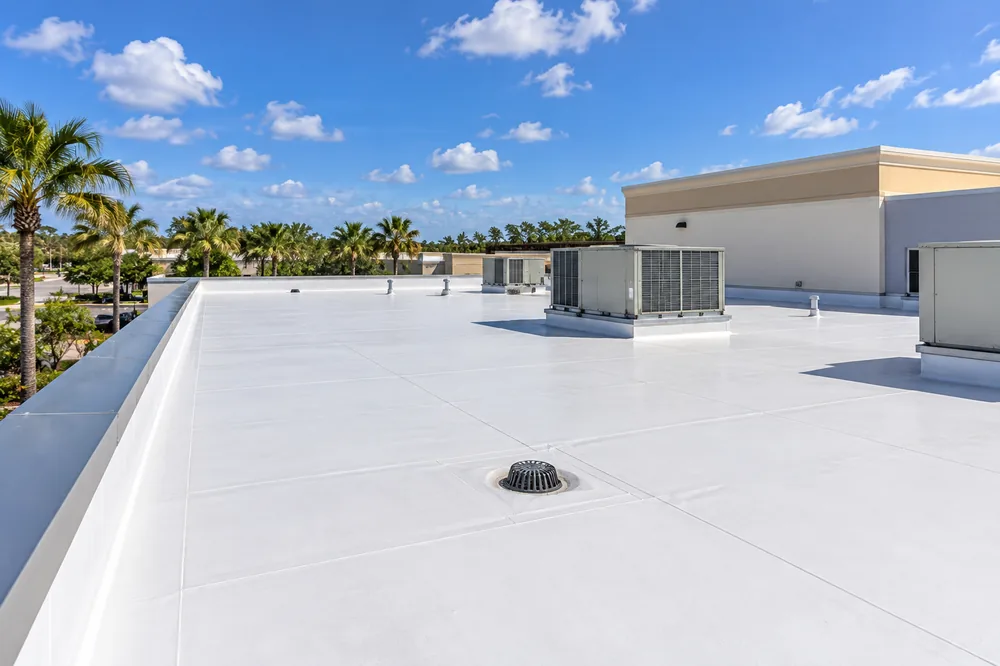
TPO and PVC Single-Ply
White, heat-reflective membranes with heat-welded seams. TPO is widely used on commercial roofs in Florida for its reflectivity and relatively straightforward repairs. PVC is similar and often chosen where chemical or grease exposure is a concern.
- Heat-welded seams
- Reflective surface reduces heat absorption
- Condition of seams and flashing drives long-term performance
Modified Bitumen & Built-Up
Layered asphalt-based systems with a long track record. Modified bitumen is often torch-, cold-, or self-applied in sheets, and built-up roofs add multiple plies and a surfacing layer.
- Multiple layers add redundancy
- Surfacing protects against UV
- Installation method affects fire safety requirements and cost
Lanai, Porch and Addition Roofs
Residential flat sections often use modified bitumen, TPO, or a roll-roofing system. They tend to be small, sit against walls, and have limited drainage, so wall flashing, drain details, and ponding matter most.
- Wall flashing against stucco and framing is the most common leak point
- Small roofs still need drainage planning
- Roof access and fastening affect cost
Ponding Water: When It Is Normal and When It Is Not
Not all standing water is a crisis, and some of it is.
Brief standing water after a heavy downpour is normal on a low-slope roof, because drainage takes time. Water that is still there a day or two later is not. Persistent ponding speeds membrane wear, adds weight, supports algae and organic growth, and can signal structural deflection or inadequate slope. It also voids or limits some manufacturer warranties.
| Cause of ponding | Typical fix | Notes |
|---|---|---|
| Clogged drains, scuppers, or gutters | Clear and maintain; add strainers | The easiest and most common cause |
| Insufficient slope from the original design | Add tapered insulation, crickets, or additional drains | May require engineering and permits |
| Structural deflection | Evaluate the structure; correct framing or deck | A structural issue, not a roofing patch |
| Membrane settlement or insulation compression | Local repair or replacement of affected insulation | Wet insulation must be addressed |
Flat Roof Repair, Coating or Replacement
Repair or Coating Usually Works For
- Isolated seam or flashing failures
- Membranes in decent condition with surface wear
- Roofs with dry insulation and minimal moisture
Replacement Is More Likely When
- Insulation under the membrane is wet
- Water has been ponding for years
- Repairs and patches keep recurring
Coatings
A coating can extend a sound roof's life without a tear-off, but it cannot fix wet insulation or structural problems. See commercial roof coating.
Code Changes
The 9th Edition (2026) Florida Building Code, effective December 31, 2026, revises the reroofing provisions, including when tear-off is required and a few exceptions for reusing an adequate substrate. Your contractor should confirm which edition applies to your project.
Flat Roof Membranes Compared
Each system has strengths and trade-offs. The right one depends on the building, the budget, and what happens on the roof.
| System | Strengths | Trade-offs | Often chosen for |
|---|---|---|---|
| TPO | Reflective, heat-welded seams, widely available, relatively simple repairs | Quality varies by manufacturer; seam and flashing workmanship matters | Commercial roofs, large low-slope roofs |
| PVC | Heat-welded seams, good chemical and grease resistance | Typically costs more than TPO | Restaurants and buildings with exhaust or chemical exposure |
| EPDM (rubber) | Long track record, flexible, simple repairs | Black surface absorbs heat unless coated or white; seams are adhesive-based; less common on new Florida commercial work | Some residential and older commercial roofs |
| Modified bitumen | Layered, rugged, long track record | Installation method affects fire safety and cost; heavier | Commercial and residential low-slope |
| Built-up roofing (BUR) | Multiple plies and a surfacing layer add redundancy | Heavy and labor-intensive; less common today | Older buildings and some commercial roofs |
| Spray foam with coating (SPF) | Seamless; adds insulation; coatable | Requires careful application and coating maintenance; weather-sensitive installation | Low-slope roofs where seamlessness matters |
A general comparison. The right system depends on the building and the manufacturer's requirements.
What a Good Flat Roof Installation Includes
With a membrane roof, the details are the roof.
- Tear-off or recover decision based on moisture evidence and code. Wet insulation should not be left in place.
- Deck inspection and repair. Deteriorated deck is replaced and fastened as required.
- Insulation and slope. Insulation, often tapered, creates drainage slope and adds thermal performance. Energy code requirements can apply to replacement roofs, so ask the contractor how they are met.
- Cover board where specified, to protect the membrane and improve durability.
- Membrane installation by the specified method: mechanically attached, adhered, or fully bonded, with seams welded or sealed to the manufacturer's requirements.
- Flashing, curbs, and penetrations detailed to the manufacturer's standard, since most leaks start here.
- Drains, scuppers, and edge metal installed or replaced so water leaves the roof and the edges resist wind.
- Inspection and warranty. Building department inspections, and manufacturer inspection where a manufacturer warranty applies.
How Leaks Are Found on a Flat Roof
On a low-slope roof, water can travel under the membrane and appear far from where it entered.
Because membranes are continuous, water that gets in at a puncture or open seam can run between layers before it finds a way down. A visible stain inside may be many feet from the entry point. Good crews combine several approaches:
- Visual inspection of seams, flashing, curbs, penetrations, drains, and surface damage.
- Interior tracing from the stain, looking at decking, insulation, and ceiling tiles from below.
- Moisture surveys. Infrared thermography, nuclear gauges, or capacitance meters can map wet insulation, with core cuts to confirm.
- Flood testing. Sections can be temporarily dammed and filled with water to find leaks, where the roof and structure can safely bear it.
- Electronic leak detection on some membranes, using electrical conductivity to find breaches in the surface.
None of these is magic, and the best result comes from combining them. A crew that offers a repair without explaining how it located the leak is guessing.
Flat Roofs on Homes: Lanais, Porches, Additions and Modern Designs
Residential flat roofs are small, which makes them easy to neglect and surprisingly consequential when they leak.
Many Central Florida homes have a flat or very low-slope section somewhere: a lanai or screened porch, a garage or room addition, a covered entry, or the main roof of a modern-style house. These areas often sit directly over living space or against stucco walls, so a failure shows up as interior damage quickly, and they are exactly the parts of the roof that get the least attention.
| Area | Typical issue | What to check |
|---|---|---|
| Lanai or screen enclosure roof | Ponding; leaks where the enclosure frame is attached; failed wall flashing | Drainage direction, frame attachment points, wall flashing against stucco |
| Garage or room addition | Seam failure where the addition meets the main house; flashing at the tie-in | The transition between flat and pitched roofs |
| Covered entry or porch | Small area with limited drainage; debris | Scuppers or gutters and surface condition |
| Modern-style flat roof | Parapet flashing, scuppers and drains, ponding | Roof drainage design and membrane condition |
- Wall flashing against stucco is the most common leak point, because stucco and flashing move differently and sealants age
- A small roof still needs drainage planning; ponding on a lanai roof is common and fixable
- Match the repair method to the existing membrane. Mixing incompatible materials causes failures
- Interior stains under a flat section deserve prompt attention, since water can run along the deck before it shows
Storms, Wind, and Insurance on Flat Roofs
Flat roofs face their own storm risks, and their own claim questions.
- Wind uplift at edges and corners. Edge metal and perimeter attachment are where membranes fail first in high wind.
- Debris and punctures. Limbs and airborne debris puncture membranes; punctures are fixed by patching, and the area is inspected for wet insulation.
- Drains during heavy rain. A clogged drain turns a downpour into a pool on the roof; keep drains clear before storms.
- Claims. After a storm, document damage and report it promptly. Under SB 2-A (2022), a new or reopened claim must be reported within one year of the date of loss and a supplemental claim within 18 months. Flat and low-slope roofs on older buildings may be subject to depreciation or roof-age conditions in the policy.
- Contractors and claims. A contractor cannot waive your deductible or negotiate your claim. See storm damage and insurance claims.
What Drives the Cost of Flat Roof Work in Orlando
| Cost factor | How it changes the price |
|---|---|
| Repair, coating, or replacement | Repairs cost the least; replacement the most. A coating sits between, if the roof qualifies. |
| System and thickness | TPO, PVC, modified bitumen, and SPF have different material and labor costs. |
| Insulation and slope | Tapered insulation and insulation thickness change both cost and performance. |
| Roof size and access | Larger roofs spread fixed costs; tight access and height add labor. |
| Penetrations and equipment | Each curb, vent, and unit adds flashing and labor. |
| Deck and moisture condition | Wet insulation or deteriorated deck adds scope. |
| Warranty level | Manufacturer system warranties cost more and have requirements. |
Published cost guides give wide ranges for Florida flat roofs depending on system and insulation. Because the range is so wide, and because your roof's scope is specific, we do not publish a figure. A written, itemized estimate after an inspection is the useful number.
Choosing a Flat Roofing Contractor
Flat roof installation is a specialty with real consequences.
- Verify the license at MyFloridaLicense.com. A Certified Roofing Contractor (CCC) is licensed statewide; a Registered Roofing Contractor (RC) only in a local jurisdiction.
- Ask about manufacturer certification if a manufacturer warranty matters.
- Ask for the moisture evidence before any coating or recover.
- Compare line by line: system, thickness, insulation, attachment, flashing, drains, and warranty.
- Get insurance proof and a written contract with payment terms.
- Understand Florida's down payment rule. Under section 489.126, a contractor taking more than 10 percent up front must apply for the permit within 30 days and start work within 90 days of permitting. Large deposits remain a risk.
Sources & Verification
Facts on this page were checked against the sources below in October 2026. Laws, codes, and program rules change, so confirm current details with the agency before you rely on them.
Permits, Inspections, and the 25% Rule on a Flat Roof
Flat roofs are permitted work like any other roof.
Replacing a flat roof generally requires a permit and inspections through the local building department. In the City of Orlando, the in-progress (dry-in) inspection applies to all residential and commercial re-roof projects, and the final inspection requires a completed affidavit verifying roof deck nailing and the secondary water barrier. Other jurisdictions have comparable requirements.
Florida's old 25% rule, which required bringing a whole roof section up to current code when more than 25% of it was repaired or replaced in a year, was changed by SB 4-D in 2022 (section 553.844(5), Florida Statutes) for roofs built, repaired, or replaced under the 2007 Florida Building Code or later. Older roofs may still be subject to the earlier rule. The building department decides for your address.
Sources & Verification
Facts on this page were checked against the sources below in October 2026. Laws, codes, and program rules change, so confirm current details with the agency before you rely on them.
Flat Roof Maintenance Checklist
Most flat roof failures are preventable with regular upkeep.
- Inspect twice a year and after storms, ideally before June 1.
- Clear drains, scuppers, and gutters of leaves, palm fronds, and debris, especially before the rainy season.
- Check seams and flashing, including wall and curb flashing and penetrations.
- Walk pads for equipment access protect the membrane from technician traffic.
- Watch for ponding, blisters, splits, and punctures.
- Keep trees trimmed so limbs do not scrape or puncture the roof.
- Document each visit with photos for warranties, insurers, and future planning.
Where to Go Next
Related Services
Flat Roofing Across Orlando & Central Florida
Flat roof work is dispatched across Orlando and surrounding commercial and residential areas.
Flat Roofing FAQs
It depends on the system, installation, and maintenance. Florida sun and heat are hard on membranes, which is why inspections and upkeep matter.
Seams and flashings are the most common failure points, from movement, UV, and age.
Brief drainage after rain is normal. Water that lingers for days is a problem. See ponding water.
Sometimes, if the membrane and insulation are sound and dry. An inspection determines whether a coating is a viable option. See cool roof coatings and Florida summer heat for what coatings do and do not do.
Yes, including additions, porches, and lanais.
Generally yes. Your contractor handles it, and in the City of Orlando that includes a dry-in inspection and a final inspection with an affidavit.
It depends on the building and use. See TPO vs. EPDM vs. modified bitumen.
At least once a year and after major storms. See inspection frequency.
Wet insulation does not dry reliably and usually pushes the decision toward replacement of the affected area.
It depends on the governing documents or lease. Check them before ordering work.
Get a Flat Roof Assessment
A free inspection checks drainage, seams, and membrane condition and gives you a written scope.
Orlando Roofing Crew connects property owners with vetted, independently licensed and insured Florida roofing contractors. Inspections, repairs, and workmanship warranties are provided directly by the independent licensed contractor assigned to your property.
Request a Free Inspection
A local specialist inspects your roof and gives you a written scope. No obligation.