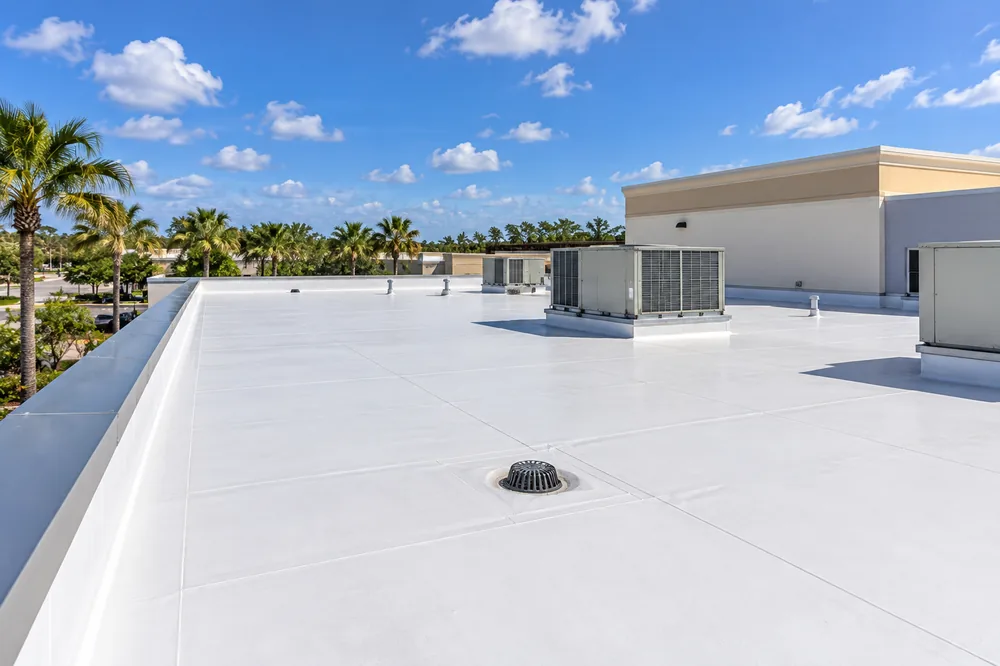
How often should a commercial flat roof be inspected? See why Orlando owners check before hurricane season to protect warranties. Call (689) 359-5257.
Commercial flat roofs in Florida must be professionally inspected at least twice annually—once in late spring prior to the Atlantic hurricane season and once in late autumn following storm season—along with mandatory post-severe weather assessments. This semi-annual schedule satisfies manufacturer No Dollar Limit (NDL) warranty mandates, catches micro-fissures and seam delamination before interior water intrusion occurs, and protects commercial property portfolios across Central Florida from expensive structural insulation saturation.
The Standard Commercial Inspection Cadence: Spring, Autumn, and Post-Storm Events
Low-slope commercial roofs represent one of the largest capital assets on any commercial balance sheet, yet they remain largely out of sight until water drips onto retail merchandise, office workstations, or industrial manufacturing lines. Unlike steep-slope residential shingle roofs where water drains instantly, a low-slope roof functions as a complex hydraulic basin that manages millions of gallons of rainwater annually.
The National Roofing Contractors Association (NRCA) and leading commercial membrane manufacturers establish a strict baseline cadence:
- Late Spring (Pre-Hurricane Season Audit): Conducted in April or May, this comprehensive evaluation prepares the facility for the June 1 start of the Atlantic hurricane season. Technicians inspect the entire perimeter edge metal for secure attachment, clean all primary drains and scuppers, evaluate expansion joints, and repair any winter seam stress to ensure the building envelope can withstand 130+ mph wind uplift forces.
- Late Autumn (Post-Hurricane Season Audit): Conducted in November or December, this inspection assesses the cumulative physical toll of Florida's summer convective thunderstorm cycle, intense ultraviolet solar degradation, and any tropical storm winds. Inspectors identify micro-tears from wind-borne debris, drain blockages caused by decaying organic silt, and thermal fatigue at rooftop mechanical curbs.
- Post-Severe Weather Triggers: In addition to scheduled semi-annual visits, a documented walkthrough must occur immediately following any severe storm event involving sustained winds exceeding 50 mph, nearby tornado activity, hail, or torrential cloudbursts that overwhelm municipal stormwater systems.
For commercial building owners in Winter Park managing professional suites, retail plazas, or corporate offices, maintaining this cadence is essential for identifying developing leaks while they remain inexpensive surface repairs rather than structural emergencies.
Central Florida Climate Stressors That Accelerate Commercial Membrane Aging
Commercial flat roofs in Central Florida age at more than double the rate of roofs in temperate northern climates. The primary engineering driver is severe thermal cycling combined with intense ultraviolet (UV) radiation.
On an average July afternoon in Orlando, an unshaded roof surface absorbs intense solar radiation, heating membranes to between 110°F (for white TPO) and 180°F (for black EPDM or un-granulated asphalt). When a sudden afternoon thunderstorm rolls across the Florida peninsula, ambient temperatures plummet by 20°F to 30°F in minutes, and cold rainwater drenches the superheated membrane. This rapid thermal shock causes dramatic contraction of the membrane sheet, placing massive shear and tensile loads on adhesive lap seams, metal termination bars, and perimeter fasteners.
Furthermore, Central Florida receives an average of 52 inches of rainfall annually, much of it concentrated in short, high-intensity convective squalls. Any slight deflection in the structural steel bar joists, minor settlement of perimeter masonry walls, or blockage in internal roof drains leads to persistent ponding water. Standing water accelerates chemical breakdown of single-ply plasticizers, supports aggressive biological vegetation growth, and creates hydrostatic pressure that forces water through microscopic pinholes that would never leak on a dry or properly sloped surface.
The 10-Point Technical Commercial Roof Inspection Protocol
A professional commercial roof inspection goes far beyond a casual rooftop glance. Certified commercial roof inspectors follow a rigorous, 10-point diagnostic protocol to evaluate every layer of the building envelope:
- Field Membrane Integrity: Inspecting the continuous field sheet for mechanical punctures, abrasions from loose hardware, chemical softening from HVAC compressor oils, bird pecking, and membrane crazing or cracking.
- Seam and Lap Probing: Utilizing a rounded mechanical seam probe tool to physically test every linear foot of welded or taped laps, detecting unbonded cold welds or micro-separations before water can enter.
- Perimeter Copings and Edge Metal: Examining parapet wall coping caps, continuous cleats, and gravel stops for loose fasteners, failing lap sealant, and compliance with ANSI/SPRI/FM 4435/ES-1 wind resistance standards.
- Mechanical Curbs and Penetration Flashings: Auditing HVAC rooftop package units, exhaust fans, electrical conduits, gas lines, and skylights. Technicians verify that base flashings extend a minimum of 8 inches above the finished roof plane and inspect pitch pockets for cracked or shrunken pourable sealer.
- Primary Internal Drains and Sumps: Checking clamping rings, under-deck drain bowls, hardware bolts, and cast-iron or polypropylene strainer domes. Ensuring drain bowls sit below the finished membrane plane without restrictive debris buildup.
- Secondary Overflow Scuppers and Collectors: Inspecting through-wall emergency scupper openings to ensure they remain clear of tar, debris, or nesting animals, verifying compliant secondary drainage per Florida Building Code Section 1503.4.
- Expansion Joints and Structural Dividers: Evaluating flexible bellows, neoprene covers, and metal counterflashings designed to accommodate differential thermal movement and building settling.
- Fastener and Stress Plate Anchorage: Checking mechanically attached roofs for loose or "backed-out" fasteners where steel screws have worked loose from steel decking or wood purlins, protruding beneath the membrane like tent poles.
- Rooftop Walkway Pads and Traffic Areas: Checking the adhesion and condition of dedicated walkway rolls around service access hatches, HVAC service doors, and high-traffic pathways.
- Interior Deck and Plenum Inspection: Accessing the building interior, drop ceilings, and structural joists to inspect for water staining, active drips, rust scale on metal decking, or efflorescence on poured concrete decks.
Specifying this thorough audit across your portfolio of commercial roofing assets transforms subjective facility assessments into objective, actionable engineering reports.
Non-Destructive Moisture Diagnostics: Infrared Thermography and Electronic Leak Detection
When visual inspections identify suspect areas or unexplained interior water staining, commercial roofing specialists employ non-destructive testing (NDT) to map subsurface moisture without cutting into the roof.
Infrared (IR) Thermography: Infrared aerial or handheld surveys operate on the thermodynamic principle of thermal capacitance. Dry polyisocyanurate roof insulation has a low thermal mass and cools rapidly once the sun sets. In contrast, wet insulation saturated by trapped water retains heat significantly longer. By scanning the roof with high-resolution Forward Looking Infrared (FLIR) cameras 1 to 2 hours after sunset, inspectors capture striking thermal images where wet insulation glows bright yellow and orange against the dark purple of dry insulation. This allows property managers to excise and replace only the localized wet areas during re-roofing or repairs, saving tens of thousands of dollars.
Electronic Leak Detection (ELD): For single-ply TPO, PVC, and EPDM assemblies, low-voltage and high-voltage ELD testing per ASTM D7877 and ASTM D8231 delivers pinpoint accuracy. Because single-ply membranes are electrically non-conductive and the building structure is grounded, applying a low-voltage electrical potential across a wet roof surface creates an electric circuit wherever water bridges a membrane puncture to the grounded deck. Technicians follow the electrical current vector directly to pinhole breaches smaller than the tip of a pencil.
Commercial Flat Roof Inspection Checklist & Diagnostic Thresholds
The following technical matrix outlines the key components, diagnostic tools, and actionable thresholds utilized during commercial flat roof evaluations in Florida:
| Roof Component | Diagnostic Method | Standard Acceptance Criteria | Actionable Failure Threshold |
|---|---|---|---|
| Membrane Field | Visual & Tactile Survey | Uniform thickness, no punctures | Cuts, gouges, chemical softening |
| Membrane Seams | Mechanical Seam Probe | 100% monolithic fusion/bond | Any probe insertion > 1/8 inch |
| Subsurface Insulation | Infrared Thermography / Core Cut | 0% moisture content (dry polyiso) | Thermal anomaly confirmed wet (> 20%) |
| Parapet Coping | Physical Load / Torque Test | ANSI/SPRI/FM ES-1 compliant attachment | Loose cleats, missing screws, open joints |
| Internal Roof Drains | Clamping Ring & Flow Audit | Secure bolts, clean strainer dome | Cracked bowl, loose ring, standing debris |
| Penetration Flashings | Visual & Sealant Probe | Minimum 8-inch vertical rise | Curbed flashings < 8 in, dried pitch pocket |
| Fastener Stability | Tactile Sweep across Seams | Flush seating against stress plate | Backed-out screws protruding under sheet |
| Drainage Slope | Digital Level & 48-Hr Rain Test | Positive slope >= 1/4 in per foot | Ponding water remaining > 48 hours |
Protecting Manufacturer NDL Warranties and Insurance Claim Eligibility
One of the most dangerous misconceptions held by commercial property managers is that a 20- or 25-year manufacturer No Dollar Limit (NDL) warranty acts as an unconditional maintenance-free guarantee. Every commercial warranty issued by major manufacturers—including Carlisle SynTec, GAF Commercial, Johns Manville, and Elevate—contains explicit owner responsibility clauses.
These contracts legally require the building owner to exercise reasonable care and maintain documented semi-annual inspections and clean drainage waterways. If a leak develops and an authorized manufacturer field inspector discovers that the roof drain was choked with silt or that unauthorized HVAC technicians dragged equipment across the membrane, the manufacturer has legal standing to deny the warranty claim. The owner is then forced to pay for interior tenant repairs and membrane restoration entirely out of operational funds.
Furthermore, following a hurricane or declared windstorm disaster, commercial property insurance carriers require proof that roof failure resulted directly from storm perils rather than pre-existing wear, tear, or deferred maintenance. Maintaining a continuous, timestamped binder of professional inspection reports establishes legal proof that the roof was fully intact and watertight prior to the storm, dramatically streamlining insurance claim settlements.
Commercial Asset Management for Professional and Retail Centers
For organizations operating retail strip centers, medical plazas, and corporate office complexes utilizing commercial roofing in Winter Park, roof inspections serve an additional financial role: preventing tenant lease disputes. A single roof leak above a medical suite can destroy hundred-thousand-dollar diagnostic machines, contaminate sterile environments, and trigger constructive eviction claims under Florida commercial leasing law.
By synchronizing semi-annual roof inspections with tenant HVAC maintenance schedules, facility directors can identify whether rooftop leaks originate from roofing membrane failure or leaking HVAC condensate drain pans and unsealed ductwork—protecting property managers from unjust repair expenses.
Establishing a Comprehensive Digital Roof Asset Management Log
The output of every commercial inspection should be compiled into a digital Roof Asset Management Log. This dynamic document includes:
- An aerial CAD roof plan clearly demarcating roof sections, square footage, membrane type, and installation dates.
- High-resolution, timestamped photographs of all inspected roof elements, penetrations, and identified deficiencies.
- Detailed logs of all rooftop service work performed by third-party mechanical, electrical, and plumbing contractors.
- Manufacturer warranty certificates, serial numbers, and certified contractor contact information.
- Historical repair receipts and warranty transfer documentation.
When commercial properties are bought, sold, or refinanced, a clean, multi-year Roof Asset Management Log provides immediate credibility during buyer due diligence, preventing aggressive capital expenditure price re-trades.
Frequently Asked Questions About Commercial Flat Roof Inspections
While the Florida Building Code primarily governs new construction and re-roofing permitting, institutional standards (such as the NRCA, ASTM, and manufacturer warranty guidelines) dictate professional inspections at least twice per year: in late spring before hurricane season and in late autumn after storm season. In addition, post-storm walkthroughs are required whenever severe weather or winds exceeding 50 mph impact the building.
Neglecting documented semi-annual inspections can invalidate your manufacturer No Dollar Limit (NDL) warranty. Commercial warranty covenants explicitly mandate that building owners perform periodic preventive maintenance and maintain free-flowing drainage. If a leak occurs due to ponding water from clogged drains or unaddressed puncture wear, the manufacturer can formally reject warranty coverage, leaving the owner fully liable for all repair expenses.
Infrared roof thermography takes advantage of thermal mass differences. Dry polyisocyanurate roof insulation releases heat rapidly after sunset, while water-saturated insulation retains absorbed solar heat for several hours. By scanning the roof surface with high-resolution FLIR cameras during twilight cooling, wet insulation glows brightly as thermal anomalies, allowing technicians to map the precise boundaries of wet subsurface decking without destructive demolition.
In-house maintenance personnel can perform routine monthly debris clearing and drain checks, but official semi-annual inspections should be conducted by a licensed Florida commercial roofing contractor or certified roof consultant. Certified professionals possess specialized diagnostic tools (such as mechanical seam probes and thermal imagers) and factory certifications required to sign off on warranty compliance documents and insurance condition reports.
Over 80% of flat roof leaks originate at flashings and penetrations rather than within the open field membrane. The most common failure points include dried or shrunken pitch pocket sealants, unsealed mechanical equipment curbs, deteriorating parapet wall coping seams, clogged drain bowls causing chronic ponding water, and puncture tears inflicted by third-party HVAC technicians walking across unprotected membrane sheets.
Related Central Florida Roofing Guides: Continue reading TPO vs. EPDM vs. Mod-Bit for Florida Flat Roofs and Commercial Roof Leak Liability for Property Managers.