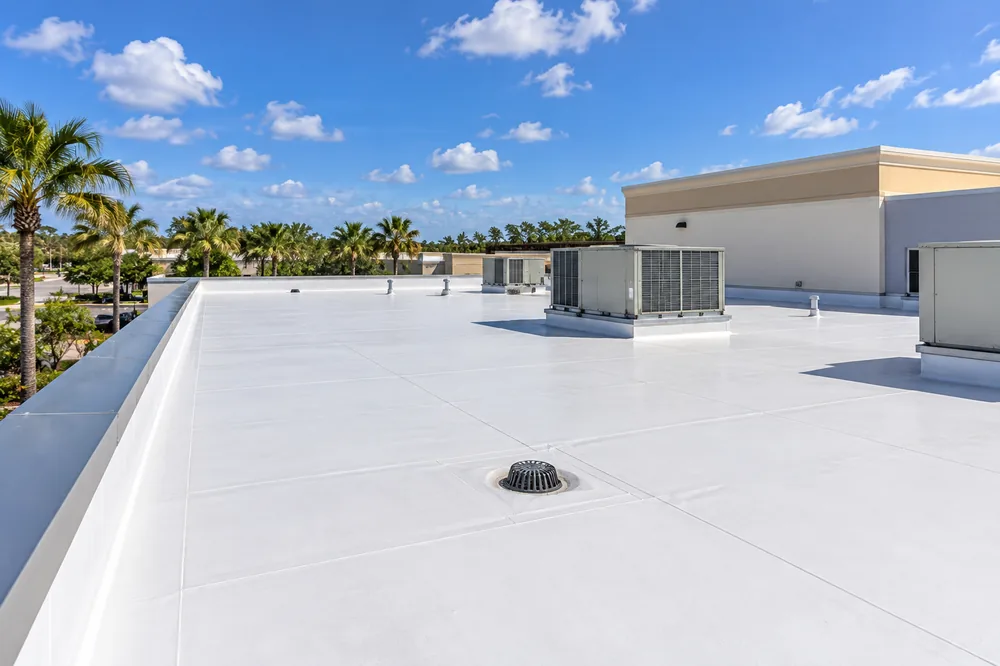
TPO, EPDM or modified bitumen for your Florida flat roof? Compare UV reflectivity, seams and uplift performance before you bid. Call (689) 359-5257.
For commercial flat roofs in Central Florida, Thermoplastic Polyolefin (TPO) is the superior overall membrane system due to its high solar reflectance (SRI > 100) and hot-air welded monolithic seams that withstand relentless thermal expansion and subtropical deluges. While Ethylene Propylene Diene Monomer (EPDM) synthetic rubber excels in freeze-thaw northern climates and multi-ply Modified Bitumen provides outstanding puncture resistance for high-traffic industrial decks, TPO delivers the optimal balance of rooftop cooling efficiency, hurricane wind uplift resistance, and chemical durability for Orlando area commercial properties.
Core Membrane Chemistries: Thermoplastic, Thermoset, and Asphaltic Formulations
Selecting the appropriate commercial roof membrane requires a precise understanding of polymer chemistry and how different materials react to atmospheric forces. Flat and low-slope roofs across Central Florida do not shed water through gravitational pitch alone; they function as continuous waterproof basins engineered to endure standing water, intense solar radiation, and extreme barometric pressure differentials.
Commercial membranes fall into three distinct chemical families:
- Thermoplastic Polyolefin (TPO) per ASTM D6878: TPO is a single-ply elastomeric blend combining polypropylene (a rigid thermoplastic polymer) and ethylene-propylene rubber, reinforced internally with a heavy polyester scrim. Because it is thermoplastic, TPO can be repeatedly melted and reformed, enabling high-temperature fusion welding of seams without chemical adhesives.
- Ethylene Propylene Diene Monomer (EPDM) per ASTM D4637: EPDM is a cross-linked thermoset synthetic rubber membrane. Once vulcanized during factory curing, its polymer chains form permanent cross-links that cannot be melted or heat-welded. Field seams must be joined using liquid primers and specialized double-sided butyl bonding tapes.
- Polymer-Modified Bitumen per ASTM D6162, D6163, and D6164: Modified bitumen evolved from traditional multi-ply built-up roofing (BUR). It infuses asphalt with modifying polymers—either atactic polypropylene (APP) for a plasticized, torch-applied sheet, or styrene-butadiene-styrene (SBS) for a rubberized, flexible sheet installed using cold adhesives or hot asphalt mopping. Modified bitumen systems are installed in multiple plies (typically a base ply followed by a granulated mineral cap sheet).
Understanding these chemical foundations explains why each membrane performs radically differently when exposed to the intense heat and severe storm seasons typical of Florida commercial construction.
Central Florida Solar Radiation: Surface Temperatures and Thermal Load Dynamics
Orlando commercial buildings experience more than 2,800 hours of intense sunshine annually. The thermodynamic impact of this radiation depends heavily on a membrane's Solar Reflectance Index (SRI), a composite metric defined under ASTM E1980 that incorporates both solar reflectance and thermal emittance.
A standard black EPDM membrane possesses a very low SRI of approximately 9. On a standard 95°F summer afternoon in Orange County, the surface temperature of a black EPDM roof frequently climbs to between 165°F and 180°F. This extreme heat creates two major problems for facility managers: first, it conducts immense thermal energy through the roof deck into the plenum space, forcing commercial rooftop HVAC units to work continuously under severe head pressure; second, it accelerates the thermal degradation of underlying polyisocyanurate insulation boards and adhesive compounds.
In contrast, standard white 60-mil TPO boasts an initial SRI of 100 to 110, reflecting more than 78% of incoming solar radiation back into the atmosphere. Under identical midday solar intensity, a white TPO roof remains at 100°F to 110°F—scarcely warmer than ambient air temperatures. For developers managing high-occupancy commercial properties in Lake Nona, this 60°F to 70°F reduction in surface temperature directly translates to measurable utility bill savings and substantially reduced mechanical wear on packaged chiller plants.
Modified bitumen with a standard ceramic granule surface provides an intermediate SRI ranging between 25 and 35, resulting in surface temperatures around 140°F to 150°F. While "cool roof" granulated cap sheets and bright-white elastomeric coatings can elevate modified bitumen's SRI above 70, single-ply white TPO remains the standard for solar reflectance without requiring secondary reflective topcoats.
Seam Integrity Under Subtropical Rainstorms: Molecular Welds vs. Chemical Adhesives
Seam construction represents the single greatest point of vulnerability in low-slope commercial roofing. While rain runs off a steep-pitch shingle roof within seconds, flat roof assemblies must hold water during severe convective downpours where rainfall rates can exceed 3 to 4 inches per hour.
The seam technology of TPO is its greatest engineering advantage. Using automated robotic hot-air welders operating between 800°F and 1,000°F, certified roofing technicians heat the overlapping thermoplastic sheets until the opposing polymer surfaces liquefy. As weighted rollers compress the seam, the polymer chains interlock at the molecular level. Once cooled, the seam becomes a continuous, monolithic sheet with seam peel strength exceeding 50 pounds per linear inch per ASTM D6878—making the seam physically stronger and more tear-resistant than the surrounding membrane sheet itself.
EPDM relies entirely on chemical bonding tapes. While modern butyl-based tapes outperform historical liquid contact adhesives, they remain vulnerable to long-term degradation in subtropical environments. Prolonged heat, saturated humidity, and unavoidable micro-ponding near scuppers cause adhesive creep, plasticizer migration, and eventual edge curling. Over an 8- to 12-year window, EPDM lap seams frequently require manual probing, priming, and supplemental lap sealant applications to prevent capillary water intrusion.
Modified bitumen systems achieve strong seam bonds through melted bitumen flow (in torch-applied APP) or high-performance cold elastomeric adhesives (in SBS). However, modified bitumen requires overlapping joints every 36 to 39 inches across the entire roof expanse. Because a TPO roof uses 10- or 12-foot wide rolls, it reduces the total linear footage of roof seams by roughly 65% compared to modified bitumen, mathematically eliminating thousands of potential leak paths across a large warehouse or retail deck.
Mechanical Attachment vs. Fully Adhered Installation in High-Wind Zones
Wind uplift engineering in Central Florida is governed by strict building standards. Under the Florida Building Code 8th Edition (2023; in effect through Dec 31, 2026, when the 9th Edition takes effect) and ASCE 7-22 wind load criteria, commercial roof design wind speeds follow ASCE 7 maps by parcel and risk category, so confirm the figure for your building with the building department or design professional.
Contractors deploy two primary installation methods for TPO and EPDM:
- Mechanically Attached Systems: Heavy-duty barbed steel stress plates and roofing screws are driven through the edge of the membrane and underlying insulation into the structural deck (steel, wood, or poured concrete). The adjacent roll overlaps the fasteners and is hot-air welded. While cost-effective and rapid to install, mechanically attached membranes billow and flutter under hurricane-force uplift, concentrating massive stress points on fastener plates and increasing the risk of plate tear-through in ASCE 7-22 Corner (Zone 3) and Perimeter (Zone 2) areas.
- Fully Adhered Systems: High-density polyisocyanurate (polyiso) insulation or gypsum coverboards (such as DensDeck Prime or Securock) are mechanically fastened or adhered with foam adhesive to the structural deck. The membrane is then bonded 100% to the substrate using low-VOC solvent-based or water-based contact adhesives. Fully adhered systems eliminate membrane billowing, distribute aerodynamic negative pressure evenly across the deck, and routinely achieve FM 1-90, FM 1-120, or higher Factory Mutual wind uplift ratings.
For building owners investing in commercial roofing installations, specifying a fully adhered 60-mil or 80-mil TPO assembly over a dedicated coverboard provides the highest structural safety factor against catastrophic hurricane wind blow-off.
Technical Specification Matrix: TPO vs. EPDM vs. Modified Bitumen
The following engineering comparison summarizes the primary physical, thermal, and economic characteristics of the three dominant commercial flat roofing membranes under Florida environmental conditions:
| Engineering Property | TPO (60-Mil Standard) | EPDM (60-Mil Rubber) | Modified Bitumen (2-Ply SBS) |
|---|---|---|---|
| ASTM Standard | ASTM D6878 | ASTM D4637 | ASTM D6163 / D6164 |
| Polymer Base | Polypropylene & EP Rubber | Cross-linked Synthetic Rubber | Asphalt modified with SBS/APP |
| Initial Solar Reflectance (SRI) | 100 to 110 (High Reflective) | 9 to 15 (Standard Black) | 25 to 35 (Granular) / 70+ (Cool) |
| Midday Surface Temp (95°F Ambient) | 100°F to 110°F | 165°F to 180°F | 135°F to 155°F |
| Seam Joining Method | Hot-Air Fusion Welding (800°F+) | Chemical Primer & Butyl Tape | Torch Fusion or Cold Adhesive |
| Seam Failure Mechanism | Extremely rare (material tear first) | Tape adhesive degradation & creep | Bitumen voids & cold laps |
| Puncture & Traffic Resistance | Moderate-High (Scrim reinforced) | Low-Moderate (Puncture prone) | Very High (Multi-ply armor) |
| Grease & Chemical Resistance | High (Resists fats & HVAC oils) | Very Poor (Swells from petroleum) | Moderate (Damaged by solvents) |
| Typical Central Florida Lifespan | 20 to 25 Years | 12 to 18 Years | 18 to 22 Years |
| Estimated Cost per Square (Installed) | $700 to $1,100 | $650 to $950 | $850 to $1,300 |
Foot Traffic, Puncture Resistance, and Rooftop Mechanical Penetrations
Modern commercial facilities feature crowded rooftop profiles. Air handlers, commercial refrigeration condensers, makeup air units, exhaust fans, telecom equipment, and solar arrays all demand frequent maintenance. Rooftop service technicians carrying heavy toolbags and dragging compressor gauges create constant puncture risks for single-ply membranes.
Two-ply modified bitumen is the undisputed champion of puncture resistance. Consisting of a heavy base sheet plus a mineral-surfaced cap sheet, the combined assembly measures between 150 and 250 mils in total thickness. The thick, bitumen-saturated polyester reinforcement absorbs heavy impacts, resisting dropped tools and foot traffic far better than unreinforced elastomeric sheets.
Standard 45-mil or 60-mil EPDM rubber is unreinforced and relatively soft, making it vulnerable to puncture cuts from dropped sheet metal screws or sharp tools. Furthermore, EPDM exhibits extreme vulnerability to petroleum products. If an HVAC technician accidentally spills compressor oil or an exhaust fan discharges animal fats onto an EPDM roof, the rubber absorbs the hydrocarbon compounds, softens, swells, and permanently blisters within days.
TPO occupies a strong middle ground. Because commercial TPO incorporates an internal polyester woven scrim, it resists tear propagation and puncture loads significantly better than unreinforced EPDM. In addition, TPO is inherently resistant to animal fats, cooking oils, and mild industrial acids. When installing a TPO roof on a building with heavy rooftop equipment, contractors weld dedicated heavy-gauge textured TPO walkway rolls around access hatches, HVAC perimeters, and service ladders to provide slip-resistant, impact-absorbing paths for mechanical crews.
Florida Building Code Compliance and Hurricane Uplift Engineering
The Florida Building Code 8th Edition (2023; in effect through Dec 31, 2026, when the 9th Edition takes effect), Chapter 15, outlines strict commercial re-roofing and wind resistance mandates. Every low-slope roof system installed in Central Florida must hold a valid Florida Product Approval (FPA) or Miami-Dade Notice of Acceptance (NOA) proving that the specific combination of deck type, vapor retarder, insulation layer, coverboard, and membrane can withstand the calculated negative design wind pressures.
Under FBC Section 1504.3.1, edge metal flashing, gutters, and parapet copings must be tested and fabricated in strict accordance with ANSI/SPRI/FM 4435/ES-1. Wind damage during hurricanes rarely begins in the center of a flat roof; it initiates at the perimeter when hurricane winds peel back improperly fastened metal edge flashings, allowing high-velocity air to pressurize the underside of the membrane. Whether specifying TPO, EPDM, or modified bitumen, the perimeter edge detail must feature heavy-gauge continuous cleat plates and certified coping caps engineered to match the building's calculated wind uplift profile.
Lifecycle Cost Analysis, Capital Budgeting, and NDL Warranties
When evaluating commercial roof systems, forward-thinking CFOs and property managers look beyond initial installation costs to calculate the 20-year Total Cost of Ownership (TCO). This financial model balances initial capital expenditure against cooling load energy penalties, semi-annual maintenance costs, and manufacturer warranty backing.
For organizations managing institutional real estate and investing in commercial roofing in Lake Nona, a fully adhered 60-mil or 80-mil TPO system consistently yields the lowest 20-year TCO. While modified bitumen provides exceptional durability, its higher initial labor cost and lower solar reflectance produce longer payback horizons. EPDM’s lower initial purchase price is quickly negated in Central Florida by elevated electric utility bills and escalating seam maintenance after year 10.
Furthermore, major manufacturers (including Carlisle SynTec, GAF Commercial, Johns Manville, and Elevate) offer comprehensive No Dollar Limit (NDL) warranties on TPO systems ranging from 15 to 30 years. Under an NDL warranty, the manufacturer assumes 100% of the financial liability for labor and materials to correct warrantable leaks, without depreciation or monetary caps. Securing an NDL warranty requires installation by an authorized, factory-certified commercial contractor and formal third-party field inspection before policy issuance.
Frequently Asked Questions About Commercial Flat Roof Membranes
TPO dominates the Florida market primarily because of its high solar reflectance (SRI > 100) and heat-welded seams. White TPO reflects the intense subtropical sun, keeping roof surface temperatures 60°F to 70°F cooler than black EPDM and dramatically lowering building HVAC energy loads. Additionally, TPO's hot-air welded seams fuse at the molecular level, resisting high humidity and standing water far better than the taped or glued seams of EPDM.
A properly installed, fully adhered 60-mil TPO roof typically delivers a service lifespan of 20 to 25 years in Central Florida when supported by semi-annual preventive maintenance. Upgrading to an 80-mil membrane or installing a high-density polyisocyanurate coverboard beneath the membrane provides enhanced puncture protection and thermal resistance, frequently extending service life beyond 25 to 30 years.
Yes, subject to Florida Building Code Section 1511 and local permitting rules. A recover (overlay) is permissible only if the building currently has only one existing roof layer and moisture surveys (such as infrared thermography or core sampling) confirm that the underlying insulation is dry and structurally sound. An approved recover involves mechanically attaching a 1/2-inch high-density coverboard over the old roof before adhering or fastening the new TPO membrane.
Mechanically attached TPO uses heavy-duty steel screws and barbed plates installed along the edge of each membrane sheet before the overlapping seam is heat welded. Fully adhered TPO bonds the entire underside of the membrane to a high-density coverboard using specialized bonding adhesives. Fully adhered assemblies eliminate membrane fluttering during hurricanes, distribute wind uplift loads evenly, and provide superior resistance to ASCE 7-22 design wind speeds.
An NDL (No Dollar Limit) warranty is a premium commercial guarantee issued directly by the membrane manufacturer (such as Carlisle, GAF, or Johns Manville). Unlike standard material warranties that prorate over time, an NDL warranty covers 100% of the material and labor costs required to repair warrantable leaks for the entire term (15, 20, or 30 years) with no financial ceiling. Obtaining an NDL warranty requires certified contractor installation and strict adherence to manufacturer specifications.
Related Central Florida Roofing Guides: Continue reading How Often Should a Commercial Flat Roof Be Inspected? and Commercial Roof Leak Liability for Property Managers.