Coat, recover or replace your commercial roof? Compare costs, limits and the two-roof code rule before you plan capital. Call (689) 359-5257 for options.
Commercial property owners deciding between a fluid-applied roof coating, a single-ply recover system, or a complete tear-off replacement must evaluate existing insulation moisture content, structural substrate adhesion, and the Florida Building Code two-roof limit. When thermal moisture surveys verify a completely dry substrate and the facility has only one existing roof assembly, an elastomeric silicone coating or TPO recover can restore watertight building integrity at 40% to 70% lower capital expenditure than a full tear-off replacement.
The Core Commercial Dilemma: Capital Expenditure vs. Long-Term Asset Longevity
Commercial building owners, asset managers, and corporate CFOs operate under constant financial tension between capital expenditure (CapEx) conservation and long-term asset preservation. When a commercial flat roof reaches 15 to 20 years of age and begins developing recurrent leaks, building owners are presented with three fundamentally different pathways:
- Restore with a Fluid-Applied Elastomeric Roof Coating: Applying a high-solids silicone or acrylic elastomeric coating directly over the prepared existing membrane.
- Recover (Overlay) with a New Single-Ply Membrane: Mechanically fastening or adhering a high-density coverboard over the existing roof, followed by a brand-new 60-mil TPO or PVC membrane sheet.
- Complete Tear-Off and Structural Replacement: Demolishing the existing membrane, wet insulation, and coverboards down to the structural steel, wood, or concrete deck, followed by engineered multi-layer polyiso insulation and a new roofing assembly.
Each option carries radically different price tags, expected lifespans, tax accounting treatments, and building code hurdles. Making the wrong choice can lead to trapped moisture rotting your structural deck or municipal building officials issuing immediate stop-work orders for code violations.
Option 1: Fluid-Applied Commercial Roof Coatings (Restoration Systems)
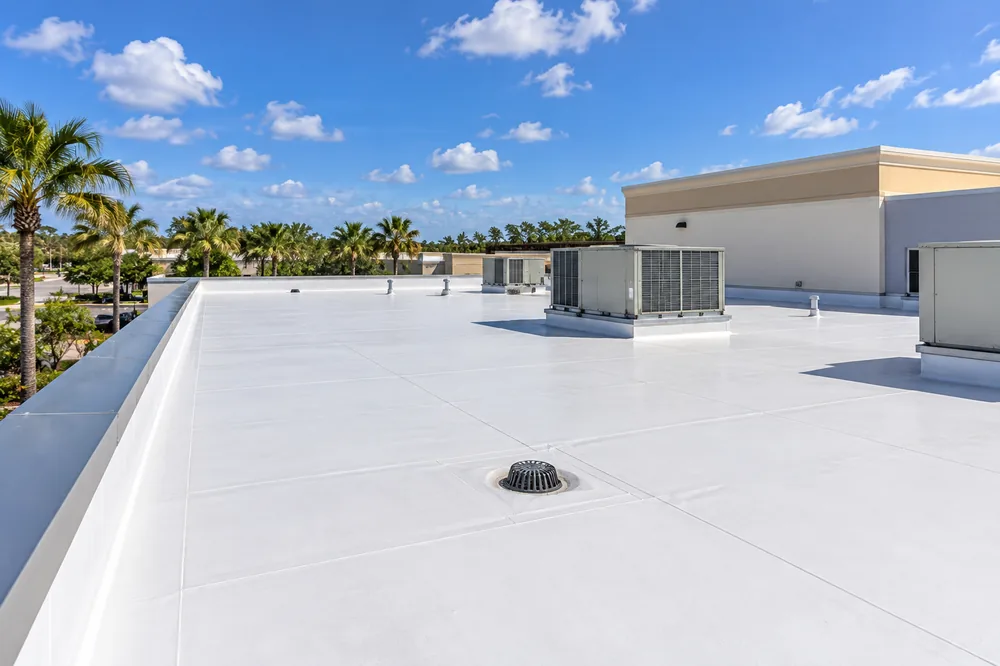
A commercial roof coating is not paint; it is an engineered, seamless, liquid-applied elastomeric membrane that cures to form a continuous, rubber-like barrier over an existing, aging roof assembly.
Modern commercial coatings fall into two primary chemistries:
- High-Solids Silicone per ASTM D6694: Silicone is the gold standard for Florida commercial roof restoration. Unlike organic materials, silicone is inorganic and completely impervious to ultraviolet degradation. Most importantly, silicone resists ponding water indefinitely, maintaining seam adhesion even in low spots where standing water pools. Silicone delivers an exceptional Solar Reflectance Index (SRI > 105), reducing cooling costs dramatically.
- Elastomeric Acrylic per ASTM D6083: Acrylic coatings are water-based, highly reflective, and economical. However, acrylic coatings re-emulsify (break down into liquid suspension) under prolonged standing water. In Central Florida’s subtropical climate, acrylic should only be applied to roofs with flawless positive drainage (slopes exceeding 1/4 inch per foot).
The Golden Rule of Coatings: Roof coatings only restore—they do not repair structural failure. If a roof possesses widespread wet insulation, rotting decking, or unbonded seams, applying a coating traps moisture inside the building envelope, causing rapid deck corrosion and blistering. Coatings require rigorous surface preparation: 100% dry substrate verification, 3,500 PSI pressure washing, specialized primers, and fabric tape reinforcement across every seam, flashing, and mechanical curb.
Option 2: Commercial Roof Recover (Single-Ply Overlay Systems)
A commercial roof recover (also known as a roof overlay) bridges the gap between topical coatings and full demolition. In a recover project, the existing roofing membrane remains in place, serving as an additional secondary underlayment layer.
The standard engineering methodology for an approved Florida recover involves:
- Excising any localized wet insulation identified during non-destructive moisture surveys and patching with dry polyisocyanurate.
- Mechanically fastening or foam-adhering a 1/2-inch high-density polyiso coverboard (such as HD ISO) or specialized gypsum board (DensDeck Prime or Securock) over the entire old roof surface to create a flat, smooth, fire-rated substrate.
- Installing a brand-new 60-mil or 80-mil TPO or PVC single-ply membrane over the coverboard, complete with new hot-air welded seams, edge metal copings, and penetration boots.
The financial advantage is immense: by eliminating the extensive labor, dumpsters, and landfill tipping fees associated with tearing off hundreds of thousands of pounds of old roofing, a recover typically saves between 25% and 40% compared to a complete tear-off. Furthermore, recover systems qualify for full 15- to 20-year manufacturer No Dollar Limit (NDL) warranties.
For commercial real estate portfolios in Dr. Phillips, recovering an existing single-layer retail or office roof allows tenants to continue normal daily business operations without the noise, dust, and weather exposure of a total tear-off.
Option 3: Complete Commercial Tear-Off and Replacement
While coatings and recovers offer attractive initial savings, there are technical conditions where full demolition and replacement is the only sound engineering choice.
A complete tear-off involves stripping all existing roofing materials down to the structural steel, wood, or concrete deck. This approach is legally or structurally mandatory when:
- The Two-Roof Limit Has Been Reached: The building already possesses two roof layers (e.g., an original built-up roof and a previous recover). Florida Building Code Section 1511 strictly prohibits adding a third roof layer.
- Extensive Insulation Saturation: Non-destructive moisture surveys reveal that more than 25% of the subsurface polyisocyanurate insulation is wet or degraded. When moisture is this widespread, localized patching is financially unfeasible.
- Severe Structural Deck Deterioration: Leaks have corroded metal decking, rotted wood purlins, or spalled lightweight concrete, requiring physical deck replacement to maintain structural load-bearing capacity.
- Energy Code Upgrades: A total tear-off allows building owners to install multi-layered staggered polyiso insulation meeting the Florida Energy Conservation Code minimum of R-30 (continuous insulation) for Climate Zone 2, drastically cutting long-term building operating expenses.
Head-to-Head Comparison: Coating vs. Recover vs. Full Replacement
The following engineering and financial matrix summarizes the operational parameters, cost profiles, and lifespans of the three commercial roofing approaches:
| Decision Factor | Fluid-Applied Silicone Coating | Single-Ply Recover (Overlay) | Complete Tear-Off & Replacement |
|---|---|---|---|
| Primary Objective | Surface restoration & UV armor | New engineered membrane system | Total structural reset & new R-value |
| Installed Cost per Sq Ft | $3.50 to $6.00 | $6.50 to $10.00 | $11.00 to $18.00+ |
| Expected Service Lifespan | 10 to 15 Years (Renewable) | 18 to 22 Years | 25 to 30+ Years |
| Substrate Dryness Requirement | 100% Dry (Zero trapped water) | 100% Dry (< 5% localized repair) | Accommodates 100% wet/failed roof |
| FBC Layer Limit Impact | Does NOT count as a new layer | Counts as Second (Final) Layer | Resets layer count back to 1 |
| Tenant Business Disruption | Zero disruption (No tear-off noise) | Minimal disruption (Clean install) | High disruption (Fumes, noise, dust) |
| Manufacturer NDL Warranty | 10 to 15-Year Material/Labor | 15 to 20-Year Full NDL | 20 to 30-Year Comprehensive NDL |
| R-Value Energy Improvement | Zero (Reflective SRI only) | Minor (+R-3 from HD coverboard) | Substantial (+R-25 to R-30 polyiso) |
Florida Building Code Regulations: The Two-Roof Maximum and Recover Rules
Commercial building owners in Florida must navigate strict regulatory barriers under the Florida Building Code 8th Edition (2023; in effect through Dec 31, 2026, when the 9th Edition takes effect), Existing Building Volume, Section 706 (Reroofing).
The most critical mandate is Section 706.3: Recovering vs. Replacement. The code states that a roof recover shall not be installed where any of the following conditions exist:
- Where the existing roof or roof covering is water-soaked or has deteriorated to the point that the existing roof or roof covering is not adequate as a base for additional roofing.
- Where the existing roof covering is wood shake, slate, clay, cement, or asbestos-cement tile.
- Where the existing building has two or more applications of any type of roof covering.
This rule is absolute. If a historical commercial building already has an original built-up asphalt roof and a subsequent modified bitumen recover installed 15 years ago, municipal building officials will reject any permit application for a third layer. A full tear-off down to the bare deck is legally mandatory.
Furthermore, under Florida Statutes Section 553.844 (as updated by SB 4-D), if an existing commercial roof built or replaced under the 2007 Florida Building Code or later requires repair or replacement of 25% or more of its total surface area, only the repaired portion must comply with current building code, provided the rest of the roof remains compliant. However, the two-roof maximum layer restriction remains fully enforceable across all jurisdictions.
Partnering with a licensed commercial contractor for commercial roofing permitting ensures your capital project navigates these municipal regulations cleanly.
Thermal Moisture Surveys: Core Cuts and Infrared Diagnostics
Because the Florida Building Code strictly prohibits recovering over wet insulation, and because coatings fail rapidly over damp substrates, commercial property managers must never make a restore-recover-replace decision based on a casual visual walkthrough.
A certified commercial contractor must perform a standardized non-destructive moisture survey, such as an evening Infrared (IR) Thermography scan or electronic moisture testing per ASTM C1153. Technicians follow up thermal anomalies by extracting physical Core Cuts—small 2-inch by 2-inch cylindrical core samples bored through the entire roof assembly down to the structural deck. Core cuts verify:
- The exact number of existing roof layers present.
- The precise type and thickness of existing insulation (polyiso, expanded polystyrene, perlite, or wood fiberboard).
- Whether moisture is present within the core sample, verified by laboratory gravimetric moisture analysis.
- The structural condition and material of the underlying deck (corrugated steel, poured-in-place concrete, or gypsum).
Tax Accounting Implications: Section 179 Expensing vs. 39-Year Depreciation
Beyond engineering and building codes, the choice between coating, recovering, and replacing carries profound tax accounting consequences under federal tax law.
Historically, commercial roof replacements were classified as capital improvements that had to be depreciated on a straight-line basis over an excruciating 39-year depreciation schedule. Under this legacy rule, spending $300,000 on a new roof only yielded a meager $7,692 annual tax deduction.
However, under the Tax Cuts and Jobs Act (TCJA) and current IRS Section 179 guidelines, qualifying commercial taxpayers can immediately expense 100% of the cost of commercial roof improvements in the year the work is completed (subject to annual federal investment and phase-out thresholds). Both commercial roof replacements and recover systems qualify for immediate Section 179 expensing. Meanwhile, fluid-applied roof coatings are frequently classified as routine maintenance and repair operating expenses under IRS Treasury Regulation Section 1.162-4, allowing building owners to deduct 100% of the cost as an operational expense against current-year taxable income.
Corporate property managers overseeing investments in commercial roofing in Dr. Phillips should consult with certified public accountants to leverage these tax write-offs and maximize cash flow.
Frequently Asked Questions About Commercial Roof Restoration Options
No. Under Florida Building Code Section 1511 and Existing Building Code Section 706, a liquid-applied roof coating is classified as a roof maintenance and restoration system, not an additional roof covering layer. Therefore, applying an approved elastomeric coating does not trigger the statutory two-roof maximum limit, making it an excellent restoration method for roofs with existing recover layers, provided the substrate is 100% dry.
Your roof is an eligible candidate for a recover if it meets three mandatory criteria: (1) it currently has only ONE existing roof covering layer (meeting the Florida two-layer code limit); (2) non-destructive infrared moisture surveys confirm that the existing insulation is structurally sound and largely dry (less than 15-20% localized dampness that can be cut out); and (3) the structural deck can support the minor added dead load.
You cannot simply apply a coating over an actively leaking roof without prior preparation. All active puncture wounds, failed seams, and saturated insulation must first be excised, replaced with dry material, and flashed with reinforcement fabric. Applying a liquid coating over wet, trapped moisture will cause immediate vapor blistering, membrane delamination, and accelerated structural deck rust.
A commercial recover typically saves between 25% and 40% in total capital expenditure compared to a complete tear-off. For a 50,000 square foot building, this translates to $100,000 to $200,000 in immediate savings by eliminating extensive demolition labor, dumpster roll-off charges, landfill tipping fees, and the cost of new full-thickness base insulation boards.
Fluid-applied roof coatings are generally classified as operational maintenance and repair expenses under IRS regulations, allowing commercial property owners to deduct 100% of the cost in the current tax year against operating income. While replacements can also qualify for immediate deduction under IRS Section 179 up to annual statutory caps, coatings provide a flexible operational write-off without depleting annual capital expenditure allocations.
Related Central Florida Roofing Guides: Continue reading TPO vs. EPDM vs. Mod-Bit for Florida Flat Roofs and How Often Should a Commercial Flat Roof Be Inspected?.