Soft wash or pressure wash your roof? Compare both for Orlando homes to protect shingles, warranties and leak-proofing. Call (689) 359-5257 with questions.
Using a high-pressure power washer on an asphalt shingle or tile roof in Central Florida will immediately strip protective mineral granules, fracture tile watercourses, and permanently void your manufacturer warranty. Professional roof cleaning in Orlando must always be performed using low-pressure chemical soft washing—an Asphalt Roofing Manufacturers Association (ARMA) approved procedure that applies specialized biocide solutions at under 60 PSI to eradicate algae at the root without mechanical surface erosion.
The Physics of Surface Destruction: How High Pressure Destroys Roof Coverings
When property owners observe thick black streaks, green moss, or grey lichens spreading across their roof, their initial instinct is often to rent a commercial pressure washer or hire a general exterior handyman. However, applying high-pressure water streams (typically ranging from 1,500 to 4,000 pounds per square inch) to roofing materials causes catastrophic, irreversible damage.
Asphalt shingles are engineered composites consisting of a woven fiberglass reinforcement mat embedded in petroleum-grade asphalt bitumen and coated with a dense surface layer of ceramic-coated mineral granules. Under ASTM D3462 testing standards, these granules serve three non-negotiable functions: they provide Class A fire resistance, protect the petroleum asphalt core from ultraviolet (UV) photochemical breakdown, and establish the roof's architectural color.
When a pressurized water jet strikes an asphalt shingle, the kinetic energy shears the ceramic granules right out of the asphalt matrix. In a matter of seconds, an uncertified pressure washing contractor can scour away five to ten years worth of protective mineral surfacing. The exposed raw asphalt underneath rapidly oxidizes under Florida's intense solar radiation, drying out, cracking, and curling. Furthermore, high-pressure spray directed upward or sideways lifts unsealed shingle tabs, forcing gallons of pressurized water backward underneath the laps, soaking the underlayment and soaking structural decking.
On concrete and clay tile roofs, the physical destruction is equally severe. While concrete tiles appear durable, high-pressure wands blast away the factory slurry coat, turning a smooth, water-shedding surface into an intensely porous substrate that absorbs moisture even faster. More critically, walking across brittle barrel tiles with heavy pressure-washing hoses invariably fractures the hidden interlocking side laps, creating water intrusion pathways straight to the concealed underlayment.
The Chemical Science of Soft Washing: Eradicating Spores at the Cellular Level
Soft washing is not merely "gentle pressure washing"; it is an entirely distinct discipline based on targeted biochemical remediation. Instead of relying on mechanical brute force to blast surface growth away, soft washing uses a dedicated low-pressure chemical delivery pump operating at an average of 45 to 60 PSI—roughly equivalent to the pressure of a standard garden hose nozzle.
The active cleaning solution is formulated around recommendations established by the Asphalt Roofing Manufacturers Association (ARMA). It utilizes a precise blend of sodium hypochlorite (typically diluted to an active surface concentration of 3% to 4%), water, and specialized non-ionic surfactants:
- Surfactant Surface Tension Reduction: Standard water forms high surface-tension beads that roll quickly down steep roof pitches. Specialized horticultural-safe surfactants lower the liquid surface tension, transforming the biocide into a clinging foam that adheres to vertical shingle edges and tile profiles for a full 15-minute dwell time.
- Cellular Oxidation of Melanin and Capsular Sheaths: The active hypochlorite ions penetrate the protective melanin sheaths of Gloeocapsa magma cyanobacteria, lichens, and fungal spores. The chemical breaks open the cellular membranes, denaturing proteins and neutralizing the organic pigmentation on contact.
- Complete Root System Eradication: High pressure merely shears off the visible top growth of lichens and moss, leaving microscopic cellular root anchors (rhizines) embedded inside the shingle fissures. Soft washing sanitizes the root structures completely, eliminating regrowth for several years.
Roofing Manufacturer Standards and Warranty Enforcement
Every major roofing manufacturer in North America—including GAF, CertainTeed, Owens Corning, and IKO—explicitly addresses roof cleaning methods within their technical service bulletins and limited warranty contracts. These corporations unequivocally prohibit pressure washing on their products.
Manufacturer warranties contain specific exclusion clauses stating that any mechanical damage, granule depletion, or water ingress caused by high-pressure washing equipment immediately voids both the shingle warranty and any accompanying algae-resistance coverage. If a homeowner experiences premature shingle failure or storm damage down the road, manufacturer field inspectors and insurance forensic engineers routinely inspect the shingle granule distribution. Circular or linear gouge patterns and widespread granule loss caused by pressure wands are instantly identified, resulting in swift claim denials.
Conversely, adhering to an established professional roof maintenance program that utilizes ARMA-approved chemical soft wash protocols preserves all manufacturer warranty protections intact while extending the functional lifespan of the roof assembly.
Tile Roof Vulnerabilities in Winter Garden: Foot Traffic and Concealed Underlayment
In historic and lakeside residential communities throughout Winter Garden, barrel tile and flat concrete tile roofs are architectural staples. While tile surfaces endure decades of intense solar heat, their underlying waterproofing systems remain deeply vulnerable to improper cleaning techniques.
A primary hazard of uncertified roof cleaners on tile roofs is catastrophic foot traffic damage. Concrete tiles are brittle, cantilevered plates designed to withstand compressive loads across specific contact points—not the concentrated weight of an untrained technician wearing wet boots and carrying a pressurized hose. Stepping on the unsupported midsection or fragile lower corners of a Spanish S-tile will instantly crack the tile along its structural axis.
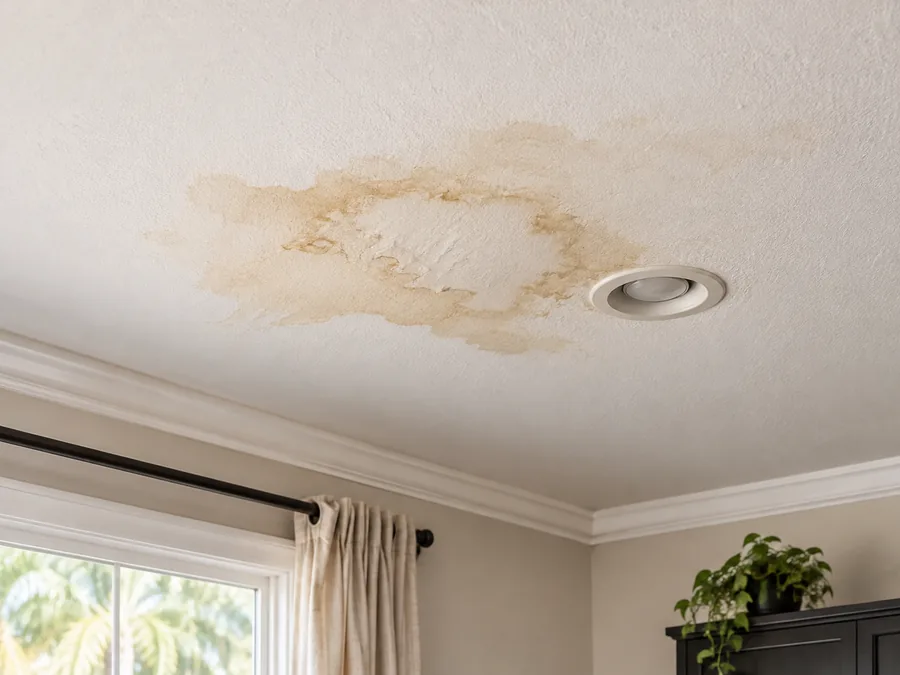
Even worse, when cracked tiles go unnoticed following a power-washing job, rainwater infiltrates the gaps and attacks the secondary waterproofing layer: the underlayment. In Central Florida, organic felt underlayment beneath tile roofs dries out and becomes brittle after 15 to 20 years. When high-pressure water or careless foot traffic compromises the tiles above, sudden ceiling leaks follow shortly. When homeowners discover widespread tile breakage and water stains after an improper cleaning, their only recourse is emergency roof leak repair in Winter Garden, FL to replace cracked units and re-seal compromised underlayment flashings.
| Operating Parameter | Professional Soft Washing | High-Pressure Power Washing |
|---|---|---|
| Delivery Pressure | 40 to 60 PSI (Low pressure / chemical soak) | 1,500 to 4,000+ PSI (High mechanical force) |
| Cleaning Mechanism | Biochemical cellular oxidation and spore sterilization | Hydraulic erosion and surface blasting |
| Impact on Shingle Granules | Zero granule displacement; preserves mineral protective layer | Severe, irreversible granule stripping and surface gouging |
| Manufacturer Warranty Status | Fully endorsed by ARMA, GAF, CertainTeed, and Owens Corning | Explicitly voids all manufacturer warranties |
| Spore Eradication Depth | 100% biological kill down to microscopic root structures | Topical only; leaves microscopic spores intact inside pores |
| Risk of Water Intrusion | Negligible; spray falls like gentle rainfall | Extreme; forces water under laps, vents, and step flashings |
| Typical Regrowth Interval | 3 to 5 years in Florida climate | 6 to 12 months (spores rapidly recolonize) |
Landscaping Protection and Runoff Management Protocols
A legitimate concern frequently voiced by homeowners regarding soft washing is the potential environmental impact on surrounding ornamental landscaping, turfgrass, and swimming pools. Because the active cleaning formula contains concentrated sodium hypochlorite, professional roof cleaning technicians must execute strict plant-protection and environmental protocols before, during, and after application:
- Pre-Wetting Soil and Foliage: Before a single drop of cleaning chemical touches the roof, the ground crew saturates all surrounding shrubs, palms, flowers, and lawns with copious amounts of fresh water. Plant roots cannot absorb chemical runoff if their root systems and vascular structures are already fully engorged with clean water.
- Downspout Redirection and Collection: Chemical runoff entering aluminum gutters must not be allowed to discharge directly into foundation flowerbeds or community storm drains. Professional crews attach flexible runoff bags or heavy-duty plastic redirection conduits to all downspout boots, collecting concentrated chemical drainage for safe neutralization and disposal.
- Continuous Rinsing During Application: While the roof technician applies the foaming biocide, an assigned ground technician continuously sprays a fresh water curtain over all perimeter foliage, diluting any accidental chemical drift to harmless parts-per-million levels.
- Post-Application Neutralizer Spray: Following the roof treatment, high-value landscaping is misted with a specialized chemical neutralizing agent that breaks down residual chlorine compounds and feeds plant root systems with beneficial micronutrients.
How Often Should an Orlando Roof Be Soft Washed?
Because Central Florida's atmosphere contains a high ambient concentration of airborne Gloeocapsa magma spores, biological recolonization is an inevitable natural process. However, over-cleaning a roof is unnecessary and counterproductive.
Under typical conditions in Orange, Seminole, and Osceola Counties, a quality soft wash treatment keeps an asphalt shingle or concrete tile roof pristine for three to five years. Shaded properties situated beneath dense live oak canopies or near lakefront shorelines may require maintenance closer to every two-and-a-half to three years, while open suburban roofs exposed to full afternoon sun frequently maintain their clean appearance for upwards of four years.
Homeowners should coordinate roof cleaning with a broader preventative maintenance schedule. Having a licensed roofing professional inspect pipe boots, flashing seals, and ridge caps during the same operational cycle ensures that minor sealant defects are repaired before chemical cleaning solutions or tropical rainstorms can exploit them.
Frequently Asked Questions About Orlando Roof Cleaning
While metal standing seam panels will not lose granules, high-pressure washing poses significant risks. Pressurized water streams can easily cut through cured elastomeric sealants along ridge vents, drive water backward beneath horizontal flashing laps, and dislodge concealed expansion clips. Furthermore, high-pressure wands can scratch or micro-abrade factory Kynar 500 or Hylar 5000 fluoropolymer coatings, exposing underlying galvalume steel to premature coastal oxidation.
When performed by trained technicians, soft washing is completely safe around screen pool enclosures. Technicians tarp open pool surfaces or continuously run fresh water curtains over screen mesh to ensure biocide solutions do not alter pool water chemistry or stain aluminum framework. In fact, soft washing effectively cleans stubborn green algae off pool cage framing without denting aluminum or stretching screen spline.
During the active application and for a few hours afterward, homeowners will notice a mild chlorine swimming-pool aroma outdoors. Because soft washing formulations break down rapidly into harmless water and common salt when exposed to sunlight and air, the odor dissipates entirely within 12 to 24 hours of treatment.
Florida property insurance underwriters routinely review high-resolution satellite photography and automated drone flyovers during annual policy underwriting. In aerial imaging, dark algae streaking obscures shingle surface condition and is frequently flagged by underwriting algorithms as evidence of severe neglect, deterioration, or organic rot. In many instances, carriers issue 30-day conditional notices requiring professional cleaning as a prerequisite for policy renewal.
Yes, but with an important technical distinction: while soft washing instantly kills the moss and lichen organisms down to their microscopic roots, thick lichen colonies anchor deeply into asphalt granules. Ripping them off immediately while alive would dislodge ceramic granules. After the chemical kills the organism, the dried lichen naturally decomposes and washes away harmlessly with subsequent rains over several weeks, leaving shingles undamaged.
Related Central Florida Roofing Guides: Continue reading Black Streaks on Florida Roofs: Algae Cause & Prevention and Roof Maintenance Checklist for Central Florida Homes.