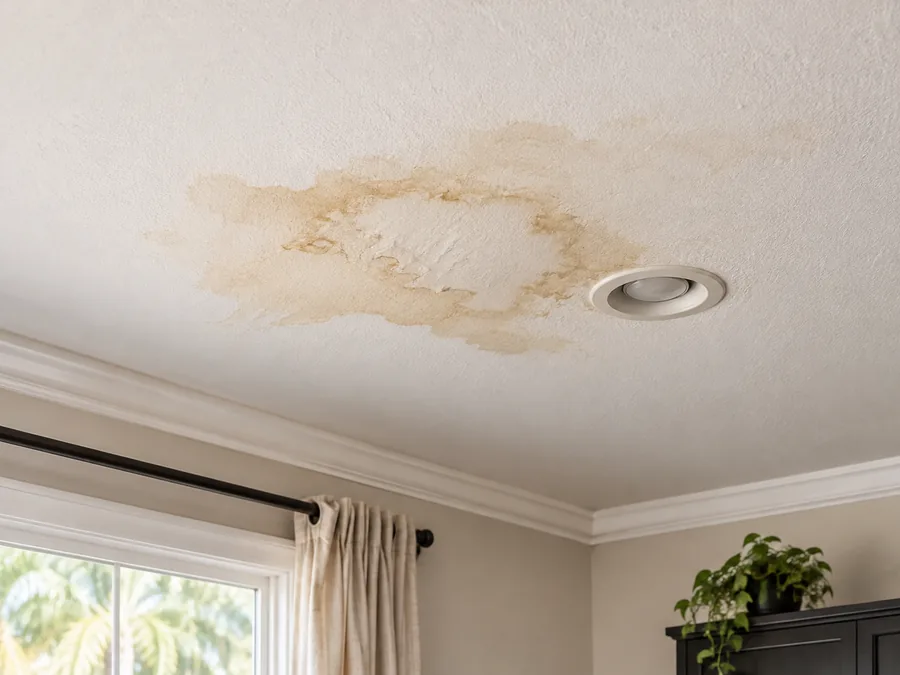
How often should you clean gutters in Central Florida? See the schedule that prevents roof leaks and fascia rot. Call (689) 359-5257 for gutter help.
For most homes in Central Florida, gutters must be thoroughly cleaned at least two to four times per year, with properties situated beneath dense live oak or pine canopies requiring bi-monthly maintenance during peak tree shedding seasons. Failing to maintain unobstructed drainage channels causes torrential summer rains to back up beneath the roof's drip edge, rotting structural fascia boards, flooding soffit cavities, and eroding foundation footings.
The Hydrodynamics of Gutter Overflow: How Clogged Gutters Destroy Roof Systems
Seamless gutters are frequently viewed as simple decorative accents or minor water-diversion troughs. From a building science perspective, however, your gutter and downspout system is an essential hydraulic drainage channel protecting the most vulnerable perimeter juncture of your home: the roof eave.
When Central Florida enters its summer convective thunderstorm cycle, rainfall intensity regularly exceeds three to four inches per hour. A standard 2,500-square-foot roof sheds approximately 1,550 gallons of water during a one-inch storm. When that volume of water races down roof slopes into gutters blocked by leaves, moss, and pine needles, the trough fills to capacity within minutes.
Once gutters overflow, water cannot simply spill harmlessly over the front lip. Due to surface tension and hydrostatic head pressure, water pools against the rear wall of the gutter trough, submerging the lower flange of the metal drip edge. According to the Florida Building Code Section R905.2.8.5, the drip edge must guide water cleanly into the trough. But when gutters back up, capillary action draws water upward between the drip edge and the wooden sub-fascia. The moisture soaks the outer edge of the plywood decking, rots the structural rafter tails, and drips into the soffit framing, creating hidden mold reservoirs and inviting subterranean termite colonization.
Central Florida's Vegetative Canopy: The Oak, Pine, and Palm Debris Cycle
While northern homeowners typically clean gutters once in late autumn after deciduous trees drop their leaves, Central Florida's subtropical canopy operates on an entirely different biological calendar. Distinct tree species create specific seasonal debris surges throughout the year:
- Southern Live Oaks (February through April): Live oaks do not drop their leaves in autumn; they shed old leaves and release massive quantities of stringy pollen tassels (catkins) in early spring. These catkins form dense, felt-like mats inside gutter troughs that quickly wrap around downspout strainers and create watertight dams.
- Longleaf and Slash Pines (Year-Round, Peaking in Autumn): Pine needles are notorious for penetrating standard gutter screens. They interlock into tight mesh structures that trap organic silt, decomposing into an acidic peat that accelerates the electrolytic corrosion of gutter hangers and fastener screws.
- Cabbage Palms and Washingtonians (Summer Storm Season): During severe summer squalls, palm trees drop fibrous brown husk boots, heavy flower spathes, and massive dead fronds that can knock gutters completely off their pitch or crush gutter brackets.
- Spanish Moss and Air Plants: Dislodged by summer thunderstorm gusts, clumps of Spanish moss fall directly onto roof valleys and roll down into gutters, acting like dense sponges that absorb moisture and block water velocity.
The Four Critical Gutter Maintenance Windows in Central Florida
To prevent water damage, Central Florida property owners should organize their gutter maintenance around four strategic seasonal windows:
- Early Spring (March / April): The post-oak bloom cleanout. Clears away heavy carpets of live oak catkins, pollen residue, and winter leaf drop before the onset of spring convective rain.
- Late Spring (May): The pre-hurricane season preparation. Clears all drainage valleys, verifies downspout flow rates, re-secures loose gutter spikes, and inspects fascia seals before the Atlantic hurricane season begins on June 1.
- Late Summer (August / September): The peak tropical season cleanout. Removes wind-blown storm debris, dislodged roof granules, and summer vegetation following the first half of the tropical storm season.
- Early Winter (November / December): The dry season tune-up. Removes late autumn pine needles and deciduous leaf shedding, ensuring gutters remain clean and free of stagnant water that breeds mosquitoes during the mild Florida winter.
Gutter Sizing and Hydraulic Volume: Why Standard 5-Inch Gutters Fail
Many older subdivisions across Central Florida were built with residential 5-inch K-style aluminum gutters serviced by narrow 2x3-inch rectangular downspouts. While 5-inch systems were historically considered standard across the United States, they are severely undersized for modern Florida meteorological realities.
A standard 5-inch K-style gutter has a maximum water capacity of approximately 1.2 gallons per linear foot. By contrast, a 6-inch seamless aluminum gutter holds approximately 2.0 gallons per linear foot—representing a 66% increase in water volume capacity. More importantly, upgrading from standard 2x3-inch downspouts to commercial-grade 3x4-inch downspouts doubles the discharge rate from approximately 180 gallons per minute to over 390 gallons per minute.
In communities where heavy downpours overwhelm older systems, upgrading to seamless 6-inch gutters and downspouts prevents gutter overflow, reduces cleaning frequency, and ensures torrential rainwater is swiftly directed away from the building envelope.
Do Gutter Guards Eliminate the Need for Cleaning in Florida?
Property owners inundated with debris frequently install aftermarket gutter guards, hoping to eliminate maintenance altogether. However, in Florida's unique climate, gutter guards alter maintenance requirements rather than eliminating them entirely:
- Perforated Plastic or Vinyl Screens: Inexpensive slotted or mesh vinyl screens perform poorly in Central Florida. Oak catkins and pine needles wedge themselves vertically into the slots, creating a flat "roof" of debris over the trough that forces rainwater to sheet straight over the gutter like a waterfall.
- Reverse-Curve Surface Tension Guards: While these systems shed large leaves effectively, surface tension also pulls airborne roof algae, pollen slime, and organic silt around the curved nose into the gutter, where it forms an inaccessible sludge bed that requires disassembling the guards to clean.
- Micro-Mesh Stainless Steel Guards: Surgical-grade stainless steel micro-mesh guards represent the most effective barrier against pine needles and sand. However, in humid environments, cyanobacteria (Gloeocapsa magma) and green roof algae can form a microscopic biological film over the mesh openings. If this biofilm is not brushed off annually with a mild surfactant, water sheets across the blocked screen rather than filtering into the gutter.
| Property Canopy Environment | Recommended Cleanings Per Year | Peak Debris Months | Dominant Debris Hazards | Primary Failure Risks |
|---|---|---|---|---|
| Dense Live Oak Canopy (e.g. Historic Winter Park) | 4 to 6 Times (Bi-monthly in Spring) | March, April, June, September | Oak catkins, pollen sludge, Spanish moss | Catkin dams, fascia wicking, roof eave rot |
| Pine & Mixed Hardwood Mix | 3 to 4 Times | April, July, October, December | Longleaf needles, pinecones, deciduous leaves | Downspout bridging, acidic silt corrosion |
| Open Suburban Lot (Minimal Trees) | 2 Times | May (Pre-Hurricane) & November | Wind-blown dust, asphalt granules, seed pods | Downspout elbow silt clogs, standing water |
| Homes with Micro-Mesh Gutter Guards | 1 to 2 Times (Topical Sweep & Wash) | May & October | Algae biofilm, pine needle bridging on mesh | Water sheeting over guards, bracket strain |
Eave Preservation and Water Damage in Winter Park
The consequences of neglected gutter maintenance are visible throughout older residential districts. In historic, tree-lined neighborhoods like Winter Park, where sprawling hundred-year-old live oaks form towering overhead canopies, gutter troughs fill with oak catkins and heavy organic mulch within weeks of spring bloom.
When heavy summer storms hit these clogged troughs, water cascades backward behind the gutter, saturating the historic tongue-and-groove wooden eaves and decorative rafter tails. Because wood rot develops out of sight beneath the metal drip edge, homeowners often remain completely unaware of the structural damage until wet rot migrates into the living room ceiling drywall or exterior wall framing. When hidden eave rot compromises the structural integrity of your roofline, homeowners require immediate diagnostic intervention and roof leak repair in Winter Park, FL to replace decayed decking and rebuild compromised drip edge assemblies.
Safety Protocols: Ladder Hazards vs. Professional Cleaning
According to data from the Centers for Disease Control and Prevention (CDC) and OSHA, ladder falls account for thousands of severe injuries annually, with residential gutter cleaning representing one of the leading causes of domestic orthopedic trauma.
Cleaning gutters on a two-story Central Florida home requires maneuvering heavy extension ladders across uneven sandy turf, navigating around delicate foundation landscaping, and working in close proximity to overhead electrical service drops. Furthermore, resting heavy metal ladders directly against aluminum gutters crushes the thin aluminum troughs and bends gutter hanger brackets, destroying the slope of the system.
Professional gutter technicians utilize specialized ladder stand-offs that rest securely against the exterior wall or roof deck rather than the gutters. Equipped with commercial high-flow flushing hoses, vacuum retrieval systems, and OSHA-compliant fall protection harnesses, licensed crews remove all organic sludge and test downspout drainage without risking personal injury or gutter damage.
Frequently Asked Questions About Gutter Maintenance in Florida
Telescoping curved wand attachments connected to a standard garden hose or leaf blower allow homeowners to clear light, dry leaves from single-story gutters from the safety of the ground. However, when Florida live oak catkins and decomposed silt form a dense, wet sludge, ground-based tools cannot scrape the heavy sediment out or clear compacted downspout elbows, necessitating physical access by a trained technician.
Yes. Central Florida mosquito species, including Aedes albopictus (the Asian tiger mosquito), require as little as a half-inch of stagnant water to complete their breeding cycle within 7 to 10 days. Sagging or clogged gutters hold warm, organic-rich standing water, transforming your roofline into an active mosquito breeding zone directly outside bedroom windows.
Properly installed gutters must maintain a continuous downward slope of at least 1/4 inch per 10 feet of horizontal run toward each downspout outlet. If you observe standing water puddles in the center of a dry gutter trough days after a rainstorm, or if water constantly spills over the middle of a gutter run, the hangers have sagged and the system must be re-pitched to establish positive drainage.
In the Orlando area, professional gutter cleaning generally ranges from $125 to $225 for a single-story home (approx. 150 to 200 linear feet) and $200 to $350 for a two-story home with complex rooflines. Bundling gutter cleaning with an annual roof maintenance package or soft-washing service frequently reduces the per-visit cost.
Gutters pull away from the roofline for two primary reasons: excessive weight and rotted fascia wood. A clogged 40-foot gutter filled with wet mulch and standing water can weigh over 300 pounds. This heavy static load strains old gutter spikes, pulling them out of the fascia. If the wooden fascia has suffered water rot from chronic overflow, the wood fibers soften and lose all fastener holding power, causing the brackets to detach completely.
Related Central Florida Roofing Guides: Continue reading Black Streaks on Florida Roofs: Algae Cause & Prevention and Roof Cleaning in Orlando: Soft Wash vs. Pressure Washing.