Standing seam or corrugated metal for your Florida roof? Compare attachment, lifespan, wind, cost and upkeep to see which suits you. Read the comparison.
Metal roofing has surged in popularity across Central Florida as homeowners seek permanent protection against hurricane-force winds, intense solar heat, and soaring property insurance rates. However, "metal roof" is not a single product. The residential market is fundamentally divided into two distinct engineering architectures: concealed-fastener standing seam systems and exposed-fastener (corrugated or 5V-crimp) metal panels. While both provide superior fire and impact resistance compared to asphalt, their mechanical attachment, Florida Building Code wind ratings, maintenance demands, and realistic lifespans could not be more different. This guide provides an engineering-level comparison of standing seam versus corrugated metal roofing in Orlando's unique subtropical climate.
The Fundamental Engineering Difference: Concealed vs. Exposed Fasteners
Every mechanical advantage and cost disparity between these two systems originates in a single design factor: how the metal panels are fastened to the roof deck.
Exposed-Fastener Systems (Corrugated, R-Panel, 5V-Crimp)
In an exposed-fastener installation, large sheet metal panels are laid across the roof deck and secured by driving thousands of screws directly through the face of the metal into the underlying wood deck or purlins. On a typical 2,400-square-foot Orlando home, an exposed-fastener roof requires between 2,500 and 4,000 screw penetrations. Each screw relies on a small compressed neoprene or EPDM rubber washer beneath its hexagonal head to create a watertight seal against the metal surface.
Standing Seam Systems (Concealed Fastener)
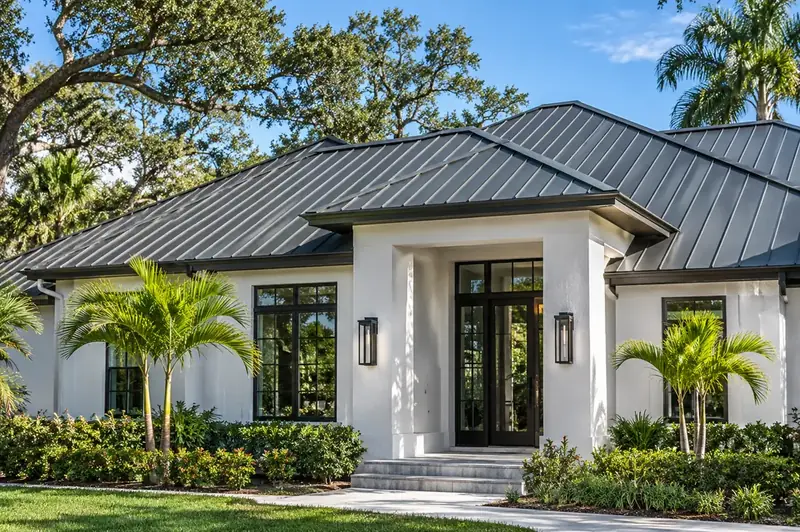
Standing seam metal roofing utilizes vertical metal panels with raised interlocking ribs (typically 1.5 to 2 inches high) running continuously from ridge to eave. The panels are anchored to the roof deck using concealed stainless steel or coated clips that hook over the panel edges and are screwed to the deck underneath the adjacent panel. The adjacent panel is then snapped into place or mechanically folded and seamed using an electric seamer tool. Not a single screw penetrates the weathering surface of the metal. All fasteners, clips, and expansion joints are completely concealed from rain, wind, and solar ultraviolet radiation.
| Specification / Performance Metric | Exposed Fastener (5V-Crimp / Corrugated) | Concealed Fastener (Standing Seam) |
|---|---|---|
| Fastener Penetrations Exposed to Weather | 2,500 to 4,000 exposed screws | Zero exposed screws |
| Attachment Mechanism | Screws with EPDM rubber washers | Concealed clips & mechanical/snap-lock seams |
| Thermal Expansion Accommodation | Rigidly pinned; zero thermal movement | Floating clips allow continuous expansion/contraction |
| Washer Replacement Requirement | Every 8 to 12 years in Central Florida | Never (no exposed washers) |
| Standard Steel Gauge | 26-gauge or thin 29-gauge | Heavy-duty 24-gauge (or 0.032" aluminum) |
| Paint Coating System | Siliconized Modified Polyester (SMP) | Kynar 500 / Hylar 5000 (PVDF resin) |
| Central Florida Expected Lifespan | 20 to 25 years (with maintenance) | 50+ years (virtually maintenance-free) |
| Wind Uplift Rating (TAS 125 / UL 580) | Class 60 to Class 90 (110–130 mph) | Class 90 to 180+ mph hurricane resistance |
| HOA Architectural Approval in Orlando | Often banned in master-planned communities | Widely approved in luxury developments |
The Thermal Expansion and Washer Degradation Problem: Why Exposed Fasteners Leak
Central Florida roofs endure extreme thermal cycling. Under direct Orlando sunshine, a dark metal roof can easily reach surface temperatures of 165°F to 180°F by mid-afternoon, before a violent convective thunderstorm drops temperatures down to 75°F in a matter of twenty minutes. Under basic physics, sheet metal expands when heated and contracts when cooled. A 30-foot continuous panel of steel metal expands nearly 1/4 inch across this temperature range.
In a standing seam system, concealed expansion clips allow the metal panels to slide longitudinally along the roof deck without placing stress on the fasteners or structural seams. The roof literally "breathes" with temperature fluctuations.
In an exposed-fastener system, however, the panels are rigidly pinned to the wood deck by thousands of screws. As the metal expands and contracts, the panel pushes against the rigid screw shafts. Over 8 to 12 years of Florida summers, this thermal rocking creates two inevitable failure modes:
- "Slotting" of Screw Holes: The repetitive back-and-forth movement wallows out the screw hole in the metal sheet, turning a round 1/4-inch penetration into an elongated oval slot.
- EPDM Washer Dry-Rot: Intense solar UV radiation and ozone degrade the rubber washers, causing them to harden, crack, cup, and lose compression. Once a washer shrinks and cracks over a slotted hole, rainwater is drawn directly through the deck into the attic.
Consequently, exposed-fastener roofs in Orlando require a complete "re-screw" maintenance cycle every 8 to 12 years—backing out every single fastener, sizing up to a wider screw shank, and installing fresh oversized washers. If neglected, minor fastener seepage rots the plywood roof deck beneath the metal panels.
The Re-Screw Maintenance Requirement
If you choose an exposed-fastener metal roof in Central Florida, factor in the recurring maintenance cost. Having a professional crew inspect, re-tighten, or replace 3,000+ exposed screws and degraded EPDM washers costs roughly $1,500 to $2,800 every decade.
Wind Performance and Hurricane Uplift Resistance
Both standing seam and corrugated metal roofs offer superior wind resistance compared to traditional 3-tab shingles, but standing seam provides a significantly higher structural safety envelope during major storms like Hurricane Ian or Irma.
Under the Florida Building Code (FBC), metal roofing must be tested for wind uplift under UL 580 or TAS 125. In exposed-fastener systems, hurricane uplift forces pull against the thin metal sheet surrounding each screw head. If gusts exceed 110 to 120 mph, the thin metal (especially 29-gauge residential panels) can tear over the screw heads like paper, peeling the entire sheet away. In contrast, standing seam panels utilize continuous interlocking seams anchored by heavy 24-gauge stainless steel clips. Standing seam profiles are tested for uplift under UL 580 or TAS 125; a test classification is not a guaranteed survival speed.
Paint Coatings: Kynar 500 (PVDF) vs. Siliconized Modified Polyester (SMP)
The protective coating applied to the metal substrate dictates whether your roof retains its vibrant color or fades into an oxidized chalky chalkline over a decade of intense Florida UV exposure:
- Kynar 500 / Hylar 5000 (PVDF Resin): Standard on standing seam panels. PVDF is a fluoropolymer resin with tight carbon-fluorine bonds that resist ultraviolet breakdown. Premium Kynar 500 finishes carry 30- to 40-year warranties against color fade and chalking, maintaining their original appearance and solar reflectance for decades.
- Siliconized Modified Polyester (SMP): Standard on exposed-fastener agricultural and residential panels. While superior to basic polyester paints, SMP coatings break down under Florida's high UV index after 10 to 15 years, leading to noticeable color fading, chalking, and loss of gloss.
Considering a Metal Roof in Orlando?
Compare itemized quotes for 24-gauge standing seam metal vs. 5V-crimp installations with code-approved Florida Product Approvals.
Cost Comparison: Upfront Investment vs. 50-Year Value
The primary barrier to standing seam metal roofing is the upfront financial investment. Standing seam panels require heavier gauge steel, specialized fabrication equipment (often roll-formed on-site from master coils), and skilled metal craftsmen to hand-bend transitions at eaves, valleys, and rakes.
| Cost Component | Exposed Fastener (5V-Crimp / Corrugated) | Standing Seam (24-Gauge Galvalume) |
|---|---|---|
| Installed Turnkey Cost Per Square | $550 to $850 / sq | $1,100 to $1,850 / sq |
| Total Investment (24 Squares) | $13,200 to $20,400 | $26,400 to $44,400 |
| 10-Year Maintenance (Re-Screws) | $1,500 to $2,800 per cycle | $0 (routine visual inspections only) |
| Expected Service Lifespan | 20 to 25 years | 50+ years |
| 50-Year Cost (Replacements & Upkeep) | ~$35,000 to $50,000 (2 roof cycles) | $26,400 to $44,400 (1 roof cycle) |
While an exposed-fastener roof saves $12,000 to $20,000 on day one, an Orlando homeowner planning to stay in their home for several decades will spend more money over a 50-year horizon replacing the exposed-fastener roof and repairing fastener leaks than installing a standing seam system once.
HOAs, Architectural Guidelines, and Neighborhood Standards
In master-planned Central Florida communities—including Winter Park, Windermere, Lake Nona, Celebration, Dr. Phillips, and Baldwin Park—Homeowners Association (HOA) Architectural Review Boards (ARBs) maintain strict material standards. Corrugated and exposed-fastener metal roofs carry a historic association with barns, agricultural sheds, and industrial warehouses. Consequently, many Orlando HOAs explicitly prohibit exposed-fastener metal roofing while enthusiastically approving concealed-fastener standing seam profiles. Always consult your community's Covenants, Conditions, and Restrictions (CC&Rs) before signing a metal roofing contract.
Frequently Asked Questions
Standing seam metal roofing lasts significantly longer—typically 50 years or more with minimal maintenance. Corrugated and exposed-fastener roofs generally last 20 to 25 years in Florida because the rubber washers on thousands of exposed screws dry out, crack, and leak under intense heat and UV radiation every 8 to 12 years.
Exposed-fastener roofs use thinner metal (typically 26- or 29-gauge steel with SMP paint), wider panel widths, and require less labor to install because crews screw straight through the face of the metal. Standing seam requires heavier 24-gauge Galvalume or aluminum, specialized concealed clips, Kynar 500 paint, and skilled craftsmen to hand-seam edges.
Yes. In Central Florida, thermal expansion and intense UV rays degrade neoprene and EPDM screw washers within 8 to 12 years. Homeowners must hire a roofing contractor to perform a full re-screw service—backing out old screws, inspecting for wood rot, and driving new oversized fasteners with fresh UV-resistant washers.
No. When installed on a residential home over solid plywood roof decking, secondary water barrier underlayment, and an insulated attic space, a metal roof produces no more interior sound during a heavy Florida rainstorm than standard asphalt shingles.
Yes. A permitted standing seam metal roof earns maximum credits under Section 6 of the Florida Uniform Mitigation Verification Inspection Form (OIR-B1-1802). More importantly, metal roofs avoid the 10- to 15-year insurance cancellation policy that Florida carriers apply to aging asphalt shingles.
Sources & Technical Verification
Engineering references verified in October 2026:
- Florida Building Code Residential 8th Edition — Chapter 9, Section R905.10 (Metal Roof Panels) & TAS 125 (Wind Uplift Resistance)
- Metal Construction Association (MCA) — Technical Manual on Fastener Performance and Thermal Expansion in Low/Steep Slope Metal Roofing
- Galvalume Sheet Technical Specifications — 50-Year Atmospheric Corrosion Performance in Subtropical Environments
Concealed fastener standing seam panels eliminate exposed neoprene screw washers that degrade under Florida UV radiation. For homeowners in Celebration, FL, explore ARC-compliant metal profiles in our Celebration metal roofing guide.