Do you need a public adjuster for a roof claim? See who works for whom, Florida fee caps and what a roofer can and cannot do before you decide.
Navigating a roof storm damage claim in Orlando often involves interacting with multiple professionals with "adjuster" in their job title. Homeowners frequently find themselves confused by the competing roles of insurance company adjusters, independent catastrophic adjusters, roofing contractors, and private public adjusters. When an insurer offers a lowball settlement or denies a roof replacement after a hurricane, hiring a licensed Public Adjuster (PA) can feel like your only lifeline. However, public adjusters take a legally capped percentage of your total insurance settlement—money that is often essential to cover actual construction costs. This guide breaks down the legal loyalties of each adjuster type, what roofing contractors are strictly prohibited from doing under Florida law, fee caps under Florida Statute § 626.854, and how to determine whether hiring a public adjuster is mathematically worth it for your home.
The Three Adjuster Roles: Who Works for Whom?
The term "adjuster" is applied to three completely different roles in Florida property claims, each operating with distinct legal allegiances and fiduciary duties:
| Adjuster Type | Who Employs & Pays Them | Legal Fiduciary Duty | Cost to the Policyholder |
|---|---|---|---|
| Company / Staff Adjuster | Direct salaried employee of your insurance company | Fiduciary duty to the insurance company | $0 out of pocket (covered by insurance) |
| Independent Adjuster (IA) | Third-party firm contracted by your insurer during storm surges | Contractual allegiance to the insurance company | $0 out of pocket (paid by insurance per claim) |
| Public Adjuster (PA) | Hired directly by you, the property owner | Fiduciary loyalty to YOU, the policyholder | 10% to 20% of your total claim settlement |
1. Company (Staff) Adjuster
A staff adjuster is a full-time, salaried employee of your insurance carrier. While professional and bound by Florida's unfair claims settlement practices statutes, their core job is to settle claims strictly within the carrier's internal loss guidelines and coverage definitions.
2. Independent Adjuster (IA)
Despite the word "independent," an IA does not work for you. Following major Florida hurricanes like Ian or Nicole, insurance carriers hire thousands of third-party contract adjusters from across the country to handle catastrophic claim volume. Independent adjusters inspect damage, write initial Xactimate repair estimates, and report their findings back to carrier desk adjusters who make the final payment decisions.
3. Public Adjuster (PA)
A Public Adjuster is an independent, state-licensed professional claims advocate who represents the policyholder exclusively. In Florida, PAs are licensed and regulated by the Department of Financial Services (DFS). They perform comprehensive forensic damage inspections, review policy coverages, prepare itemized estimates, and negotiate directly with the insurance company's claims team to secure the maximum legal settlement.
What Florida Law Forbids Roofing Contractors from Doing
Homeowners often ask: "Can't my roofing contractor just negotiate the claim for me?" In Florida, the answer is an absolute no. Under Florida Statute § 489.147 and § 627.70153, the Florida Legislature cracked down on the "Unauthorized Practice of Public Adjusting" (UPPA):
- Contractor Prohibitions: A roofing contractor cannot negotiate claim terms, interpret policy exclusions, discuss coverage limits, or act as a claims advocate with an insurance adjuster unless they hold an active, separate Florida Public Adjuster license.
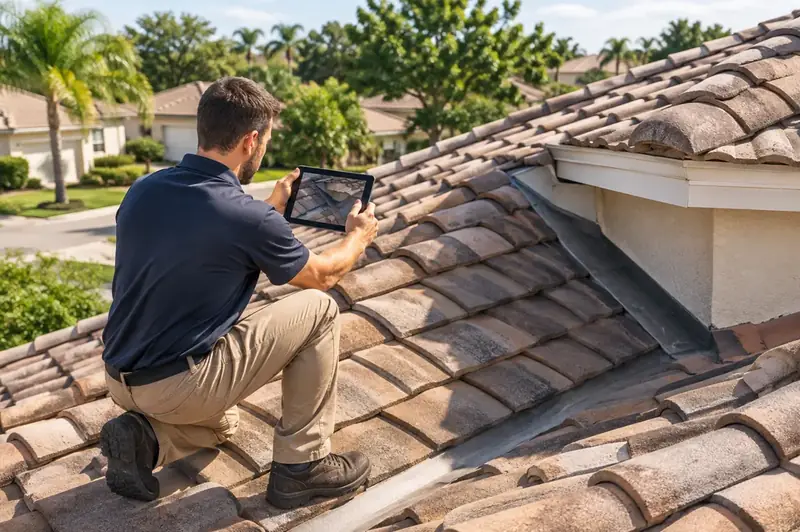
- What Roofers CAN Legally Do: A professional roofing contractor can perform a physical damage inspection, provide an itemized repair or replacement estimate using local labor and material pricing, point out code-mandated upgrades (such as FBC secondary water barriers and deck re-nailing), and attend the on-site inspection with the insurance adjuster to point out physical roof damage.
Why the Law Separates Roofers and Adjusters
Florida law strictly separates the contractor (who performs the physical construction work) from the adjuster (who negotiates insurance policy dollars) to prevent fraudulent claim inflation and protect homeowners from predatory Assignment of Benefits (AOB) contracts.
Public Adjuster Fee Caps Under Florida Statute § 626.854
Public adjusters in Florida do not charge hourly fees. Instead, they work on a contingency basis, taking a percentage of the final insurance claim check. Under Florida Statute § 626.854, their fees are strictly capped by state law:
- Declared State of Emergency (Hurricanes): Capped at a maximum of 10% of the total claim payment for any claim resulting from a storm event declared an emergency by the Governor if filed within the first year of the declaration.
- Non-Emergency Storm Claims: Capped at a maximum of 20% of the claim payment for standard wind, hail, or water damage claims outside an emergency declaration.
- Reopened and Supplemental Claims: If an insurer has already made an initial payment and you hire a PA to seek supplemental funds, the fee percentage applies only to the additional new money recovered—never to the initial undisputed check you already received.
Has Your Roof Insurance Claim Been Underpaid?
We provide comprehensive itemized repair scopes and code documentation to support legitimate supplemental insurance reviews.
The Financial Math: When Is a Public Adjuster Worth the Fee?
Because a public adjuster takes 10% to 20% of the insurance payout, you must evaluate whether their involvement will net you more money after their fee is deducted than you would have received on your own.
| Claim Scenario | Initial Insurer Offer | PA Adjusted Settlement | PA Fee (10% Emergency) | Net Funds for Roof Repairs | Was It Worth It? |
|---|---|---|---|---|---|
| Scenario A: Severe Underpayment | $8,000 (Partial repair) | $28,000 (Full replacement) | $2,000 (10% of $20k supplement) | $26,000 net | YES: Netted +$18,000; fully funds new roof |
| Scenario B: Total Denial Overturned | $0 (Claim denied) | $24,000 (Full replacement) | $2,400 (10% of total) | $21,600 net | YES: Transformed $0 into a new roof |
| Scenario C: Fair Baseline Offer | $22,000 (Full replacement) | $24,000 (Minor supplement) | $2,400 (10% of total) | $19,600 net | NO: Lost $2,400; left with insufficient repair funds |
As demonstrated in the table, if an insurer immediately approves a full roof replacement at fair market pricing, hiring a public adjuster reduces your construction funds by $2,000 to $4,000, leaving you with an out-of-pocket deficit to pay your roofer. A public adjuster is most valuable when there is a massive dispute over scope—such as an insurer offering a $5,000 patch when Florida Building Code mandates a $30,000 replacement.
Alternatives to Hiring a Public Adjuster in Florida
If you disagree with your insurer's estimate, you have three alternative legal remedies before committing 10% to 20% of your payout:
- Contractor Supplemental Request: Have your licensed roofing contractor submit an itemized Xactimate supplemental estimate showing missing code line items, photos of unsealed shingles, and municipal permitting requirements directly to the desk adjuster. Many disputes are resolved at zero extra cost through this straightforward process.
- Florida DFS Neutral Mediation (F.S. § 627.7015): The Florida Department of Financial Services offers a formal, non-binding mediation program for residential property claims. The insurance company pays the cost of the mediator, and homeowners can present their contractor's estimate directly to a carrier representative in an informal conference.
- The Policy Appraisal Clause: Most Florida property policies include an "Appraisal" provision. If there is a dispute over the dollar amount of damage, you hire an independent appraiser, the insurer hires an appraiser, and the two appraisers select a neutral umpire. A decision agreed to by any two parties sets the binding dollar award.
Frequently Asked Questions
An independent adjuster is hired and paid by your insurance company to represent their interests. A public adjuster is hired and paid by you, the policyholder, and has a legal fiduciary duty to maximize your settlement under the terms of your policy.
No. Under Florida Statutes § 489.147 and § 627.70153, roofing contractors are strictly prohibited from negotiating insurance claims, interpreting policy language, or acting as public adjusters. Contractors can only discuss physical damage, labor/material pricing, and building code requirements.
Under Florida Statute § 626.854, public adjuster fees are capped at 10% of the total claim payment for claims filed within the first year of a declared state of emergency (hurricane). For non-emergency claims, fees are capped at 20%.
If your insurance company promptly approves a full roof replacement at fair market pricing, hiring a public adjuster makes no financial sense. Their 10% to 20% fee will be deducted from your settlement, leaving you with insufficient funds to pay your roofing contractor for the actual work.
Under Florida Statute § 627.7015, the Florida Department of Financial Services provides an inexpensive, state-run mediation process where policyholders and insurers meet with a neutral mediator to resolve claim disputes before hiring public adjusters or entering formal litigation.
Sources & Statutory Verification
Florida statutes governing claims adjusters and licensing verified in October 2026:
- Florida Statutes § 626.854 — Public Adjuster Fee Caps and Contractual Requirements
- Florida Statutes § 489.147 — Prohibited Property Insurance Practices for Roofing Contractors (UPPA)
- Florida Department of Financial Services (DFS) — Consumer Claims Guide & Neutral Mediation Program (§ 627.7015)
Complex multi-story roof geometries demand thorough diagnostic inspection to verify water migration paths. Property owners in Windermere, FL can review local leak detection methods in our Windermere roof leak repair guide.
Keep Reading
- Windermere, FL Roofing Overview
- Roof Leak Repair in Windermere
- Complete Florida Roofing Insurance & Claims Guide
- Central Florida Storm Damage & Insurance Claims
- Roof Replacement Procedures & Building Standards
- What Voids a Roof Insurance Claim in Florida?
- Can Your Insurance Drop You for Filing a Roof Claim?