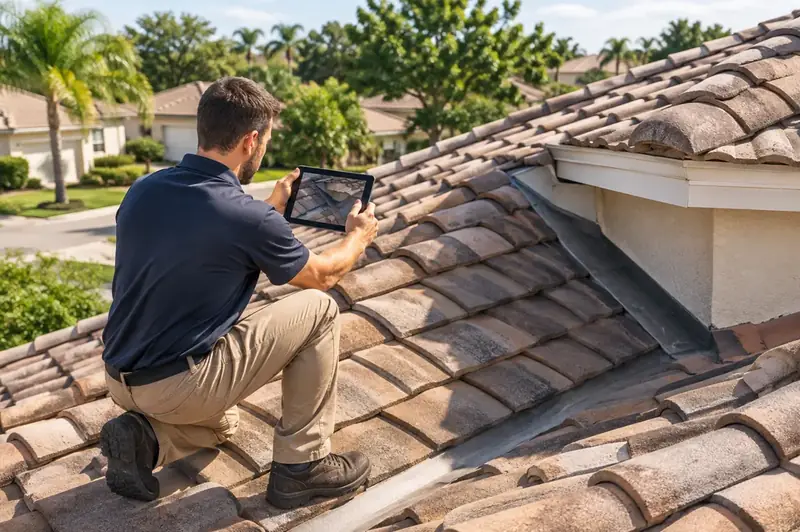
What does a wind mitigation inspection check? See how the OIR-B1-1802 form works, what changed in Rev. 04/26 and how credits can affect your premium.
In Florida's property insurance market, where premiums vary widely by carrier, home, and roof age, the single most powerful financial document a homeowner can possess is a certified Wind Mitigation Inspection. Governed by Florida Statute § 627.0629 and recorded on the state's standardized Form OIR-B1-1802, a wind mitigation inspection verifies the structural windstorm defenses of your roof and building envelope. Unlike general home inspections that identify cosmetic flaws or maintenance items, a wind mitigation inspection exists solely to unlock mandatory insurance premium credits. On an average Orlando home, a clean inspection report trims between $800 and $2,200 off your annual insurance bill. This guide breaks down each of the seven questions on Form OIR-B1-1802, the dollar value of each discount category, who can legally sign the form, and how to verify your credits.
What Is a Florida Wind Mitigation Inspection?
A Wind Mitigation Inspection is an objective architectural and engineering evaluation of how well your home resists the wind uplift and projectile impacts of a hurricane. Under Florida law, residential property insurance policies are divided into two primary billing components: the baseline hazard premium (fire, liability, theft) and the windstorm hazard premium. In Central Florida, the windstorm portion represents a share of your annual insurance bill that varies by carrier and policy.
State law mandates that every admitted insurance company operating in Florida must file an actuarially sound discount schedule with the Florida Office of Insurance Regulation (OIR). If your home possesses certified wind-mitigating features, the insurer must offer discounts under its filed rating plan. OIR-B1-1802 wind mitigation discounts are carrier-, policy-, and roof-age-specific and never guaranteed — ask your insurance agent to calculate your exact premium credit. The inspection report is recorded on the official state form—Form OIR-B1-1802—and remains legally valid for five full years from the date of the inspection.
| Form Section | Structural Feature Evaluated | Maximum Credit Qualification Criteria | Premium Impact (Carrier-Specific) |
|---|---|---|---|
| 1. Building Code | Year built & building code standard | Permitted on or after March 1, 2002 (complying with 2001 Florida Building Code) | Base qualification for modern code tier |
| 2. Roof Covering | Product approvals & installation date | FBC-compliant asphalt shingles (ASTM D7158 Class H), metal, or tile (Level A) | Base roof covering discount eligibility |
| 3. Roof Deck Attachment | Nail size, type, and spacing into trusses | Level C: 8d ring-shank nails at 6"/6" spacing verified into roof rafters | Carrier-specific credit; not guaranteed |
| 4. Roof-to-Wall Connection | Truss anchoring to exterior wall plates | Single wraps, double wraps, or hurricane clips (minimum 3 nails per clip) | Carrier-specific credit; not guaranteed |
| 5. Roof Geometry | Architectural shape of the roof plane | Hip Roof (sloped on all sides; hip perimeter ≥90%) | Carrier-specific credit; not guaranteed |
| 6. Secondary Water Barrier | Underlayment sealed over wood decking | Self-adhering polymer-modified bitumen membrane (peel-and-stick) installed to deck | Carrier-specific credit; not guaranteed |
| 7. Opening Protection | Windows, exterior doors, garage doors | Class A impact-rated glass or certified hurricane shutters on 100% of openings | Carrier-specific credit; not guaranteed |
The Anatomy of Form OIR-B1-1802: The Big Four Questions
While all seven sections matter, four specific structural questions typically matter most for credits, though the weighting is carrier-specific:
Question 3: Roof Deck Attachment (Level A vs. Level B vs. Level C)
Inspectors enter your attic to photograph the nails penetrating the underside of the plywood roof deck. The Florida mitigation form classifies deck attachment into three distinct categories:
- Level A: 6d nails, smooth staples, or unknown fasteners. Provides zero discount.
- Level B: 8d smooth-shank nails at 6-inch edge and 12-inch field spacing. Common on homes built between 1994 and 2001. Provides moderate credit.
- Level C: 8d ring-shank nails (which have threaded ridges that grip the wood fibers like screws) at 6-inch by 6-inch spacing across the entire deck. Level C provides the maximum available roof deck credit. When replacing a roof in Orlando, Florida Building Code mandates re-nailing the deck to Level C standards.
Question 4: Roof-to-Wall Connections (Toenails vs. Clips vs. Wraps)
This section evaluates how your roof trusses are anchored to the top of your exterior concrete block or wood-framed walls:
- Toenails: The truss is secured with three nails driven at an angle through the wood. Toenails provide baseline structural support but earn minimal insurance credit.
- Hurricane Clips: Heavy galvanized steel straps (such as Simpson Strong-Tie H2.5A) attached to the wall plate and secured with at least three nails into the truss. Unlocks significant insurance discounts.
- Single and Double Wraps: Steel straps that wrap completely over the top of the truss and anchor on both sides of the wall. Earns the highest possible roof-to-wall discount tier.
Question 5: Roof Geometry (The Hip Roof Bonus)
If your home features a Hip Roof (where the roof slopes downward on all four sides toward the exterior walls, with no flat triangular vertical gable ends), insurance companies may award a credit on the wind portion of your policy, and the amount is carrier-specific. Under Form OIR-B1-1802 rules, at least 90% of the home's total roof perimeter must be hip geometry to qualify. If your home has a gable wall exceeding 10% of the total perimeter, it is classified as "Other / Gable" and receives zero geometry discount.
Question 6: Secondary Water Barrier (SWB)
To qualify for Question 6 credit, the home must feature an approved Secondary Water Barrier (SWB) installed directly over the plywood sheathing. Under Florida code, this is satisfied by installing a self-adhering polymer-modified bitumen underlayment (peel-and-stick) across the entire roof deck, or sealing all plywood seams with 4-inch self-adhering modified bitumen flashing tape beneath synthetic felt. If shingles blow off during a hurricane, this waterproof barrier keeps the attic bone dry.
Why Re-Roofing Triggers Maximum Credits
When you complete a permitted roof replacement in Orlando, your contractor is required by Florida Building Code to re-nail the deck to 8d ring-shank standards (Question 3 Level C) and install a Secondary Water Barrier (Question 6). Ordering a fresh wind mitigation inspection immediately after re-roofing documents the new features for your insurer. OIR-B1-1802 wind mitigation discounts are carrier-, policy-, and roof-age-specific and never guaranteed — ask your insurance agent to calculate your exact premium credit.
Who Is Legally Authorized to Sign Form OIR-B1-1802?
Under Florida law, an insurance company will reject a wind mitigation inspection report unless it is signed by an authorized, actively licensed professional. Eligible inspectors include:
- Licensed Florida Home Inspectors certified under Florida Statute § 468.
- Certified Building, General, or Residential Contractors licensed under F.S. § 489.
- Certified Roofing Contractors (CCC) licensed under F.S. § 489.
- Licensed Professional Engineers (PE) registered under F.S. § 471.
- Registered Professional Architects registered under F.S. § 481.
Want to Lower Your Florida Property Insurance?
We provide certified Florida wind mitigation inspections and detailed documentation to maximize your policy credits.
Cost vs. Return on Investment: The 5-to-1 Payback
A professional wind mitigation inspection in Central Florida typically costs between $75 and $150. Because the completed inspection report is legally valid for five full years, the financial payback is immediate:
| Credit Level Achieved | Average Annual Premium Savings | 5-Year Cumulative Savings | Net 5-Year Return on $100 Fee |
|---|---|---|---|
| Baseline (Code Shingles + 8d Nails) | $600 to $900 / year | $3,000 to $4,500 | 30x to 45x Return |
| Standard (Code Roof + Nails + SWB) | $900 to $1,400 / year | $4,500 to $7,000 | 45x to 70x Return |
| Maximum (Hip Roof + Clips + Level C + SWB) | $1,400 to $2,200 / year | $7,000 to $11,000 | 70x to 110x Return |
OIR-B1-1802 wind mitigation discounts are carrier-, policy-, and roof-age-specific and never guaranteed — ask your insurance agent to calculate your exact premium credit.
Frequently Asked Questions
Under Florida Office of Insurance Regulation guidelines, a completed Form OIR-B1-1802 wind mitigation inspection is legally valid for exactly five years from the date of the inspection report. After five years, insurers can request an updated inspection to verify that features remain intact.
No. A wind mitigation inspection only identifies qualifying discount features. Under Florida law, insurers cannot use a wind mitigation inspection to raise your rates or penalize you if your home lacks specific features; the form is strictly used to apply discounts to your baseline premium.
A hip roof slopes downward on all four sides toward the exterior walls, creating an aerodynamic shape that deflects hurricane winds from any compass direction. Hip roofs can reduce aerodynamic uplift compared with homes that have vertical gable walls, and some carriers credit that on the wind portion of the premium. OIR-B1-1802 wind mitigation discounts are carrier-, policy-, and roof-age-specific and never guaranteed — ask your insurance agent to calculate your exact premium credit.
A Secondary Water Barrier (Question 6) is a self-adhering polymer-modified bitumen membrane (peel-and-stick underlayment) installed directly to the plywood roof sheathing, or 4-inch self-adhering flashing tape applied over all plywood seams. If storm winds blow off shingles, this sealed membrane prevents catastrophic water intrusion into the attic.
Yes, absolutely. A newly permitted re-roof upgrades your roof covering, re-nails your deck to 8d ring-shank standards (Level C), and installs an approved Secondary Water Barrier. Ordering a fresh wind mitigation inspection ensures all of these new features are officially reported to your insurer. OIR-B1-1802 wind mitigation discounts are carrier-, policy-, and roof-age-specific and never guaranteed — ask your insurance agent to calculate your exact premium credit.
Sources & Statutory Verification
Florida wind mitigation statutes and regulatory authorities verified in October 2026:
- Florida Statutes § 627.0629 — Residential Property Insurance; Mandatory Rate Filings for Windstorm Mitigation
- Florida Office of Insurance Regulation (OIR) — Form OIR-B1-1802 (Uniform Mitigation Verification Inspection Form)
- Florida Building Code Residential 8th Edition — Existing Building Section 706 (per municipal summaries) (Roof Re-Nailing & Secondary Water Barriers)
Passing your wind mitigation inspection verifies structural nail patterns and secondary water barriers for major insurer credits. In Winter Garden, FL, secure rapid post-storm assistance via our Winter Garden emergency roof repair desk.
Keep Reading
- Winter Garden, FL Roofing Overview
- Emergency Roof Repair in Winter Garden
- Complete Florida Roofing Insurance & Claims Guide
- Roof Certification Letters & Mitigation Inspections
- Comprehensive Roof & Attic Damage Inspections
- Do Florida Insurers Lower Premiums After a New Roof?
- Florida 4-Point Inspection: What the Roof Section Looks For