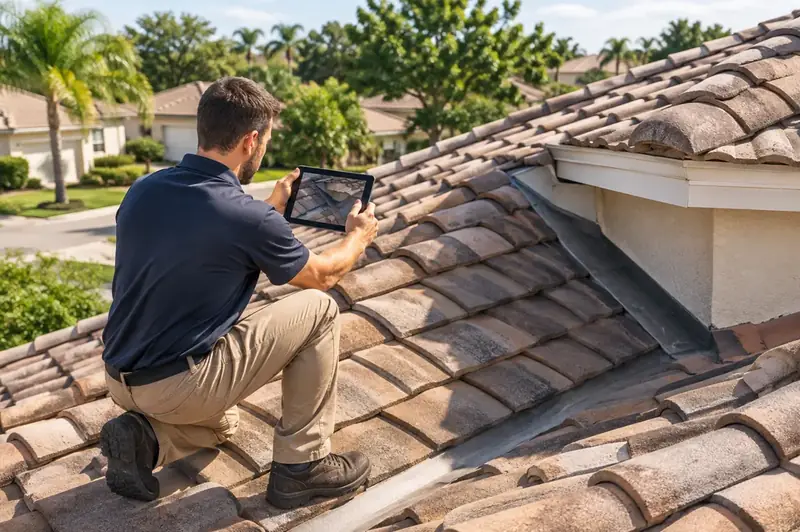
Hiring an Orlando roofer? Learn how to vet one: check the DBPR license, ask for lien waivers and verify permit records. Protect your home investment.
To properly vet a roofing contractor in Orlando, verify their active Certified Roofing Contractor license through the Florida Department of Business and Professional Regulation, demand a direct Certificate of Insurance with non-exempt workers' compensation coverage, and audit their local permitting history with the municipal building department. Never rely on yard signs, unmarked work trucks, or verbal assurances of being "licensed and bonded"—in Central Florida's storm-prone environment, rigorous credential verification is your only legal shield against mechanic liens, code violations, and premature roof failure.
Verifying Florida DBPR Licensure: Certified vs. Registered Roofing Contractors
Under Chapter 489 of the Florida Statutes, anyone contracting to repair, replace, or alter a residential or commercial roofing system must hold an active license issued by the Construction Industry Licensing Board (CILB) within the Florida Department of Business and Professional Regulation (DBPR). When examining an Orlando contractor's credentials, you will encounter two distinct license categories:
- Certified Roofing Contractor (CCC License): A certified contractor carries a license number beginning with "CCC" (such as CCC0000000 (example format)). This credential demonstrates that the qualifier has passed the state trade examination, proven required project experience, satisfied financial stability criteria, and secured statutory liability coverage. A Certified license grants legal authority to pull roofing permits and execute work across all 67 Florida counties without municipal competency exams.
- Registered Roofing Contractor (RC License): A registered contractor carries an "RC" prefix. Unlike certified contractors who hold statewide jurisdiction, registered roofers hold localized competency licenses issued by a specific city or county and registered with the state. An RC contractor is legally restricted to pulling permits and working exclusively within the specific municipal boundaries where their competency card is officially recognized.
To verify credentials, visit MyFloridaLicense.com or call the DBPR at 850-487-1395. Search by the legal entity name or license number. Ensure the status displays as "Current, Active," check for disciplinary complaints or suspensions, and verify that the primary qualifying agent is an active officer of the company bidding your project.
The "Rent-a-License" Hazard: Understanding Primary Qualifiers
A predatory practice in Central Florida involves out-of-state sales outfits and marketing crews "renting" a Florida qualifier's license. Under Florida Statute Section 489.1195, the designated qualifying agent of a roofing business is legally mandated to exercise active supervision, directional control, and financial responsibility over all projects executed under their license number.
In a license-lending arrangement, an absentee licensee is paid a fee simply to pull building permits, providing zero physical supervision on job sites. Under Florida Statute Section 489.127 and Section 489.128, contracts executed through unlawful license arrangements are deemed unenforceable by law. If leaks emerge, decking fails inspection, or substandard materials are installed, the absentee qualifier will disclaim liability, leaving the Orlando homeowner stranded without warranty recourse.
Insurance Verification: Workers' Comp vs. The Construction Exemption Trap
Nearly every roofer claims to be "fully insured," but Florida homeowners must understand the divide between general liability insurance and workers' compensation coverage. Roofing carries severe fall risks and high workers' compensation rates. Because of these costs, unscrupulous operators systematically manipulate corporate exemption laws.
Under Chapter 440 of the Florida Statutes, corporate officers in construction may file a Notice of Election to be Exempt (Form DWC-250) with the Florida Division of Workers' Compensation. Dishonest contractors misuse this provision by listing crew members as "exempt officers" or hiring uninsured laborers. However, under Florida law, an exemption applies strictly to the individual officer—it never extends to general laborers, helpers, or teardown crews on your roof.
If an uninsured laborer falls from a roof on your property, Florida premises liability exposes the homeowner to catastrophic medical lawsuits. To protect your estate:
- Never accept a paper certificate handed over by a salesman, which can be expired or falsified.
- Require the contractor's independent insurance broker to email an official Certificate of Insurance (COI) directly to you, naming you as a designated "Certificate Holder."
- Demand a minimum of $1,000,000 in Commercial General Liability coverage with completed operations protection.
- Verify the active workers' compensation policy status of the legal entity on the Florida Department of Financial Services (DFS) Proof of Coverage database.
Auditing Permitting Records and Inspection Failure Rates in Central Florida
An established Orlando roofing contractor maintains a consistent digital record across municipal building departments. Before signing a contract, audit the contractor's recent permit history. The City of Orlando Permitting Services division and the Orange County Division of Building Safety operate searchable public portals that allow homeowners to review permit records by license number or company name.
Examine their permitting volume over the past 12 to 24 months, watching for three key indicators:
- Consistent Local Activity: Are they pulling permits regularly in Orange County, Seminole County, and neighboring Central Florida municipalities, or did they surface only after a recent storm?
- Inspection Pass/Fail Ratios: Look at their historical inspection logs. Do they fail initial dry-in or sheathing inspections repeatedly? A continuous pattern of failed dry-in inspections (City of Orlando inspection code 125) indicates rushed labor and substandard underlayment fastening.
- Open or Abandoned Permits: Check whether the contractor has unresolved or expired permits on other properties, which indicates administrative disorganization or customer disputes.
Treat any request for you to pull an "Owner-Builder" permit as an immediate disqualifier. Under Florida Statute Section 489.103(7), owner-builder exemptions are designed exclusively for owners who physically build the improvements themselves. If a contractor asks you to pull the permit, they are either unlicensed, operating under suspension, or actively attempting to evade building code liability.
Florida Construction Lien Law: Notice of Commencement and Lien Releases
Under Chapter 713 of the Florida Statutes (Florida Construction Lien Law), property owners face a financial trap: if your roofing contractor fails to pay material suppliers or labor subcontractors, those unpaid parties have a statutory right to place a construction lien directly on your home—even if you paid your contractor in full.
If the lien remains unpaid, the supplier can foreclose on your property. To insulate your home against construction liens, enforce these legal protections:
- Notice of Commencement (NOC): In accordance with Florida Statute Section 713.13, a Notice of Commencement must be recorded with the Orange County Comptroller's Recording Department for roofing projects exceeding statutory thresholds ($5,000 for owner-builders and applicable contractor jobs). This document establishes the legal priority of liens and identifies all project parties.
- Notice to Owner (NTO): Within 45 days of first delivering shingles or tiles to your job site, material suppliers will mail you a formal "Notice to Owner." This is a statutory notice that they are supplying materials and advises you to secure lien waivers before releasing funds.
- Progress Lien Waivers: With every milestone draw, require the contractor to provide a signed and notarized Partial Release of Lien from both themselves and every material supplier who delivered an NTO.
- Final Unconditional Lien Waiver: Before releasing final payment, require a Final Release of Lien and a Contractor's Final Payment Affidavit certifying under oath that all labor and material suppliers have been paid in full.
Deductible Absorption and Florida Insurance Fraud Penalties
During hail and hurricane recovery seasons, deceptive roofers frequently solicit neighborhoods with promises of "waiving," "absorbing," or "rebating" your homeowner insurance deductible. Florida homeowners must understand that waiving an insurance deductible is illegal under Florida law.
Under Florida Statute Section 489.147, it is a third-degree felony for a roofing contractor to pay, waive, rebate, or promise to rebate all or any portion of an insurance deductible as an inducement to enter into a contract. Contractors are strictly forbidden from offering gifts, cash, or allowances to offset deductibles. Furthermore, Florida law mandates that all residential roof-damage repair advertisements and contracts include an explicit consumer notice in at least 12-point bold font stating that the policyholder is legally responsible for the deductible and that deductible waiver schemes constitute insurance fraud under Florida Statute Section 817.234.
A reputable contractor presents transparent, line-item pricing and requires you to pay your statutory hurricane or all-other-perils deductible directly upon completion of work.
Contract Specifications: Fasteners, Underlayments, and Florida Product Approvals
A professional roofing proposal must never consist of vague one-line summaries such as "install architectural shingles." Under the 8th Edition (2023; in effect through Dec 31, 2026, when the 9th Edition takes effect) Florida Building Code (FBC), every component of a roofing assembly must carry an official Florida Product Approval number (FL#) demonstrating compliance with regional wind resistance and impact testing.
When planning a complete structural tear-off and upgrade, consulting our comprehensive guide to roof replacement ensures you evaluate decking, underlayment, and covering systems accurately. Whether replacing a roof across Orlando, FL or evaluating historic masonry estates, review our localized guide to roof replacement in Winter Park, FL for city-specific permitting and architectural review nuances. Your contract must explicitly detail:
- Deck Re-Nailing Schedule: In accordance with FBC Existing Building Section 706.7, older roof decks must be brought up to modern wind-mitigation standards during a re-roof, utilizing 8d ring-shank nails (0.113" diameter, 2-3/8" length) spaced at 6 inches on center along all panel edges and intermediate rafter supports.
- Secondary Water Resistance (SWR): FBC Section 708.7 mandates a sealed roof deck, specifying self-adhering polymer-modified bitumen tape along all deck joints or a full-coverage self-adhered membrane (direct-to-deck peel-and-stick meeting ASTM D1970).
- Flashing and Drip Edge: New 26-gauge corrosion-resistant galvanized steel or aluminum drip edge with a minimum 2-inch roof deck flange and 3-inch face flange, fastened at 4-inch spacing per FBC Section 1507.2.4.
- Shingle Wind Ratings: Specific manufacturer line and ASTM test certifications (ASTM D3161 Class F or ASTM D7158 Class H, test classifications).
Contractor Vetting Comparison Checklist
Use the following technical comparison to evaluate prospective roofing contractors before committing your deposit or signing an authorization agreement:
| Vetting Parameter | Unvetted Storm Chaser | Standard Local Roofer | Fully Vetted Certified Contractor |
|---|---|---|---|
| DBPR Licensure | Unlicensed, out-of-state, or "rented" qualifier license | Registered (RC) license with municipal boundaries | Certified Roofing Contractor (CCC) active statewide |
| Workers' Comp | Corporate exemption loophole or uninsured subcontractors | Basic minimum policy, potential sub gaps | Direct-billed active policy covering all site workers |
| Permit Handling | Demands homeowner pull "Owner-Builder" permit | Pulls permit but struggles with reinspection delays | Pulls permit directly with high first-time pass rates |
| Lien Protection | Refuses lien releases; suppliers place liens | Provides basic receipt without supplier releases | Furnishes notarized Partial & Final Lien Waivers |
| Deductible Policy | Promises to "waive" or "rebate" your deductible | Vague pricing structure or ambiguous credits | Strict compliance with F.S. 489.147 (no waivers) |
| Product Approval | Generic materials without documented FL# specs | Standard shingles without detailed deck attachment | Itemized FL# listings, SWR, and 8d ring-shank schedule |
Frequently Asked Questions
Visit MyFloridaLicense.com or call (850) 487-1395. Search by company name or license number (prefixed with CCC for certified statewide contractors or RC for registered local contractors). Verify the status is "Current, Active," check for disciplinary complaints or suspensions, and ensure the primary qualifying agent is actively associated with the company bidding your job.
No. Under Florida Statute Section 489.147, it is a third-degree felony for a contractor to pay, waive, rebate, or credit any portion of an insurance deductible as an inducement to sell roofing services. Florida law requires policyholders to pay their own deductibles and mandates that all roofing repair contracts display a prominent 12-point disclosure warning against deductible fraud.
A Certified Roofing Contractor (CCC prefix) holds a statewide license awarded after passing state trade exams and meeting financial criteria, granting legal authority to pull permits across all 67 Florida counties. A Registered Roofing Contractor (RC prefix) holds a municipal or county competency card registered with the state, which restricts their contracting authority strictly to the local jurisdictions where they are officially registered.
Under Chapter 713 of the Florida Statutes, ensure a Notice of Commencement is recorded with the Orange County Comptroller prior to starting work. Track all Notice to Owner (NTO) documents delivered by material distributors. Demand signed, notarized Partial Lien Releases with every progress payment, and never release the final payment without an Unconditional Final Lien Waiver and a Contractor's Final Payment Affidavit.
Standard contractor deposits in Central Florida range from 10% to 33% upon contract signing for engineering and material staging. Under Florida Statute Section 489.126, if a contractor receives a deposit exceeding 10% of the total contract value, they must apply for permits within 30 days and start work within 90 days of permit issuance, unless an explicit contractual extension is agreed upon.
Related Central Florida Roofing Guides: Continue reading Do Central Florida HOAs Restrict Roofing Materials? and Orlando Roof Permits: Orange County & City Requirements.